Hypogymnia vittata (Ach.) Parrique
Act. Soc. Linn. Bordeaux, 53: 34, 1898. Basionym: Parmelia physodes var. vittata Ach. - Meth. Lich.: 251, 1803.
Synonyms: Imbricaria physodes var. vittata (Ach.) Körb.; Parmelia vittata (Ach.) Röhl.; Parmelia vittata var. alpestris Zahlbr.
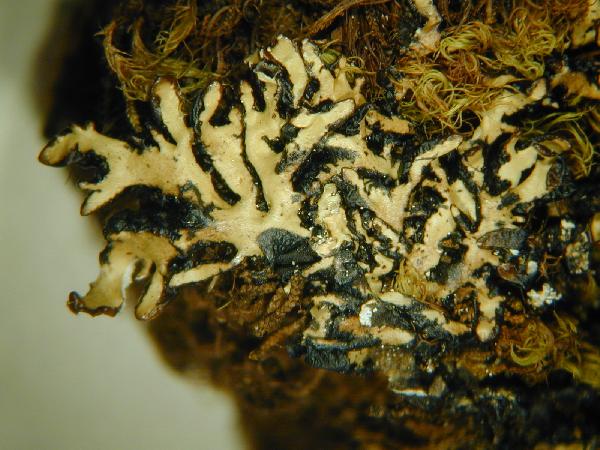
Description: Thallus foliose to subfruticose, heteromerous, dorsiventral, at first loosely adnate, but often soon ascending or pendent, forming up to 10(-15)cm broad, irregular rosettes or irregularly spreading, the lobes swollen, hollow inside, 0.5-2(-3) mm wide, elongate, slender, irregularly branching, separate to imbricate, with small, marginal secondary lobules. Soredia terminal, at first labriform, then becoming strongly lacerate. Upper surface smooth to weakly rugose, whitish, greenish grey or sometimes partially brown, often with a black border. Lower surface black to brownish black, sparsely perforate near tips and at the branching points, erhizinate, often visible from above along lobe margins. Upper cortex of tightly packed, more or less anticlinally oriented hyphae, the cell walls with Cetraria-type lichenan; medulla soon becoming hollow, lining the cavity inside the lobes; lower cortex dark, paraplectenchymatous. Apothecia rare, lecanorine, mainly laminal, brought by hollow stipes, 6-8(10) mm across, with a brown disc. Epithecium brown; hymenium and hypothecium colourless; paraphyses coherent, simple or sparingly branched in upper part. Asci 8-spored, clavate, Lecanora-type. Ascospores 1-celled, hyaline, broadly ellipsoid, 4.5-7 x 4-5.5 μm. Pycnidia frequent, laminal, black, often in clusters. Conidia narrowly cylindrical to weakly bifusiform, 4.5-6.5 x c. 1 μm. Photobiont chlorococcoid. Spot tests: upper cortex K+ yellow, C-, KC-, P- or P+ pale yellow, UV-; medulla K-, C-, KC+ orange-red, P-, UV+ pale blue-violet. Chemistry: upper cortex with atranorin; medulla with physodic acid, 3-hydroxyphysodic acid (both major), and vittatolic acid (minor/accessory).
Growth form: Foliose, narrow lobed
Substrata: bark
Photobiont: green algae other than Trentepohlia
Reproductive strategy: mainly asexual, by soredia, or soredia-like structures (e.g. blastidia)
Commonnes-rarity: (info)
Alpine belt: absent
Subalpine belt: very rare
Montane belt: extremely rare
Dry submediterranean belt: absent
Humid submediterranean belt: absent
Padanian area: absent
pH of the substrata:
1 2 3 4 5

Solar irradiation:
1 2 3 4 5
Aridity:
1 2 3 4 5
Eutrophication:
1 2 3 4 5
Poleotolerance:
0 1 2 3
Altitudinal distribution:
1 2 3 4 5 6
Rarity
absent
extremely rare
very rare
rare
rather rare
rather common
common
very common
extremely common
Loading data...
Occurrence data
Predictive map

Photo by André Aptroot - CC BY 4.0
Taiwan

P.L. Nimis; Owner: Department of Life Sciences, University of Trieste
Herbarium: TSB (2539)
2001/12/12
soraliaum

P.L. Nimis; Owner: Department of Life Sciences, University of Trieste
Herbarium: TSB (2539)
2001/12/12

Pier Luigi Nimis; Owner: Department of Life Sciences, University of Trieste
TSB 2539 (TSB 2539)

Leif Stridvall - Source: http://www.stridvall.se/la/galleries.php

Curtis Randall Björk - CC BY-SA 4.0
Robson Valley, British Columbia, Canada
rain forest morph

Curtis Randall Björk - CC BY-SA 4.0
north end of the Columbia Mountains, British Columbia, Canada
tundra morph

Leif Stridvall - Source: http://www.stridvall.se/lichens/gallery/
Courtesy: Anita Stridvall

Leif Stridvall - Source: http://www.stridvall.se/lichens/gallery/
Courtesy: Anita Stridvall

Leif Stridvall - Source: http://www.stridvall.se/lichens/gallery/
Courtesy: Anita Stridvall

P.L. Nimis CC BY-Sa 4.0
TSB 41593

P.L. Nimis CC BY-Sa 4.0
TSB 41593

P.L. Nimis CC BY-Sa 4.0
TSB 41593

P.L. Nimis CC BY-SA 4.0
TSB 41590

P.L. Nimis CC BY-SA 4.0
TSB 41590

P.L. Nimis CC BY-SA 4.0
TSB 41592

P.L. Nimis CC BY-SA 4.0
TSB 41592

Walter Obermayer CC BY-SA 4.0 - Source: Lichens of Noricum - http://lichens-of-noricum.uni-graz.at/

Walter Obermayer CC BY-SA 4.0 - Source: Lichens of Noricum - http://lichens-of-noricum.uni-graz.at/

Walter Obermayer CC BY-SA 4.0 - Source: Lichens of Noricum - http://lichens-of-noricum.uni-graz.at/

Walter Obermayer CC BY-SA 4.0 - Source: Lichens of Noricum - http://lichens-of-noricum.uni-graz.at/

Walter Obermayer CC BY-SA 4.0 - Source: Lichens of Noricum - http://lichens-of-noricum.uni-graz.at/

Walter Obermayer CC BY-SA 4.0 - Source: Lichens of Noricum - http://lichens-of-noricum.uni-graz.at/

Walter Obermayer CC BY-SA 4.0 - Source: Lichens of Noricum - http://lichens-of-noricum.uni-graz.at/
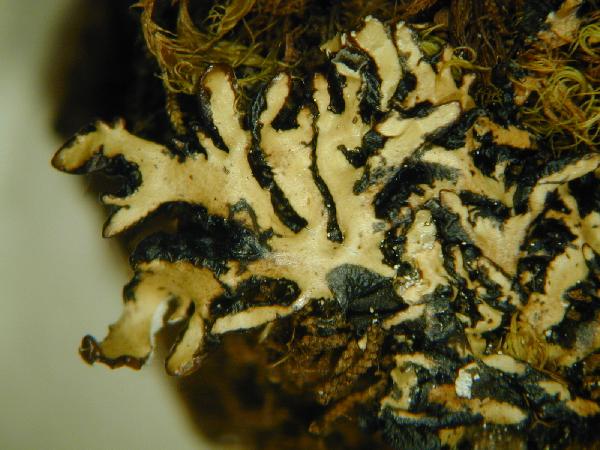
Wolfgang von Brackel - CC BY-4.0
Austria, Vorarlberg, Montafon
Wolfgang von Brackel - CC BY-4.0
Austria, Vorarlberg, Montafon
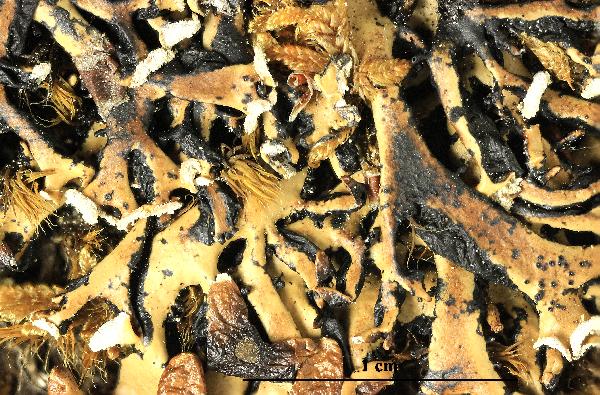
Felix Schumm - CC BY 4.0
[VZ1766], URSS, Caucasus Magnus, regtio montis Elbrus, Baksan, in
valle torrentis Adyrsu, 1700-2200 m. Supra muscos, ad saxa in ripa
torrentis. Leg. A. Vezda, 25.6.1980. EX A. VEZDA LICHENES SELECTI
EXSICCATI NR. 1766.
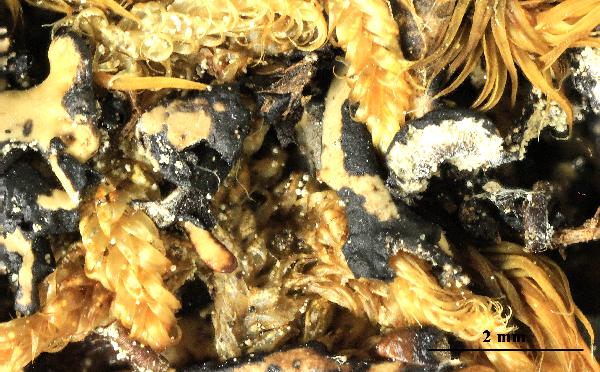
Felix Schumm - CC BY 4.0
[VZ1766], URSS, Caucasus Magnus, regtio montis Elbrus, Baksan, in
valle torrentis Adyrsu, 1700-2200 m. Supra muscos, ad saxa in ripa
torrentis. Leg. A. Vezda, 25.6.1980. EX A. VEZDA LICHENES SELECTI
EXSICCATI NR. 1766.

Felix Schumm - CC BY 4.0
[21218], Schweiz, Davos-Wolfgang, Richtung Drussetschawald, Felsblockhalde
mit Kiefern und Fichten, feucht, kalt schattig, Hanglage
nördlich einer kleinen Moorwiese, 1665 m., Leg. F. Schumm & H.-J.
Maier 21.09.1974, det. F. Schumm. 17.08.2056. EX HERBARIO F.
SCHUMM NR. 21218.

Felix Schumm - CC BY 4.0
[KU478], Japan. Honshu. Prov. Shinano: En route between Shibunoyu
Hot Spring and Kuroyuridaira, Yatsugadake Mts. On bark of Abies
veitchii, 2400m. Leg. H. Kashiwadani (no. 16087), 2.9.1980, det. H.
Kashiwadani. EX S. KUROKAWA AND H. KASHIWADANI LICHENES
RARIORES ET CRITICI EXSICCATI NR. 478.
Growth form: Foliose, narrow lobed
Substrata: bark
Photobiont: green algae other than Trentepohlia
Reproductive strategy: mainly asexual, by soredia, or soredia-like structures (e.g. blastidia)
Commonnes-rarity: (info)
Alpine belt: absent
Subalpine belt: very rare
Montane belt: extremely rare
Dry submediterranean belt: absent
Humid submediterranean belt: absent
Padanian area: absent
pH of the substrata:
| 1 | 2 | 3 | 4 | 5 |
Solar irradiation:
| 1 | 2 | 3 | 4 | 5 |
Aridity:
| 1 | 2 | 3 | 4 | 5 |
Eutrophication:
| 1 | 2 | 3 | 4 | 5 |
Poleotolerance:
| 0 | 1 | 2 | 3 |
Altitudinal distribution:
| 1 | 2 | 3 | 4 | 5 | 6 |
Rarity
absent
extremely rare
very rare
rare
rather rare
rather common
common
very common
extremely common
Loading data...
Occurrence data
Predictive map

Photo by André Aptroot - CC BY 4.0
Taiwan

P.L. Nimis; Owner: Department of Life Sciences, University of Trieste
Herbarium: TSB (2539)
2001/12/12
soraliaum

P.L. Nimis; Owner: Department of Life Sciences, University of Trieste
Herbarium: TSB (2539)
2001/12/12

Pier Luigi Nimis; Owner: Department of Life Sciences, University of Trieste
TSB 2539 (TSB 2539)

Leif Stridvall - Source: http://www.stridvall.se/la/galleries.php

Curtis Randall Björk - CC BY-SA 4.0
Robson Valley, British Columbia, Canada
rain forest morph

Curtis Randall Björk - CC BY-SA 4.0
north end of the Columbia Mountains, British Columbia, Canada
tundra morph

Leif Stridvall - Source: http://www.stridvall.se/lichens/gallery/
Courtesy: Anita Stridvall

Leif Stridvall - Source: http://www.stridvall.se/lichens/gallery/
Courtesy: Anita Stridvall

Leif Stridvall - Source: http://www.stridvall.se/lichens/gallery/
Courtesy: Anita Stridvall

P.L. Nimis CC BY-Sa 4.0
TSB 41593

P.L. Nimis CC BY-Sa 4.0
TSB 41593

P.L. Nimis CC BY-Sa 4.0
TSB 41593

P.L. Nimis CC BY-SA 4.0
TSB 41590

P.L. Nimis CC BY-SA 4.0
TSB 41590

P.L. Nimis CC BY-SA 4.0
TSB 41592

P.L. Nimis CC BY-SA 4.0
TSB 41592

Walter Obermayer CC BY-SA 4.0 - Source: Lichens of Noricum - http://lichens-of-noricum.uni-graz.at/

Walter Obermayer CC BY-SA 4.0 - Source: Lichens of Noricum - http://lichens-of-noricum.uni-graz.at/

Walter Obermayer CC BY-SA 4.0 - Source: Lichens of Noricum - http://lichens-of-noricum.uni-graz.at/

Walter Obermayer CC BY-SA 4.0 - Source: Lichens of Noricum - http://lichens-of-noricum.uni-graz.at/

Walter Obermayer CC BY-SA 4.0 - Source: Lichens of Noricum - http://lichens-of-noricum.uni-graz.at/

Walter Obermayer CC BY-SA 4.0 - Source: Lichens of Noricum - http://lichens-of-noricum.uni-graz.at/

Walter Obermayer CC BY-SA 4.0 - Source: Lichens of Noricum - http://lichens-of-noricum.uni-graz.at/

Wolfgang von Brackel - CC BY-4.0
Austria, Vorarlberg, Montafon

Wolfgang von Brackel - CC BY-4.0
Austria, Vorarlberg, Montafon

Felix Schumm - CC BY 4.0
[VZ1766], URSS, Caucasus Magnus, regtio montis Elbrus, Baksan, in valle torrentis Adyrsu, 1700-2200 m. Supra muscos, ad saxa in ripa torrentis. Leg. A. Vezda, 25.6.1980. EX A. VEZDA LICHENES SELECTI EXSICCATI NR. 1766.

Felix Schumm - CC BY 4.0
[VZ1766], URSS, Caucasus Magnus, regtio montis Elbrus, Baksan, in valle torrentis Adyrsu, 1700-2200 m. Supra muscos, ad saxa in ripa torrentis. Leg. A. Vezda, 25.6.1980. EX A. VEZDA LICHENES SELECTI EXSICCATI NR. 1766.

Felix Schumm - CC BY 4.0
[21218], Schweiz, Davos-Wolfgang, Richtung Drussetschawald, Felsblockhalde mit Kiefern und Fichten, feucht, kalt schattig, Hanglage nördlich einer kleinen Moorwiese, 1665 m., Leg. F. Schumm & H.-J. Maier 21.09.1974, det. F. Schumm. 17.08.2056. EX HERBARIO F. SCHUMM NR. 21218.

Felix Schumm - CC BY 4.0
[KU478], Japan. Honshu. Prov. Shinano: En route between Shibunoyu Hot Spring and Kuroyuridaira, Yatsugadake Mts. On bark of Abies veitchii, 2400m. Leg. H. Kashiwadani (no. 16087), 2.9.1980, det. H. Kashiwadani. EX S. KUROKAWA AND H. KASHIWADANI LICHENES RARIORES ET CRITICI EXSICCATI NR. 478.