Candelariella efflorescens R.C. Harris & W.R. Buck
Michigan Bot., 17: 155, 1978.
Synonyms:
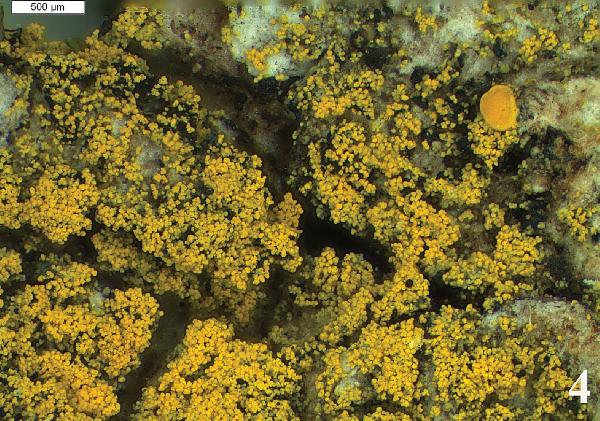
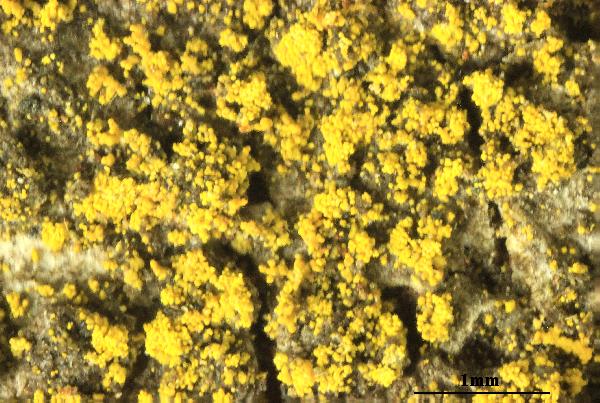
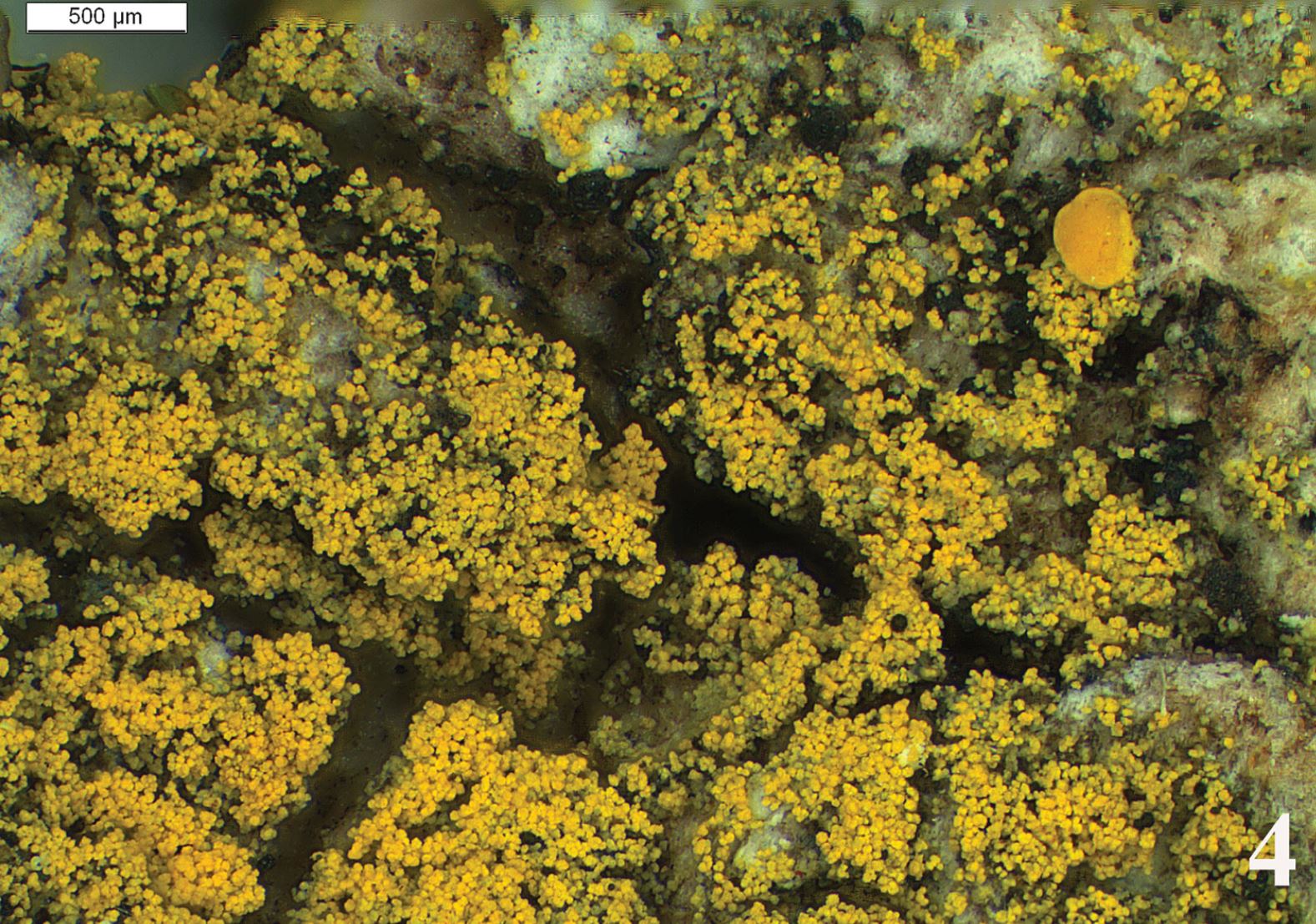
Description: Thallus crustose, formed by scattered, yellow-green to yellow, generally very small areoles which soon turn inapparent being obscured by soredia, rarely the areoles larger, apparent and up to 0.25 μm wide. Soralia emerging from the areoles and zoon filling most of their surface, 0.15-0.4 mm across, at first convex and well-delimited, but soon confluent into a large, continuous sorediate crusts. Soredia 20-55 μm in diam., yellow, composed of 10-15 photobiont cells irregularly surrounded by hyphae which often have a yellow-brown pigment. Cortex 10-15 μm thick, consisting of 1-3 layers of more or less isodiametric cells. Apothecia rare, lecanorine, 0.2-0.4 mm across, with a flat to slightly convex, yellow-orange disc and an up to 60 μm thick, irregular, often sorediate, sometimes excluded thalline margin. Thalline exciple with an indistinct, 4-9 um thick pseudocortex of thin-walled, non-gelatinized hyphae with isodiametric cells; proper exciple up to 45 μm thick in upper part, of radiating hyphae with rectangular cells; epithecium yellow-brown; hymenium colourless, 70-75 μm high; paraphyses simple or forked, septate, 1.5-2 μm thick at mid-level, the apical cells cylindrical or clavate and up to 3 μm wide; hypothecium colourless. Asci 24-30-spored, clavate, with an apical dome which is I+ blue only in the internal, lower part, interrupted in the centre by a I+ paler blue strip, Candelaria-type. Ascospores 1-celled or rarely with a thin septum, hyaline, oblong to narrowly ellipsoid, 10-15 x 3.5-5.0 μm, often poorly developed. Photobiont chlorococcoid. Spot tests: K-, C-, KC-, P-. Chemistry: pulvinic acid derivatives.
Growth form: Crustose
Substrata: bark
Photobiont: green algae other than Trentepohlia
Reproductive strategy: mainly asexual, by soredia, or soredia-like structures (e.g. blastidia)
Commonnes-rarity: (info)
Alpine belt: absent
Subalpine belt: absent
Montane belt: extremely rare
Dry submediterranean belt: rare
Humid submediterranean belt: very rare
Padanian area: absent
pH of the substrata:
1 2 3 4 5

Solar irradiation:
1 2 3 4 5
Aridity:
1 2 3 4 5
Eutrophication:
1 2 3 4 5
Poleotolerance:
0 1 2 3
Altitudinal distribution:
1 2 3 4 5 6
Rarity
absent
extremely rare
very rare
rare
rather rare
rather common
common
very common
extremely common
Loading data...
Occurrence data
Predictive map

P.L. Nimis CC BY-SA 4.0
TSB 10490

Andrea Moro; Owner: Department of Life Sciences, University of Trieste
italy, Friuli Venezia Giulia, Trieste, Trieste Karst near Borgo Grotta Gigante
16/02/2017

Felix Schumm - CC BY-SA 4.0
[ABL13666], Brazil, São Paulo, Botucatu, Botanical garden on campus.
On bark in park. 22°53'09'' S, 48°29'56'' W, 850 m. Leg. M.
Cáceres & A. Aptroot (no 13666), 13 Sept. 2012, det. A. Aptroot 2012.

Felix Schumm - CC BY-SA 4.0
[ABL13666], Brazil, São Paulo, Botucatu, Botanical garden on campus.
On bark in park. 22°53'09'' S, 48°29'56'' W, 850 m. Leg. M.
Cáceres & A. Aptroot (no 13666), 13 Sept. 2012, det. A. Aptroot 2012.
Source: Westberg M, Clerc P (2012) Five species of Candelaria and Candelariella (Ascomycota, Candelariales) new to Switzerland. MycoKeys 3: 1-12. - CC BY-4.0
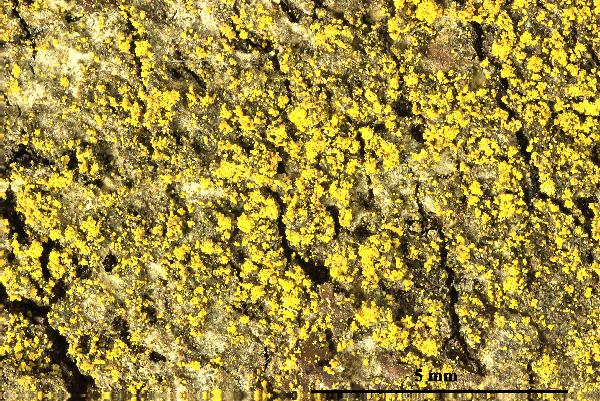
Candelariella efflorescens – granular thallus dissolved into soredia, appearing as a confluent sorediate crust
Felix Schumm - CC BY 4.0
[VZ2190], Italia. Alpes Carnici, prope Ampezzo. In cortice Aesculi
secus viam. Leg. X. Llimona et J. Poelt, 9.1987. EX A. VEZDA LICHENES
SELECTI EXSICCATI NR. 2190.
Felix Schumm - CC BY 4.0
[VZ2190], Italia. Alpes Carnici, prope Ampezzo. In cortice Aesculi
secus viam. Leg. X. Llimona et J. Poelt, 9.1987. EX A. VEZDA LICHENES
SELECTI EXSICCATI NR. 2190.

Photo by André Aptroot - CC BY 4.0
Island of Saint Helena
Growth form: Crustose
Substrata: bark
Photobiont: green algae other than Trentepohlia
Reproductive strategy: mainly asexual, by soredia, or soredia-like structures (e.g. blastidia)
Commonnes-rarity: (info)
Alpine belt: absent
Subalpine belt: absent
Montane belt: extremely rare
Dry submediterranean belt: rare
Humid submediterranean belt: very rare
Padanian area: absent
pH of the substrata:
| 1 | 2 | 3 | 4 | 5 |
Solar irradiation:
| 1 | 2 | 3 | 4 | 5 |
Aridity:
| 1 | 2 | 3 | 4 | 5 |
Eutrophication:
| 1 | 2 | 3 | 4 | 5 |
Poleotolerance:
| 0 | 1 | 2 | 3 |
Altitudinal distribution:
| 1 | 2 | 3 | 4 | 5 | 6 |
Rarity
absent
extremely rare
very rare
rare
rather rare
rather common
common
very common
extremely common
Loading data...
Occurrence data
Predictive map

P.L. Nimis CC BY-SA 4.0
TSB 10490

Andrea Moro; Owner: Department of Life Sciences, University of Trieste
italy, Friuli Venezia Giulia, Trieste, Trieste Karst near Borgo Grotta Gigante
16/02/2017

Felix Schumm - CC BY-SA 4.0
[ABL13666], Brazil, São Paulo, Botucatu, Botanical garden on campus. On bark in park. 22°53'09'' S, 48°29'56'' W, 850 m. Leg. M. Cáceres & A. Aptroot (no 13666), 13 Sept. 2012, det. A. Aptroot 2012.

Felix Schumm - CC BY-SA 4.0
[ABL13666], Brazil, São Paulo, Botucatu, Botanical garden on campus. On bark in park. 22°53'09'' S, 48°29'56'' W, 850 m. Leg. M. Cáceres & A. Aptroot (no 13666), 13 Sept. 2012, det. A. Aptroot 2012.
Source: Westberg M, Clerc P (2012) Five species of Candelaria and Candelariella (Ascomycota, Candelariales) new to Switzerland. MycoKeys 3: 1-12. - CC BY-4.0
Candelariella efflorescens – granular thallus dissolved into soredia, appearing as a confluent sorediate crust

Felix Schumm - CC BY 4.0
[VZ2190], Italia. Alpes Carnici, prope Ampezzo. In cortice Aesculi secus viam. Leg. X. Llimona et J. Poelt, 9.1987. EX A. VEZDA LICHENES SELECTI EXSICCATI NR. 2190.

Felix Schumm - CC BY 4.0
[VZ2190], Italia. Alpes Carnici, prope Ampezzo. In cortice Aesculi secus viam. Leg. X. Llimona et J. Poelt, 9.1987. EX A. VEZDA LICHENES SELECTI EXSICCATI NR. 2190.