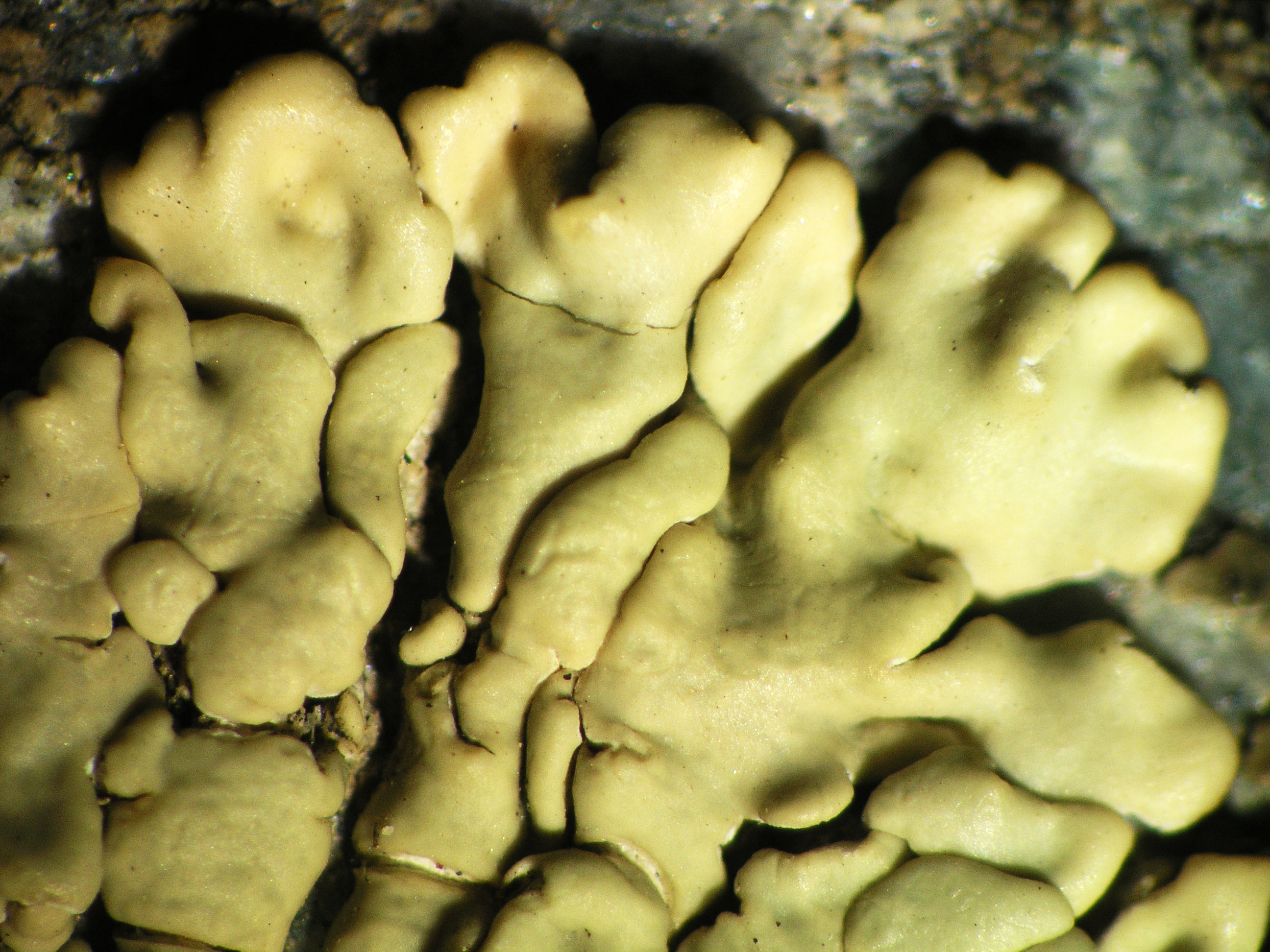
Protoparmeliopsis graeca (J.Steiner) Sipman & Cl. Roux
in Nimis, The Lichens of Italy. A Second Annotated Catalogue: 20, 2016. Basionym: Lecanora graeca J. Steiner - Verh. zool.-bot. Ges. Wien, 69: 80, 1919.
Synonyms:
Distribution: C - Abr (Nimis & Tretiach 1999).
Description: Thallus crustose-placodioid, episubstratic, areolate in central parts, brownish green to yellowish green, forming up to 4(-5) cm wide rosettes, the central areoles 0.5-2 mm wide, angular, often pruinose and with a dark bluish hue along the margins, the marginal lobes 0.5-2 mm wide, 2-5 mm long, rigid, often transversally cracked, contiguous to overlapping, flat to slightly convex. Lower surface black. Cortex 15-50 μm thick, paraplectenchymatus; medulla white, with many crystals. Apothecia lecanorine, 0.6-1 mm across, adnate to subsessile, with a flat to slightly convex, brown, epruinose disc and a rather thin, smooth, often blackened thalline margin. Thalline exciple corticate, paraplectenchymatous, 60-80 μm wide laterally; proper exciple psosoplectenchymatous; epithecium brown; hymenium colourless, 60-80 μm high, partially inspersed with oil droplets, I+ blue; paraphyses coherent, mostly simple, not capitate; hypothecium colourless. Asci 8-spored, elongate-clavate, very thin-walled, with a K/I+ blue, tall tholus penetrated by a faintly amyloid apical cushion, the wall K/I-, surrounded by a K/I+ blue outer layer, Lecanora-type. Ascospores 1-celled, hyaline, ellipsoid, 9-13(-15) x 5-8 μm. Photobiont chlorococcoid. Spot tests: cortex K-, C-, KC- or KC+ faintly yellow, P-; medulla K- or K+ yellow turning red, P+ yellow. Chemistry: cortex with usnic acid; medulla with psoromic acid and sometimes with additional norstictic acid.Note: hitherto known only from the eastern Mediterranean, the Maritime Alps of France, and the central Apennines, this lichen occurring on base rich or slightly calciferous siliceous rocks is worthy of further study.
Growth form: Crustose placodiomorph
Substrata: rocks
Photobiont: green algae other than Trentepohlia
Reproductive strategy: mainly sexual
Poorly known taxon in need of further study
Commonnes-rarity: (info)
Alpine belt: extremely rare
Subalpine belt: absent
Oromediterranean belt: absent
Montane belt: absent
Submediterranean belt: absent
Padanian area: absent
Humid submediterranean belt: absent
Humid mediterranean belt: absent
Dry mediterranean belt: absent
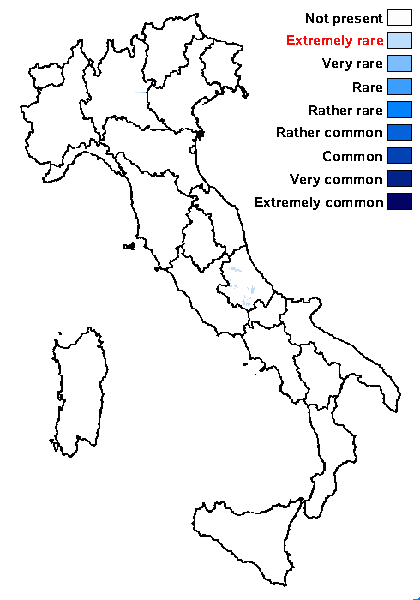
Predictive model
Herbarium samples
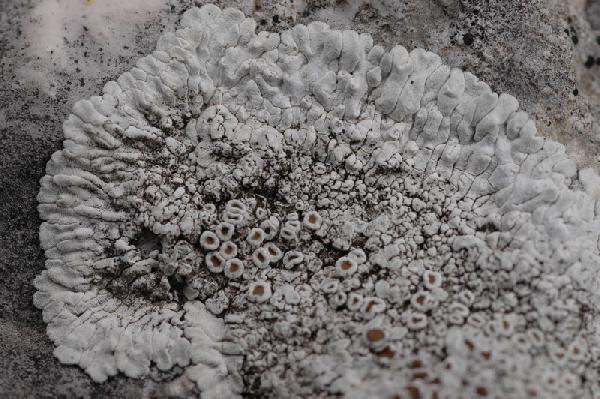
Photo by Einar Timdal - Source: https://nhm2.uio.no/lav/web/index.html
Italy, Abruzzi - 20070703 - O-L149070 - E-Timdal
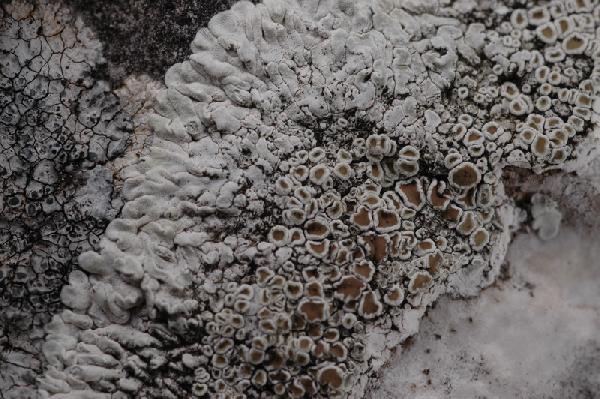
Photo by Einar Timdal - Source: https://nhm2.uio.no/lav/web/index.html
Italy, Abruzzi - 20070703 - O-L149070 - E-Timdal
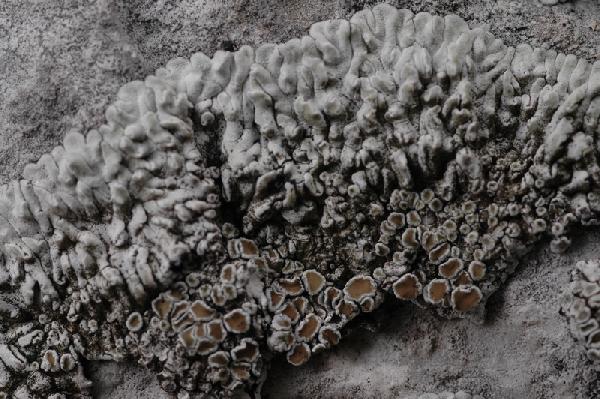
Photo by Einar Timdal - Source: https://nhm2.uio.no/lav/web/index.html
Italy, Abruzzi - 20070703 - O-L149070 - E-Timdal
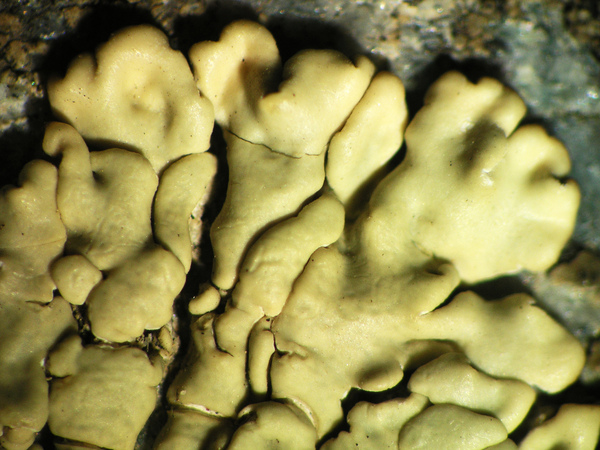
Harrrie Sipman - source: https://archive.bgbm.org/sipman/Zschackia/AegeanLichens/Protoparmeliopsis.htm
Growth form: Crustose placodiomorph
Substrata: rocks
Photobiont: green algae other than Trentepohlia
Reproductive strategy: mainly sexual
Poorly known taxon in need of further study
Commonnes-rarity: (info)
Alpine belt: extremely rare
Subalpine belt: absent
Oromediterranean belt: absent
Montane belt: absent
Submediterranean belt: absent
Padanian area: absent
Humid submediterranean belt: absent
Humid mediterranean belt: absent
Dry mediterranean belt: absent
Predictive model
| Herbarium samples |
 INDEX FUNGORUM
 GBIF
GBIF

Photo by Einar Timdal - Source: https://nhm2.uio.no/lav/web/index.html
Italy, Abruzzi - 20070703 - O-L149070 - E-Timdal

Photo by Einar Timdal - Source: https://nhm2.uio.no/lav/web/index.html
Italy, Abruzzi - 20070703 - O-L149070 - E-Timdal

Photo by Einar Timdal - Source: https://nhm2.uio.no/lav/web/index.html
Italy, Abruzzi - 20070703 - O-L149070 - E-Timdal