Diploschistes Norman
Nyt. Mag. Naturvid., 7: 232, 1853.
Systematics:
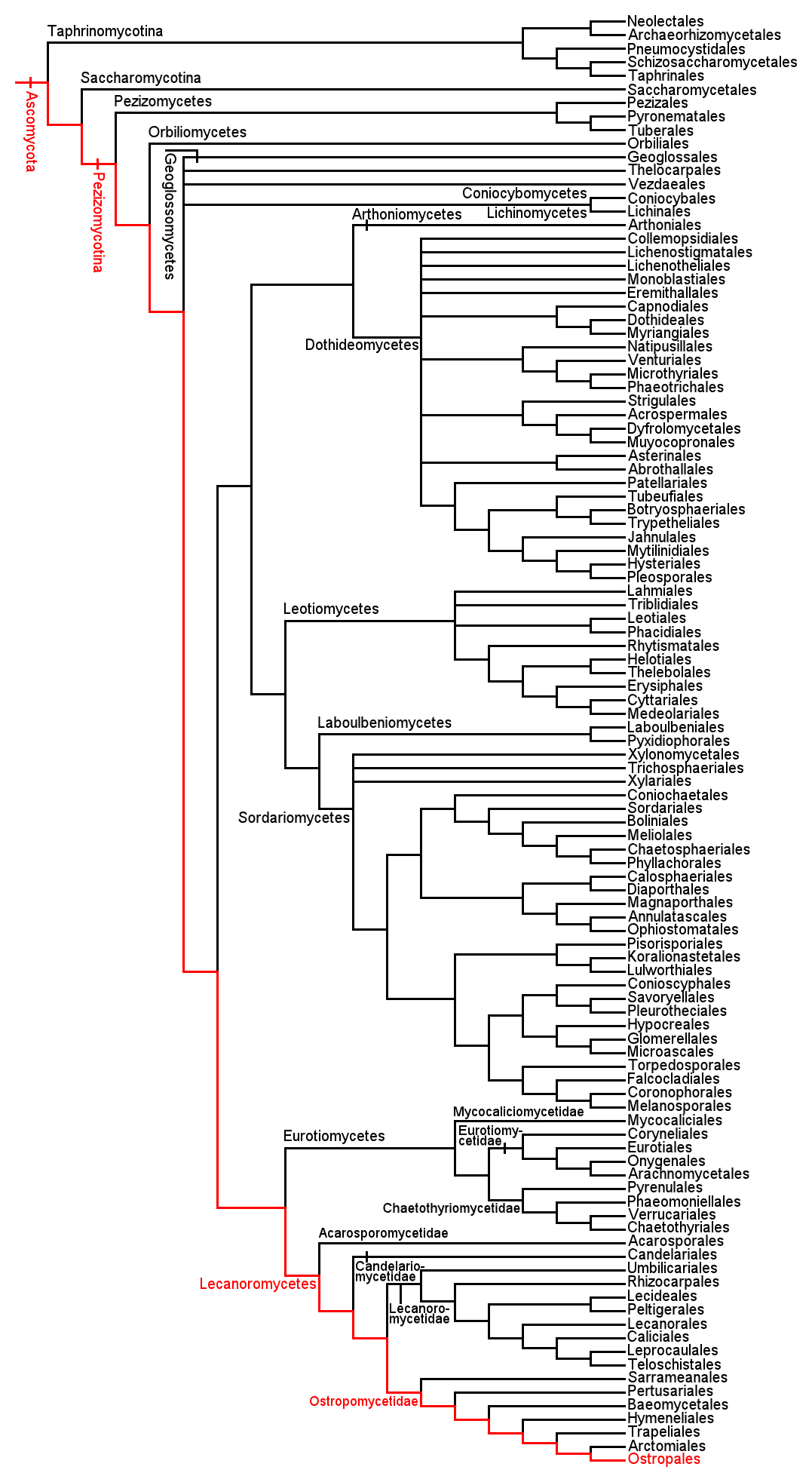
Phylum: Ascomycota Caval.-Sm.
Subphylum: Pezizomycotina O.E.Erikss. & Winka
Class: Lecanoromycetes O.E.Erikss. & Winka
Subclass: Ostropomycetidae Reeb, Lutzoni & Cl.Roux
Order: Ostropales Nannf.
Family: Graphidaceae Dumort.
Brief description: Thallus crustose, episubstratic, white. grey or yellow in some non-European species. Apothecia at first more or less perithecioid, later often urceolate, with a black disc, the margin consisting of a proper margin united with a more or less developed thalline margin. Proper exciple dark brown to black, of thick-walled, swollen to globose hyphae in lower part, extending into pale brown periphysoids in the inner, upper part; epithecium colourless to black; hymenium colourless, I-; paraphyses flexuose, mostly simple, remotely septate, the apical cells not swollen; hypothecium pale to dark. Asci (1-)4-8-spored, narrowly clavate to subcylindrical, the wall evenly thickened when mature, the somewhat abrupt apical thickening with a thin, internal apical beak, lacking any apical apparatus, the contents I+ orange-red, the walls I-, with a non-fissitunicate dehiscence. Ascospores muriform, at first hyaline but soon turning brown, broadly ellipsoid, without a distinct perispore. Pycnidia immersed in warts, black, the conidiogenous cells simple or branched at base, elongate-ampulliform. Conidia arising apically, simple, hyaline, short-bacilliform to elongate-ellipsoid. Photobiont chlorococcoid (Trebouxia or Asterochloris). Chemistry: para-depsides (e.g. lecanoric and diploschistesic acids).
Note: The genus Diploschistes, presently included either in the Graphidaceae or Diploschistaceae (Kraichak & al. 2018), comprises more than 30 species of crustose, saxicolous or terricolous lichens with a carbonised proper exciple with lateral periphyses, and a chemistry dominated by orcinol depsides. A revision based on morphological, chemical, and molecular data was published by Fernández-Brime & al. (2013), who distinguished three lineages treated as distinct subgenera. Some phylogenetic studies revealed the monophyly of Diploschistes, including D. ocellatus (e.g. Fernández-Brime & al. 2013), but others found that the genus, in its broad circumscription, is not monophyletic (e.g. Rivas Plata & al. 2013). Such discrepancies led Kraichak & al. (2013) to increase the numbers of molecular markers, showing that D. ocellatus is only distantly related to Diploschistes s.str.. While taxa in Diploschistes s.str. have perithecioid to urceolate ascomata and a dark-pigmented, paraplectenchymatous exciple with lateral periphyses, D. ocellatus has lecanoroid ascomata, a reduced exciple, and lacks lateral periphyses; chemically, it also differs in containing the norstictic acid chemosyndrome. Because of these differences the species, which was previously classified in subgen. Thorstenia within Diploschistes (Fernández-Brime & al. 2013), was included into Xalocoa, a new monotypic genus, by Kraichak & al. (2013). Another monotypic genus, Ingvariella, was segregated from Diploschistes by Guderley & al. (1997), due to the absence of a true exciple, this being replaced by a pseudoexciple of degenerating, pigmented hymenial elements, and was originally placed within the Thelotremataceae (now often recognized as part of the Graphidaceae). However, the hymenium and amyloid ascus wall suggest different affinities. The phylogenetic study by Fernandez-Brime & al. (2011) demonstrated that Ingvariella is a member of the Stictidaceae, sister to the mainly saprotrophic genus Cryptodiscus. The genus Diploschistes, in the traditional circumscription, was monographed, for species occurring in the Holarctic, by Lumbsch (1989). Within D. scruposus, the following infraspecific taxa were distinguished by Clauzade & Roux (1985): 1) subsp. violarius (Nyl.) Clauzade & Cl. Roux, with an epruinose thallus reacting K+ bright yellow turning violet red-brown; 2) subsp. iridatus (A. Massal.) Clauzade & Cl. Roux, with an epruinose thallus reacting K-, on calciferous soil above treeline; 3) subsp. interpediens (Nyl.) Clauzade & Cl. Roux, with 8-spored asci and thallus K+ yellow then brownish, saxicolous. However, according to Fernández-Brime & al. (2013), molecular variability does not correlate with either morphological or chemical diversity, so that, pending further studies, we include these taxa into D. scruposus in a broad sense. The species delimitation in the D. scruposus group with urceolate ascomata requires further studies. As in other species complexes that diversified recently, multi-gene studies are insufficient to resolve independent lineages (Zhao & al. 2017).
Type: Diploschistes scruposus (Schreb.) Norman