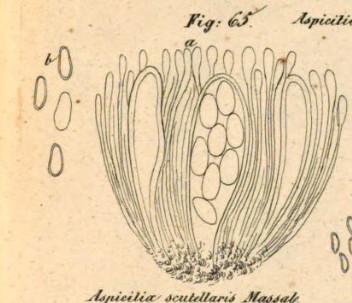
Aspicilia scutellaris A. Massal.
Ric. Auton. Lich. Crost.: 38, 1852.
Synonyms: Lecanora scutellaris (A. Massal.) Jatta; Patellaria scutellaris (A. Massal.) Trevis.
Distribution: N - Ven, Emil (Fariselli & al. 2020), Lig.
Description: Thallus crustose, episubstratic, ash-grey, areolate. Apothecia aspicilioid, 1 per areole, at first immersed and urceolate, then sessile. Paraphyses with enlarged, brown apical cells. Asci 8-spored. Ascospores 1-celled (a few of them appearing 1-septate), hyaline, ellipsoid to narrowly ellipsoid, c. 15 x 6 μm. Photobiont chlorococcoid. Spot tests and chemistry: unknown. Note: a very poorly known species of basaltic or calcareous rocks, also reported from Switzerland and France. According to Roux & coll. (2025) it does not belong to Aspicilia s.str.
Growth form: Crustose
Substrata: rocks
Photobiont: green algae other than Trentepohlia
Reproductive strategy: mainly sexual
Poorly known taxon in need of further study
Commonnes-rarity: (info)
Alpine belt: absent
Subalpine belt: absent
Oromediterranean belt: absent
Montane belt: absent
Submediterranean belt: very rare
Padanian area: absent
Humid submediterranean belt: very rare
Humid mediterranean belt: absent
Dry mediterranean belt: absent
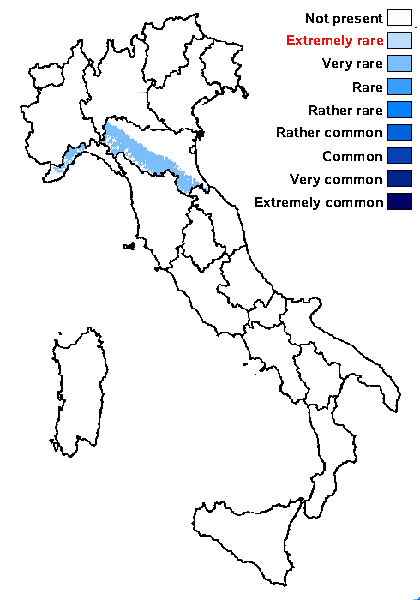
Predictive model
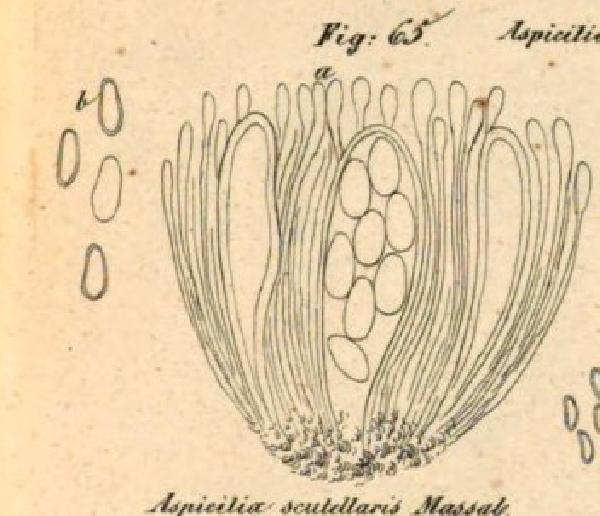
A. Massalongo - Ricerche sull'Autonomia dei Licheni Crostosi, Fig. 65 - Public Domain
Growth form: Crustose
Substrata: rocks
Photobiont: green algae other than Trentepohlia
Reproductive strategy: mainly sexual
Poorly known taxon in need of further study
Commonnes-rarity: (info)
Alpine belt: absent
Subalpine belt: absent
Oromediterranean belt: absent
Montane belt: absent
Submediterranean belt: very rare
Padanian area: absent
Humid submediterranean belt: very rare
Humid mediterranean belt: absent
Dry mediterranean belt: absent
Predictive model
 INDEX FUNGORUM
 GBIF
GBIF
 DOLICHENS