Circinaria trachytica (A. Massal.) Cl. Roux
in Roux & Coll., Catal. Lich. champ. lichen. France métr., 4 èd.: 309, 2025, comb. inval.. Basionym: Pachyospora calcarea var. trachytica A. Massal. - Ric. Auton. Lich. Crost.: 44, 1852.
Synonyms: Aspicilia cinerea var. trachytica (A. Massal.) Jatta; Aspicilia polygonia var. trachytica (A. Massal.) A. Massal.; Aspicilia trachytica (A. Massal.) Arnold; Lecanora trachyticola Zahlbr.
Distribution: N - Ven (Lazzarin 2000). S - Si (Ottonello & Romano 1997)
Description: Thallus crustose, areolate-verrucose, whitish, the areoles convex, contiguous. Cortex devoid of a pigmented layer. Apothecia aspicilioid, irregular in outline, immersed in the areoles, with a black disc. Asci 6-spored. Ascospores 1-celled, hyaline, broadly ellipsoid, 18-22 × 10-14 μm. Photobiont chlorococcoid. Spot tests and reactions: unknown, probably negative. Note: a very poorly known silicicolous species, which however has been reported from several localities in the Mediterranean area, southern central Europe and Iran. The type material is from the Euganean Hills. According to Roux & Coll. (2025), it belongs to Circinaria.
Growth form: Crustose
Substrata: rocks
Photobiont: green algae other than Trentepohlia
Reproductive strategy: mainly sexual
Poorly known taxon in need of further study
Commonnes-rarity: (info)
Alpine belt: absent
Subalpine belt: absent
Oromediterranean belt: absent
Montane belt: absent
Submediterranean belt: very rare
Padanian area: extremely rare
Humid submediterranean belt: absent
Humid mediterranean belt: absent
Dry mediterranean belt: extremely rare
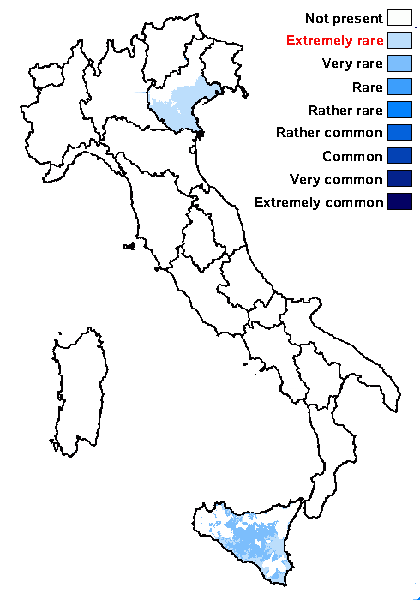
Predictive model

Collezione lichenologica Abramo Massalongo del Museo di Storia Naturale G. Ligabue di Venezia - Autori: Seggi, Linda; Trabucco, Raffaella Proprietà: Fondazione Musei Civici di Venezia - CC BY-NC
Italy, Veneto, in Euganeis
as achyospora calcarea δ trachitica Massal. - Isotype

Collezione lichenologica Abramo Massalongo del Museo di Storia Naturale G. Ligabue di Venezia - Autori: Seggi, Linda; Trabucco, Raffaella Proprietà: Fondazione Musei Civici di Venezia - CC BY-NC
Italy, Veneto, in Euganeis
as achyospora calcarea δ trachitica Massal. - Isotype
Growth form: Crustose
Substrata: rocks
Photobiont: green algae other than Trentepohlia
Reproductive strategy: mainly sexual
Poorly known taxon in need of further study
Commonnes-rarity: (info)
Alpine belt: absent
Subalpine belt: absent
Oromediterranean belt: absent
Montane belt: absent
Submediterranean belt: very rare
Padanian area: extremely rare
Humid submediterranean belt: absent
Humid mediterranean belt: absent
Dry mediterranean belt: extremely rare
Predictive model
 DOLICHENS

Collezione lichenologica Abramo Massalongo del Museo di Storia Naturale G. Ligabue di Venezia - Autori: Seggi, Linda; Trabucco, Raffaella Proprietà: Fondazione Musei Civici di Venezia - CC BY-NC
Italy, Veneto, in Euganeis
as achyospora calcarea δ trachitica Massal. - Isotype