Verrucaria dinarica Zahlbr.
Österr. bot. Z., 68: 66, 1919.
Synonyms:
Distribution: S - Si (Nimis & al. 1994).
Description: Thallus crustose, endosubstratic, continuous, grey, with dense, minute, more or less confluent, violet flecks visible under strong magnification, often delimited by a thin, black prothalline line. Pseudocortex of densely interwoven hyphae; lower part of medulla with conspicuous oil cells. Perithecia numerous, black, 0.2-0.3 mm across, semi-immersed in shallow pits in the rock, but hemispherically projecting with the slightly depressed upper part. Involucrellum well-developed, thick, reaching almost to base-level; exciple black throughout, tending to become thicker in upper part; hamathecium of periphysoids, interascal filaments absent; hymenial gel hemiamyloid, I+ red (I+ blue at very low concentrations of I), K/I+ blue. Asci 8-spored, clavate, I-, fissitunicate, the wall thickened above, with an ocular chamber, dehiscent by extrusion of an endotunica to form a delicate rostrum, Verrucaria-type, 55-62 x 17-24 μm. Ascospores 1-celled, hyaline, ellipsoid, 13-15(-17) x (5.5-)6-7.5(-8) μm. Photobiont chlorococcoid. Spot tests: K-, C-, KC-, P-, UV-. Chemistry: without lichen substances.
Note: a very poorly known species of calcareous rocks in upland areas. Indicator values refer to the situation observed in Sicily (Island of Marettimo). Breuss (2008) cites a sample from the Julian Alps (Slovenia), very close to the Italian border.
Growth form: Crustose endolithic
Substrata: rocks
Photobiont: green algae other than Trentepohlia
Reproductive strategy: mainly sexual
Poorly known taxon in need of further study
Commonnes-rarity: (info)
Alpine belt: very rare
Subalpine belt: very rare
Oromediterranean belt: very rare
Montane belt: very rare
Submediterranean belt: absent
Padanian area: absent
Humid submediterranean belt: absent
Humid mediterranean belt: very rare
Dry mediterranean belt: absent
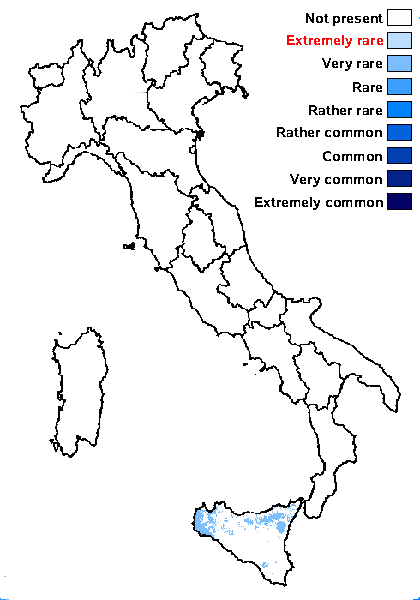
Predictive model
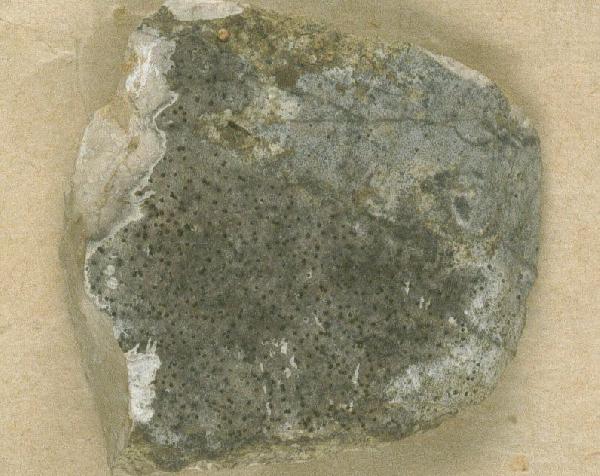
Modified from the original at: https://w.jacq.org/W19130004269
W 1913-0004269 -J. Baumgartener - 1911-06-28
Location Croatia
Label Dalmatien: Sviluja-pl., nordseitig unterm Gipfel, an Kalkfelsen, c. 1350 m. ; Alt. 1350 m

Source: Servít M. 1950b. The new lichens of the Pyrenocarpae-group III. Studia Bot. Cechoslov. 11, (1-2): 7-41.
Growth form: Crustose endolithic
Substrata: rocks
Photobiont: green algae other than Trentepohlia
Reproductive strategy: mainly sexual
Poorly known taxon in need of further study
Commonnes-rarity: (info)
Alpine belt: very rare
Subalpine belt: very rare
Oromediterranean belt: very rare
Montane belt: very rare
Submediterranean belt: absent
Padanian area: absent
Humid submediterranean belt: absent
Humid mediterranean belt: very rare
Dry mediterranean belt: absent
Predictive model
 INDEX FUNGORUM
 GBIF
GBIF

Modified from the original at: https://w.jacq.org/W19130004269
W 1913-0004269 -J. Baumgartener - 1911-06-28 Location Croatia Label Dalmatien: Sviluja-pl., nordseitig unterm Gipfel, an Kalkfelsen, c. 1350 m. ; Alt. 1350 m