Verrucaria hakulinenii Pykälä & Myllys
in Pykälä & al., Lichenologist, 56, 5: 264, 2024.
Synonyms:
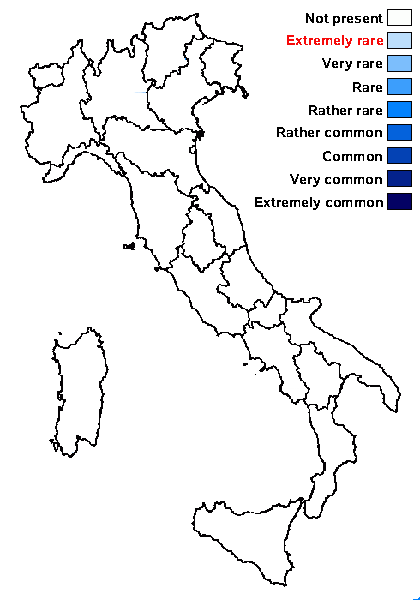
Distribution: N - Ven (Pistocchi & al. 2026).
Description: Thallus crustose, thinly episubstratic, c. 0.05-0.1 mm thick, continuous, rimose to cracked-areolate, pale to medium green, sometimes with a brownish hue, turning pale brownish grey in the herbarium, the areoles, when developed, 0.2-0.8 mm wide; prothallus absent or very thin, brown. Cortex poorly developed, 10-30 μm thick, the cortical cells pale or brown; medulla not differentiated, the algal cells distributed throughout. Perithecia c. 110–200 per cm2, 0.13-0.26 mm across, half to 3/4 immersed, not leaving pits in the rock, often with a thin thalline cover except at the apex, the ostiole tiny, pale to dark, flat or depressed, c. 10-30 μm wide. Involucrellum reaching to base-level, c. 25-70 μm thick, appressed to the exciple or slightly diverging in lower part; exciple c. 0.15-0.24 mm across, the wall pale to medium brown, c. 22-25 μm thick; periphysoids branched, c. 17-25 x 1-2 μm, interascal filaments absent. Asci 8-spored, clavate, I-, fissitunicate, the wall thickened above, with an ocular chamber, dehiscent by extrusion of an endotunica to form a delicate rostrum, Verrucaria-type. Ascospores (17-)18-22(-25) x (6.5-)7.5-9.5(-11) μm. Photobiont chlorococcoid. Spot tests: K-, C-, KC-, P-, UV-. Chemistry: without lichen substancesNote: a recently-described freshwater lichen from carbonatic rock in Finland (Pykälä et al. 2024) which is difficult to separate from other species in the V. hydrophila group by morphology alone. Its separation from V. floerkeana (which has not yet been sequenced, and for which Pykälä et al. recognized that the existing type material may be heterogenous) may require further study, but amongst those taxa for which reference sequences are available it is readily identified by its distinctive ITS-sequence.
Growth form: Crustose
Substrata: rocks
Photobiont: green algae other than Trentepohlia
Reproductive strategy: mainly sexual
Pioneer species
Commonnes-rarity: (info)
Alpine belt: rare
Subalpine belt: very rare
Oromediterranean belt: absent
Montane belt: extremely rare
Submediterranean belt: absent
Padanian area: absent
Humid submediterranean belt: absent
Humid mediterranean belt: absent
Dry mediterranean belt: absent
Predictive model
Herbarium samples
Source: Pykälä J, Kantelinen A, Myllys L. Seven new species of Verrucaria from calcareous and siliceous rocks of Finland. The Lichenologist. 2024;56(5):259-272. doi:10.1017/S002428292400029X - CC BY-NC 4.0
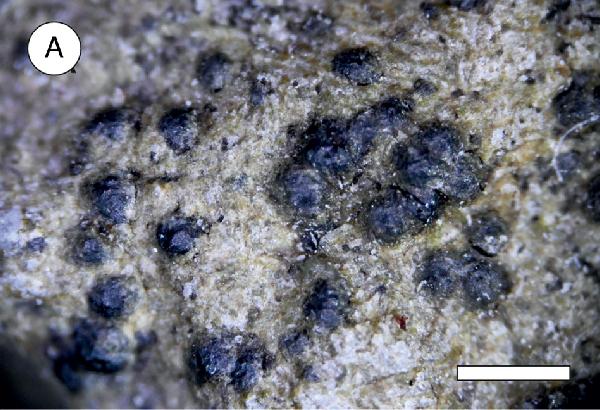
Verrucaria hakulinenii (holotype). Scale bar: 0.5 mm
Source: Pykälä J, Kantelinen A, Myllys L. Seven new species of Verrucaria from calcareous and siliceous rocks of Finland. The Lichenologist. 2024;56(5):259-272. doi:10.1017/S002428292400029X - CC BY 4.0
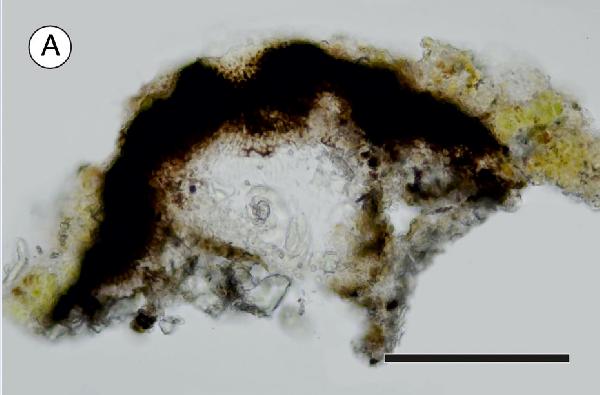
holotype - Scale: 0.1 mm
Growth form: Crustose
Substrata: rocks
Photobiont: green algae other than Trentepohlia
Reproductive strategy: mainly sexual
Pioneer species
Commonnes-rarity: (info)
Alpine belt: rare
Subalpine belt: very rare
Oromediterranean belt: absent
Montane belt: extremely rare
Submediterranean belt: absent
Padanian area: absent
Humid submediterranean belt: absent
Humid mediterranean belt: absent
Dry mediterranean belt: absent
Predictive model
| Herbarium samples |
 DOLICHENS

Source: Pykälä J, Kantelinen A, Myllys L. Seven new species of Verrucaria from calcareous and siliceous rocks of Finland. The Lichenologist. 2024;56(5):259-272. doi:10.1017/S002428292400029X - CC BY-NC 4.0
Verrucaria hakulinenii (holotype). Scale bar: 0.5 mm