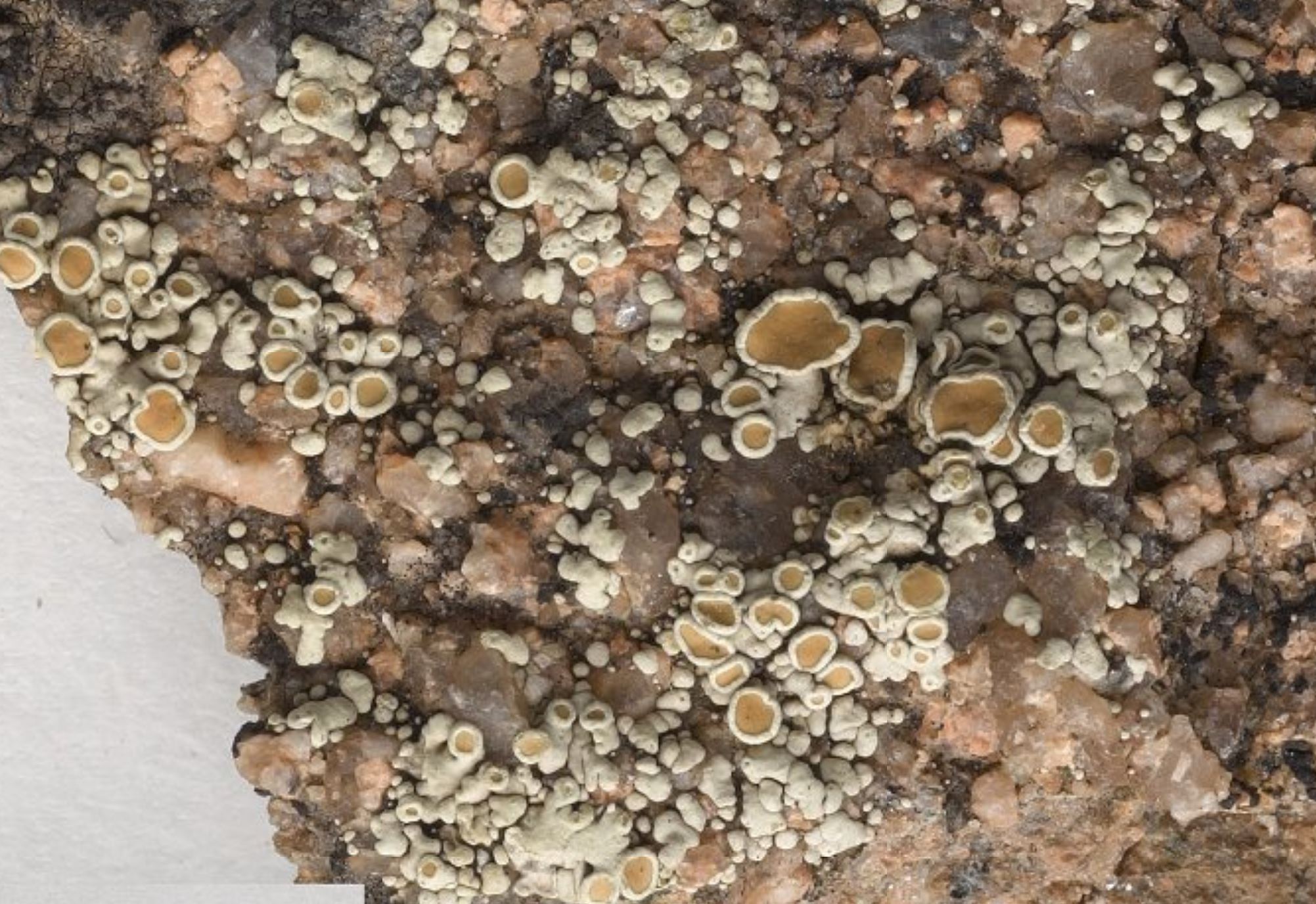
Protoparmeliopsis vaenskaei (Cl. Roux & C. Coste) Cl. Roux
in Nimis, The lichens of Italy: 20, 2016. Basionym: Lecanora vaenskaei Cl. Roux & C. Coste - in Roux & al., Canadian J. Bot., 71, 12: 1660, 1993.
Synonyms:
Distribution:
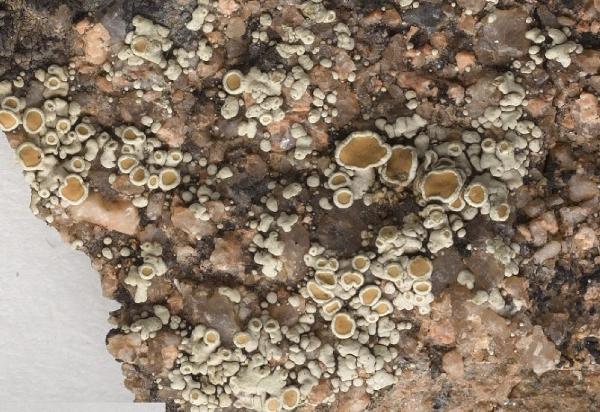
Description: Thallus subcrustose to subsquamulose, episubstratic, pale yellow-green, formed by dispersed to usually contiguous granules developing into peltate, lobulate squamules measuring (0.2-)0.3-3 x (0.2-)0.3-2 mm, the lobules up to 0.5 mm long; lower surface corticate, very pale brown, each squamule being attached by a central holdfast. Upper cortex 20-25 μm thick, paraplectenchymatous, rich in crystals soluble in K, overlain by an epinecral layer devoid of crystals; algal layer discontinuous; medulla white, 250-300 μm thick, rich in coarse crystals insoluble in K but soluble in N; lower cortex 40-70 μm thick, paraplectenchymatous, without crystals. Apothecia lecanorine, developing at the extremities of the lobules, 0.4-3(-5) mm across, constricted at base and finally sometimes short-stipitate, with a pale brown disc and a raised, 0.1-0.2 mm thick, persistent thalline margin. Thalline exciple corticate; proper exciple prosoplectenchymatous, yellowish brown in outer part, colourless within; epithecium brown, 10-20 μm high; hymenium colourless, 40-50 μm high, with crystals soluble in K; paraphyses mostly simple, 1.5-2.5 μm thick in lower part, the apical cells up to 4 μm wide; subhymenium colourless, without crystals, well-distinct from the hypothecium, 20-40 μm high; hypothecium colourless, 60-100 μm high. Asci 8- spored, elongate-clavate, very thin-walled, with a K/I+ blue, tall tholus penetrated by a faintly amyloid apical cushion, the wall K/I-, surrounded by a K/I+ blue outer layer, Lecanora-type. Ascospores 1-celled, hyaline, ellipsoid, (9-)10-14(-17) x (4-)6-8(-9) µm, often guttulate. Pycnidia fully immersed, entirely colourless, subglobose. Conidia thread-like, slightly curved, (16-)18-31 x c. 1 µm. Photobiont chlorococcoid. Spot tests: cortex K+ pale yellow, C-, KC+ pale yellow, P- , medulla R-. Chemistry: cortex with usnic acid and zeorin.Note: a species described from southern France and later found also in Corsica (Roux & Coll. 2025) and Greece (Malíček & al. 2021), growing on the lower part of large bare, slanting siliceous rocks, where rainwater runoff keeps them wet longer. For further details see Roux & al. (1993) and Roux (2004). To be looked for in Mediterranean Italy.
Growth form: Squamulose
Substrata: rocks
Photobiont: green algae other than Trentepohlia
Reproductive strategy: mainly sexual
On otherwise dry surfaces with short periods of water seepage after rain
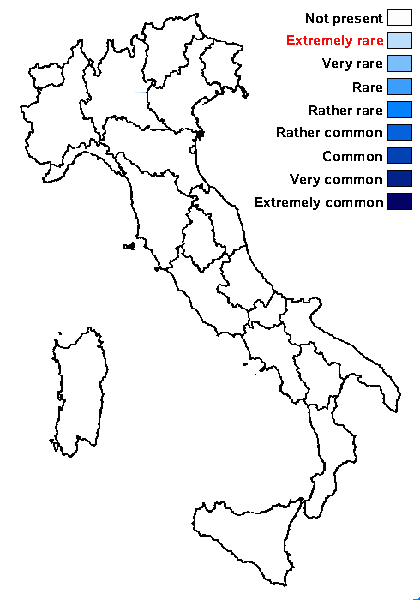
Predictive model
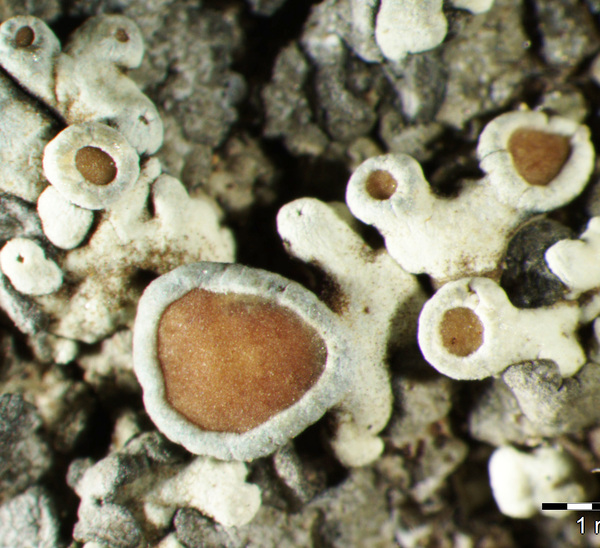
Harrie Sipman – Source http://www.bgbm.fu-berlin.de/sipman/Zschackia/AegeanLichens/CaloplacaAC.htm - As Caloplaca oasis

Harrie Sipman – Source http://www.bgbm.fu-berlin.de/sipman/Zschackia/AegeanLichens/CaloplacaAC.htm - As Caloplaca oasis
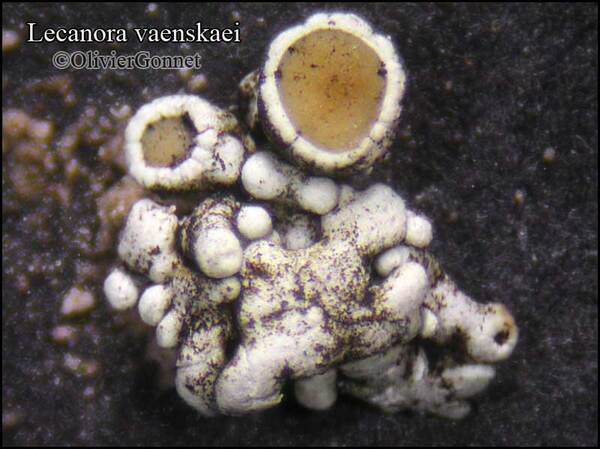
Courtesy Danièle et Olivier Gonnet - Source: https://www.afl-lichenologie.fr/Photos_AFL/Photos_AFL_P/Text_P_3/Protoparmeliopsis_vaenskaei.htm
France, 2012 - La Revellata, Calvi
Detail from: https://gzu.jacq.org/GZU000290741
GZU000290741 - Det./rev./conf./assigned C. Roux s.d.
Ident. history orig.: Lecanora vaenskaei
Isotypus of Lecanora vaenskaei Cl. Roux & C. Coste
Can. J. Bot. 71 (12): 1660-1661; fig. 1-10 (1993)
Typified by: C. Roux s.d.
Collector Ménard,T. & Roux,C. 21420
Date 1992-10-29
Location France / Provence-Alpes-Côte d'Azur
Label Francio, Provenco, Var, Le Muy, roko de Roquebrune, la Roquette, 500 m de la ruinita pregejo ; Alt. 110 m
Habitat sur roksurfaco el brecio (el granitaj elementoj), periode inundata
orientigo: generala: UNU; loka: UNU. Deklivo: 10°; Rim.: Sporohava.
Annotations GZU Inv.-Nr. 18-93
Growth form: Squamulose
Substrata: rocks
Photobiont: green algae other than Trentepohlia
Reproductive strategy: mainly sexual
On otherwise dry surfaces with short periods of water seepage after rain
Predictive model

Harrie Sipman – Source http://www.bgbm.fu-berlin.de/sipman/Zschackia/AegeanLichens/CaloplacaAC.htm - As Caloplaca oasis

Harrie Sipman – Source http://www.bgbm.fu-berlin.de/sipman/Zschackia/AegeanLichens/CaloplacaAC.htm - As Caloplaca oasis

Courtesy Danièle et Olivier Gonnet - Source: https://www.afl-lichenologie.fr/Photos_AFL/Photos_AFL_P/Text_P_3/Protoparmeliopsis_vaenskaei.htm
France, 2012 - La Revellata, Calvi