Psilolechia cretacea Palice, S. Svoboda & Vondrák
Pl. Fungal Syst., 68, 2: 286, 2023.
Synonyms:
Distribution:
Description: Thallus crustose, episubstratic, greyish white to chalky white, of dispersed or aggregated, 0.05-0.8 mm wide and up to 0.5-0.7(-1.5) mm thick granules coalescing into larger areoles and locally forming continuous to rimose-areolate, several square cm wide patches. Thallus surface matt, uneven, scurfy, finely tomentose due to the presence of numerous conidiogenous cells, the cortex not evident or up to 15 µm thick, the upper algal-free zone 15-50 µm thick, largely formed by a gelatinized layer; algal layer continuous, up to 200(-300) µm thick. Soredia-like, corticate, 8-20 µm wide granules (goniocysts) are sometimes visible on hand-cut microscopic sections of the areoles, in peripheral parts of the algal layer, containing up to c. 10 algal cells enveloped by a layer of hyaline, c. 1.5 µm thick hyphae. Medulla I-, thin in younger areoles, much thicker and very lax in old, well-developed ones, which may appear almost hollow in section. Apothecia unknown. Conidiogenous cells superficial, conical to narrowly conical/cylindrical, 5-12(-18) x 2-3 µm, locally aggregated, but not coalescing into true sporodochia. Conidia ellipsoid to ovoid, pointed at one end, (2-)2.5-3(-3.5) x 1.2-2 µm. Photobiont chlorococcoid, the cells 5-15(-21) µm wide, often with a distinct parietal pyrenoid. Spot tests: thallus K-. C-, KC-, P-, UV+ ice-blue. Chemistry: three unknowns plus at least 6 terpenoids in various concentrations.Note: a recently-described species growing on shaded, vertical to overhanging faces of acidic rocks, both in natural and in rather disturbed situations. Its known distribution is presently limited to the Czech Republic, but this easily overlooked lichen could be more widespread. For further details see Palice & al. (2023). To be looked for in Italy.
Growth form: Crustose
Substrata: rocks
Photobiont: green algae other than Trentepohlia
Reproductive strategy: mainly asexual, by conidia and thalloconidia
In underhangs rarely wetted by rain
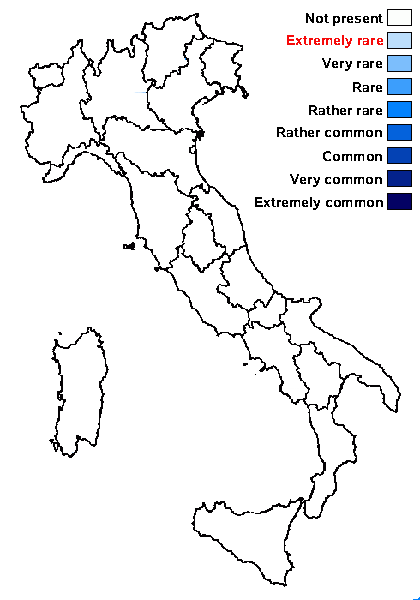
Predictive model
source: Palice Z, Svoboda S, Vondrák J. Hidden in the dark under umbrellas: two new Psilolechia species (lichenized Ascomycota, Lecanorales) described from the Czech Republic. Plant and Fungal Systematics. 2023;68(2):285-293. doi:10.35535/pfsyst-2023-0013. - CC BY 4.0
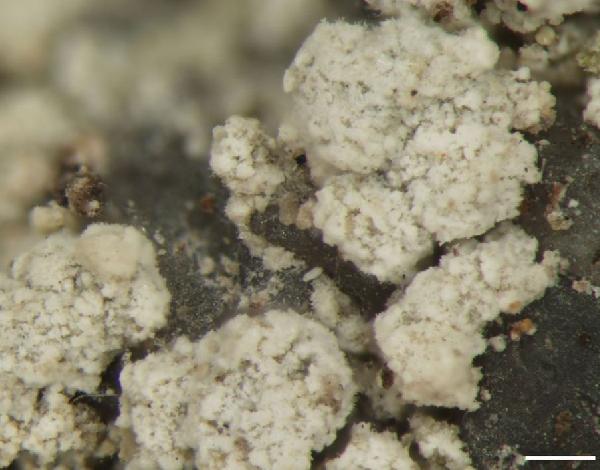
Psilolechia cretacea – a detail of scurfy / cracked areoles, numerous conidiogenous cells are visible on the lateral profiles of some of
the areoles. Part of the holotype specimen (ZP 24761). Scale = 0.2 mm.
source: Palice Z, Svoboda S, Vondrák J. Hidden in the dark under umbrellas: two new Psilolechia species (lichenized Ascomycota, Lecanorales) described from the Czech Republic. Plant and Fungal Systematics. 2023;68(2):285-293. doi:10.35535/pfsyst-2023-0013. - CC BY 4.0
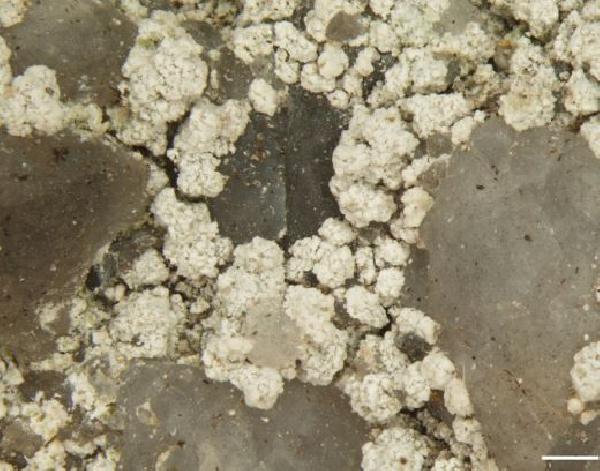
Psilolechia cretacea – habit; white areolate thalli among quartz
grains, growing along fissures of more stable parts of a crumbling sandstone rock. Part of the holotype specimen (ZP 24761). Scale = 0.5 mm
source: Palice Z, Svoboda S, Vondrák J. Hidden in the dark under umbrellas: two new Psilolechia species (lichenized Ascomycota, Lecanorales) described from the Czech Republic. Plant and Fungal Systematics. 2023;68(2):285-293. doi:10.35535/pfsyst-2023-0013. - CC BY 4.0
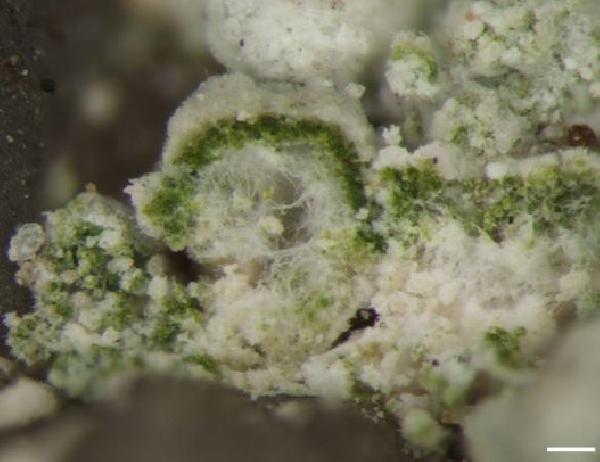
Psilolechia cretacea – a detail of sectioned larger areole (mid
of the picture) – almost continuous cortex-like outer surface, green algal
layer below and a thin medulla inside. Topotype specimen (ZP 34542).
Scale = 0.1 mm

source: Palice Z, Svoboda S, Vondrák J. Hidden in the dark under umbrellas: two new Psilolechia species (lichenized Ascomycota, Lecanorales) described from the Czech Republic. Plant and Fungal Systematics. 2023;68(2):285-293. doi:10.35535/pfsyst-2023-0013. - CC BY 4.0
Psilolechia cretacea – sectioned areole under microscope,
note a focused conical conidiogenous cell on the upper surface of the
areole. Topotype specimen (ZP 34542). Scale = 20 µm.
Growth form: Crustose
Substrata: rocks
Photobiont: green algae other than Trentepohlia
Reproductive strategy: mainly asexual, by conidia and thalloconidia
In underhangs rarely wetted by rain
Predictive model

source: Palice Z, Svoboda S, Vondrák J. Hidden in the dark under umbrellas: two new Psilolechia species (lichenized Ascomycota, Lecanorales) described from the Czech Republic. Plant and Fungal Systematics. 2023;68(2):285-293. doi:10.35535/pfsyst-2023-0013. - CC BY 4.0
Psilolechia cretacea – a detail of scurfy / cracked areoles, numerous conidiogenous cells are visible on the lateral profiles of some of the areoles. Part of the holotype specimen (ZP 24761). Scale = 0.2 mm.

source: Palice Z, Svoboda S, Vondrák J. Hidden in the dark under umbrellas: two new Psilolechia species (lichenized Ascomycota, Lecanorales) described from the Czech Republic. Plant and Fungal Systematics. 2023;68(2):285-293. doi:10.35535/pfsyst-2023-0013. - CC BY 4.0
Psilolechia cretacea – habit; white areolate thalli among quartz
grains, growing along fissures of more stable parts of a crumbling sandstone rock. Part of the holotype specimen (ZP 24761). Scale = 0.5 mm

source: Palice Z, Svoboda S, Vondrák J. Hidden in the dark under umbrellas: two new Psilolechia species (lichenized Ascomycota, Lecanorales) described from the Czech Republic. Plant and Fungal Systematics. 2023;68(2):285-293. doi:10.35535/pfsyst-2023-0013. - CC BY 4.0
Psilolechia cretacea – a detail of sectioned larger areole (mid
of the picture) – almost continuous cortex-like outer surface, green algal
layer below and a thin medulla inside. Topotype specimen (ZP 34542).
Scale = 0.1 mm