Rehmia amphibia (Fr.) E.J. Möller, Timdal, Haugan & Bendiksby
Fungal Syst. Evol., 16: 224, 2025. Basionym: Lecidea amphibia Fr. - K. svenska Vetensk-Akad. Handl., ser. 3: 262, 1822.
Synonyms: Rhizocarpon amphibium (Fr.) Körb.
Distribution:
Description: Thallus crustose, episubstratic, grey-brown, epruinose, areolate, the areoles 0.2-0.8(-1) mm wide, flat to slightly convex, forming 2-5 cm wide patches, usually without a distinct prothallus. Medulla white, I-. Apothecia black, largely immersed in the thallus, sometimes arranged in concentric circles, (0.4-)0.6-0.8(-1) mm across, with a barely evident, slightly raised, soon excluded proper margin. Proper exciple very thin, of radiating hyphae, blue-grey in outer part, paler within, the greenish parts N+ red; epithecium pale red-brown, K+ purple-red; hymenium colourless, (125-)150-200(-275) µm high; paraphysoids coherent, branched and anastomosing, 1.5-2 µm thick, the apical cells hardly swollen, without a strongly delimited pigmented cap; hypothecium brown, without crystals. Asci 8-spored, clavate, fissitunicate, with a well-developed tholus that is K/I- in lower part and K/I+ blue near the apex, lacking an ocular chamber, Rhizocarpon-type. Ascospores muriform, with (7-)8-12(-15) cells in optical view, hyaline, ellipsoid, (23-)28-38(-47) x (10-)13-17(-20) µm, halonate. Photobiont chlorococcoid. Spot tests: cortex and medulla K-, C-, KC-, P-, UV-. Chemistry: thallus without lichen substances. Note: on periodically inundated siliceous rocks e.g. along streams; widespread in Europe but much rarer than Rh. lavata and mostly in areas with a suboceanic climate, with a few isolated records from the Alps (Austria, Switzerland). To be looked for in the Italian Alps.
Growth form: Crustose
Substrata: rocks
Photobiont: green algae other than Trentepohlia
Reproductive strategy: mainly sexual
Most common in areas with a humid-warm climate (e.g. most of Tyrrenian Italy)
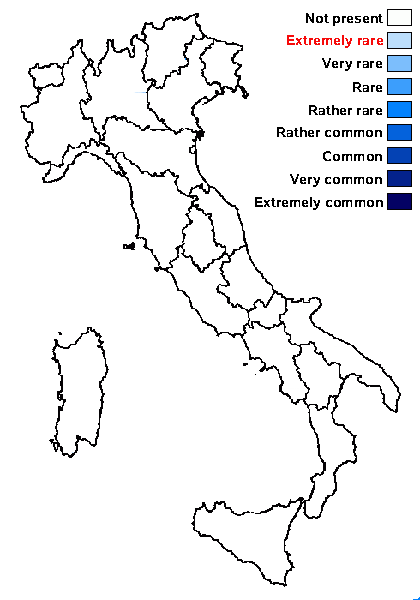
Predictive model
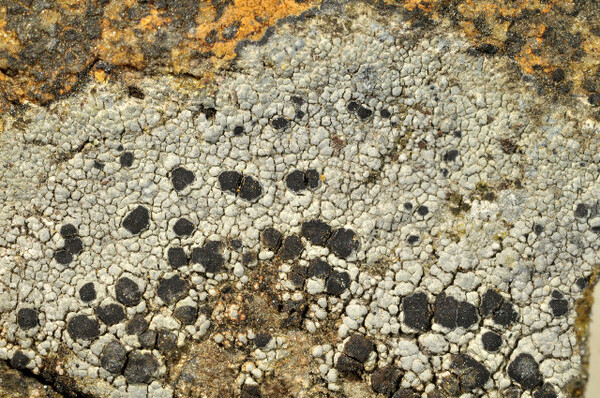
Einar Timdal - CC BY-SA NC
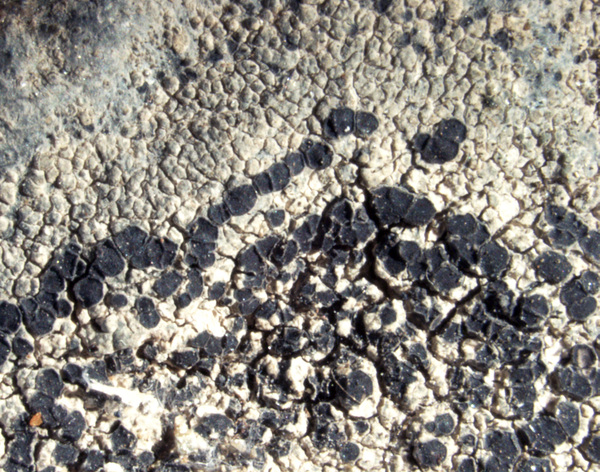

P.L. Nimis CC BY-SA 04
TSB 28212
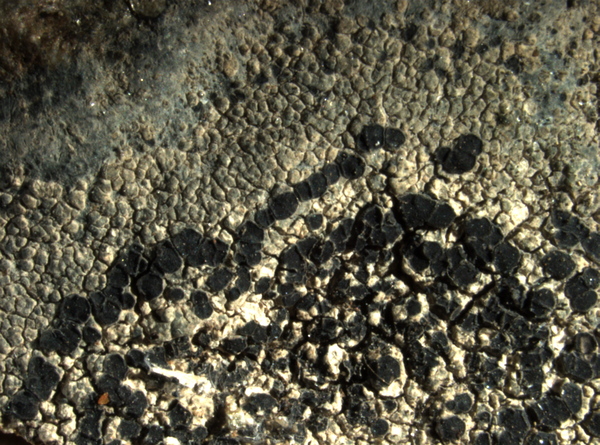
Pier Luigi Nimis - CC BY-SA 4.0
Herbarium: TSB 28212
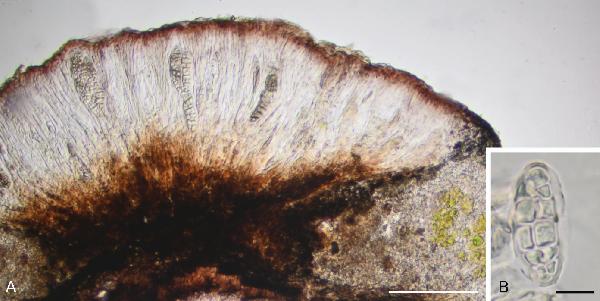
Photo by E. Timdal. Source: Möller E.J., Timdal E., Haugan R., Bendiksby M. 2025. Integrative taxonomy and genus delimitation in the Rhizocarpaceae (lichenized Ascomycota). Fungal Syst. Evol., 16: 215-231. – CC BY-NC-ND
Norway, O-L-
163528. Scale bars: A = 100 μm; B = 10 μm
Growth form: Crustose
Substrata: rocks
Photobiont: green algae other than Trentepohlia
Reproductive strategy: mainly sexual
Most common in areas with a humid-warm climate (e.g. most of Tyrrenian Italy)
Predictive model

Einar Timdal - CC BY-SA NC

P.L. Nimis CC BY-SA 04
TSB 28212

Pier Luigi Nimis - CC BY-SA 4.0
Herbarium: TSB 28212