Rhizocarpon atrovirellum (Nyl.) Zahlbr.
Cat. Lich. Univ. 4: 347, 1926. Basionym: Lecidea atrovirella Nyl. - Flora, 67, 21: 390, 1884.
Synonyms:
Distribution:
Description: Thallus crustose, areolate, greenish yellow, shiny, forming more or less orbicular, 2-6 mm wide patches on the thalli of aspicilioid lichens, the areoles flat, more or less angular, 0.2-0.8 mm wide. Medulla white, I-. Apothecia lecideine, black, constricted at base, round, 0.3-0.5 mm across, mostly developing on the areoles and more or less completely surrounded by them, with a flat to slightly convex disc. Exciple purple-black in outer part, paler within; epithecium brown-black, inspersed with blackish granules, K+ purple-red; hymenium colourless; paraphysoids strongly coherent, richly branched and anastomosing, the apical cells sometimes slightly capitate; hypothecium brown-black, K-. Asci 8-spored, clavate, fissitunicate, with a well-developed tholus that is K/I- in lower part and K/I+ blue near the apex, lacking an ocular chamber, Rhizocarpon-type. Ascospores at first 1-septate, then submuriform with 3-6 cells visible in optical view, dark brown, ellipsoid, 12-15 x 8-10 μm, halonate when young. Photobiont chlorococcoid. Spot tests: thallus K-, C-, KC-, P-. Chemistry: cortex with rhizocarpic acid.Note: a species close to Rh. viridiatrum, differing in the smaller, submuriform ascospores (to 20 µm long) with a single transversal septum; on schists in SW Europe, with a few records from the Western Alps (France). To be looked for in Italy.
Growth form: Crustose
Substrata: rocks
Photobiont: green algae other than Trentepohlia
Reproductive strategy: mainly sexual
paras Aspicilia sp.
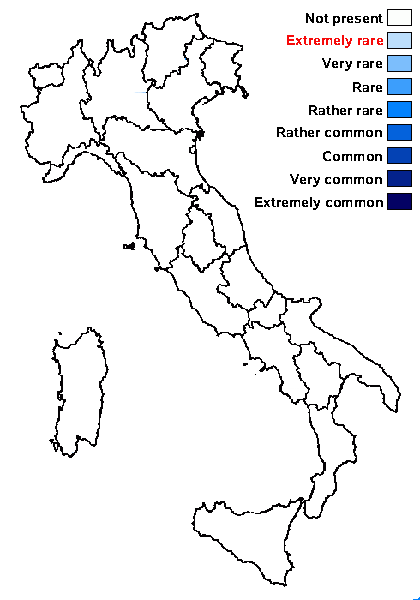
Predictive model
Growth form: Crustose
Substrata: rocks
Photobiont: green algae other than Trentepohlia
Reproductive strategy: mainly sexual
paras Aspicilia sp.
Predictive model