Thrombium aoristum (Nyl.) Arnold
Flora, 53, 30–31: 486, 1871.. Basionym: Verrucaria aorista Nyl. - Flora, 47: 355, 1864.
Synonyms:
Distribution:
Description: Thallus crustose, greenish, thin and often film-like, continuous, subgelatinous when wet, sometimes evanescent. Perithecia frequent, black, globose, not flattened at the top, 0.1-0.2(-0.4) mm across, covered by thallus up to the ostiole. Involucrellum absent; exciple 20-30 µm thick laterally, brown only near the ostiole, otherwise colourless or very pale brown, paraphyses persistent, simple, c. 1.5 µm thick, not apically thickened, free; periphyses absent. Asci 8-spored, subcylindrical but often clavate at apices, thin-walled, the apex slightly thickened, I+ blue with a narrow, cylindrical axial mass. Ascospores 1-celled, hyaline, narrowly ellipsoid, thin-walled, (14-)16-23(-25) x 6-8(-10) µm, 1-2-seriately arranged in the asci. Photobiont chlorococcoid. Spot tests: K-, C-, KC-, P-, UV-. Chemistry: without lichen substances.Note: a very poorly understood species growing on sandy-clayey soil in dry grasslands. Nimis & al. (2018) claimed that it could be just a morphotype of Th. epigaeum with a pale exciple, but according to Roux & Coll. (2025) it has a slightly different ecology and, contrary to the former, a Mediterranean-submediterranean distribution in France. To be looked for in Italy.
Growth form: Crustose
Substrata: soil, terricolous mosses, and plant debris
Photobiont: green algae other than Trentepohlia
Reproductive strategy: mainly sexual
Poorly known taxon in need of further study
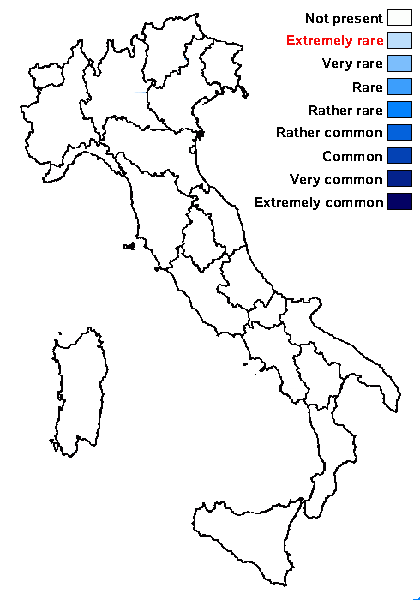
Predictive model
Growth form: Crustose
Substrata: soil, terricolous mosses, and plant debris
Photobiont: green algae other than Trentepohlia
Reproductive strategy: mainly sexual
Poorly known taxon in need of further study
Predictive model