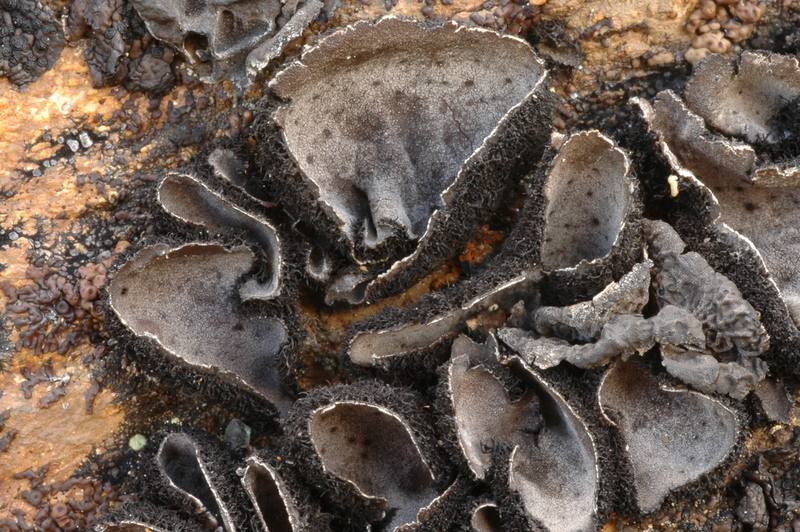
Umbilicaria dendrophora (Poelt) Hestmark
Mycotaxon, 46: 211, 1993. Basionym: Umbilicaria vellea var. dendrophora Poelt - in Hasenhüttl & Poelt, Ber. deutsch. bot. Ges., 91: 284, 1978.
Synonyms:
Distribution:
Description: Thallus foliose-umbilicate, heteromerous, dorsiventral, mono- or polyphyllous, rigid, 2-4(-8) cm wide, with entire to slightly lacerate, down-tuned margins, attached by a thick, dark, more or less central holdfast. Upper surface pale to medium grey, dull, smooth or sometimes pruinose. Lower surface smooth, light pinkish buff, covered, except around the umbilicus, with moderately to richly branched, terete, up to 3 mm long, black rhizinomorphs which produce thalloconidia mainly at their tips. Thalloconidia multi-septate, 4-20(-60)-celled, occasionally 1-2-septate, globose to slightly angular, (8-)22.7(-73) x (7.5-)18(-50) µm, brown to brown-black. Upper cortex palisade-plectenchymatous; algal layer discontinuous; medulla white, dense; lower cortex brown, scleroplectenchymatous, sharply delimited from the medulla. Apothecia rare, gyrodisc, black, to 2 mm across, stipitate to substipitate. Epithecium black-brown, up to 24 µm high; hymenium colourless, up to 50 µm high; paraphyses mostly simple, c. 2 µm thick, with enlarged apical cells; subhymenium colourless, up to 65 µm high; hypothecium brown, up to 110 µm high. Asci 8-spored, broadly clavate, thick-walled, with an amyloid apical dome, Umbilicaria-type. Ascospores 1-celled to rarely 1-septate, hyaline, broadly ellipsoid to subglobose, 5-10 x 5-8 µm. Pycnidia common, broadly pyriform, up to c. 0.3 mm wide, with a colourless to pigmented wall, the conidiogenous cells moderately branched. Conidia 2-3 x c. 0.5 µm. Photobiont chlorococcoid. Spot tests: cortex and medulla K-, C-, KC-, P-. Chemistry: thallus without lichen substances or with traces of norstictic acid. Note: a species growing on steeply inclined faces of siliceous cliffs and large boulders, widespread in Europe but rather rare, from the subarctic zone to the alpine belt of the Alps and the Pyrenees, known from the Eastern Alps (Austria). To be looked for in Italy
Growth form: Foliose, umbilicate
Substrata: rocks
Photobiont: green algae other than Trentepohlia
Reproductive strategy: mainly sexual, or asexual by conidia and thalloconidia
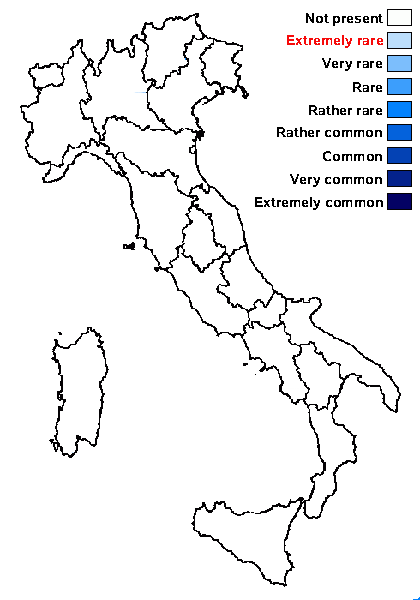
Predictive model
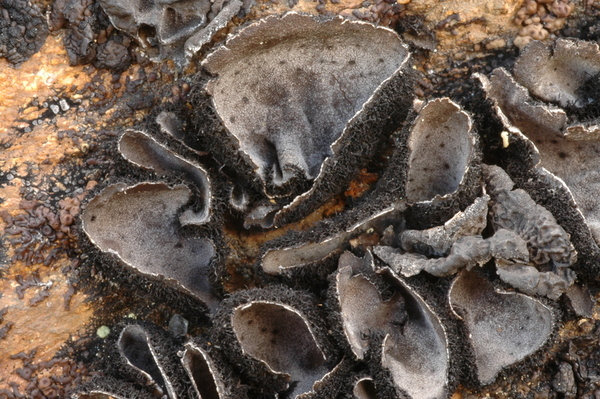
Einar Timdal. Source: http://www.nhm2.uio.no/botanisk/lav/Photo_Gallery/Umbilicaria/dendrophora_G=Norway+Oppland+Dovre_D=20050804_H=O-L148968_O=E-Timdal_C=ET_I=DSC_1944.JPG
Growth form: Foliose, umbilicate
Substrata: rocks
Photobiont: green algae other than Trentepohlia
Reproductive strategy: mainly sexual, or asexual by conidia and thalloconidia
Predictive model