Usnea arianae P. Clerc, E. Caviró & A. Gerlach
in Gerlach & al., Pl. Fungal Syst., 65, 2: 290, 2020.
Synonyms:
Distribution:
Description: Thallus fruticose, filamentous, greenish, shrubby, 2-5(-6) cm long, branching anisotomic-dichotomously, the main branches 0.7-1.9 mm thick, terete or rarely slightly flattened, often strongly irregular in longitudinal section, often small-papillate, rarely with a few fibrils but with numerous fibercles, the lateral branches constricted at the point of attachment, the terminal branches with foveolae and transverse furrows, the base blackened for c. 1 mm, without annular cracks. Cortex thin (c. 5% of total branch thickness), shiny, of the Ceratina-type; medulla thick and lax; central axis thin. Soralia 0.1-0.35 mm across, circular or irregular in outline, wider than half of branch width at maturity, tending to remain individual and become efflorescent, often with abundant isidiomorphs. Apothecia rare, up to 7 mm across, terminal, with a corticate thalline margin. Ascospores unknown. Photobiont chlorococcoid. Spot tests and chemistry: cortex K-, C-, KC-, P-, with usnic acid, medulla with 4 chemotypes : 1) K-, P-, UV+ white, with lobaric and fatty acids, 2) K-, P-, with fatty acids, 3) K+ yellow turning red, P+ yellow-orange, with norstictic and fatty acids, 4) K+ yellow turning red, P+ yellow-orange, UV+ white, with norstictic and lobaric acids. The lobaric acid chemotypes are the most frequent in Europe.Note: a recently-described species in the U. cornuta complex, with a tropical to Mediterranean-Atlantic distribution. It Europe it is known from several stations from Portugal to the British Isles, but also from Corsica and, surprisingly, from Switzerland. For further details see Gerlach & al. (2020). To be looked for in Italy.
Growth form: Fruticose filamentous
Substrata: bark
Photobiont: green algae other than Trentepohlia
Reproductive strategy: mainly asexual, by soredia, or soredia-like structures (e.g. blastidia)
Most common in areas with a humid-warm climate (e.g. most of Tyrrenian Italy)
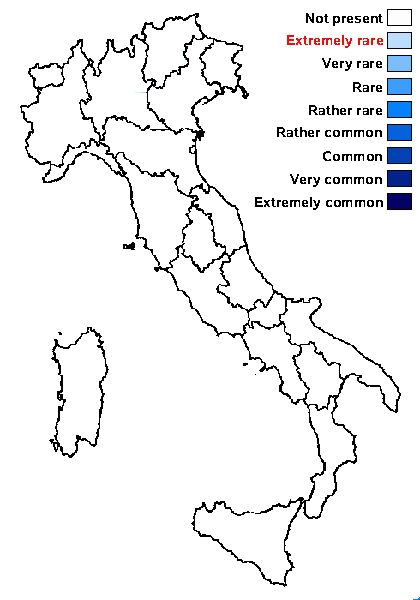
Predictive model
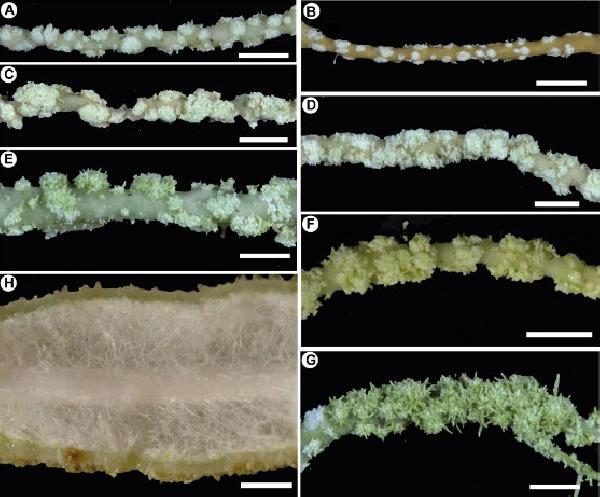
CC BY 4.0 - Source: Gerlach A, da Silveira R MB, Rojas C, Clerc P. Naming and describing the diversity in the Usnea cornuta aggregate (lichenized Ascomycota, Parmeliaceae) focusing on Brazilian specimens. Plant and Fungal Systematics. 2020;65(2):272–302. doi:10.35535/pfsyst-2020-0024.
Usnea arianae. A, B – young and well delimited soralia (A: Aptroot 75514, DNA 232; B: Clerc 2009/179); C – twisted terminal branches
densely covered with aggregating soralia (Gerlach & Penati 2016/P1, DNA 192); D – ± convex efflorescent soralia (Aptroot 75514, DNA 232);
E, F – mature, convex efflorescent soralia, with small isidiomorphs (E: Aptroot 75514, DNA 232; F: Aptroot 75517, DNA 231); G – aggregating
soralia richly covered with isidiomoprhs (Clerc & Ohmura G00599921); H – transversal section of main branch, CMA of cornuta-type CMA,
thin axis and lax medulla (Clerc, Kissling & Favre s.n., holotype). Scales: A–H = 500 μm.
Growth form: Fruticose filamentous
Substrata: bark
Photobiont: green algae other than Trentepohlia
Reproductive strategy: mainly asexual, by soredia, or soredia-like structures (e.g. blastidia)
Most common in areas with a humid-warm climate (e.g. most of Tyrrenian Italy)
Predictive model