Caloplaca egeana Cl. Roux & Nav.-Ros.
Bull. Soc. linn. Provence, 43: 98, 1992.
Synonyms:
Distribution: C - Sar (Herb. Vondrák 10781).
Description: Thallus crustose, episubstratic, well-evident, areolate, chalky white, well-delimited, the areoles 0.2- 0.5(-0.8) mm wide, 0.05-0.2 mm thick, angulose, flat, with a rough surface which is often subdivided by small cracks. Apothecia zeorine, more or less round in outline, (0.1-)0.2-0.4(-0.5) mm across, orange to brownish orange, 1-2(-3) per areole, at first urceolate and immersed in the thallus, then adnate, not constricted at base, with a concave to flat disc and a thin, concolorous or slightly paler, persistent of finally excluded proper margin. Thalline exciple developed only at the base of the apothecium, rich in algae; proper exciple 40-75 μm wide, prosoplectenchymatous, with a 20-30 μm wide, pigmented cortex and a colourless medullary part, of radiating hyphae whose lumina measure 2-6 x 2 μm; epithecium orange-brown, rich in crystals of anthraquinones, 8-20 μm high, K+ purple-red; hymenium colourless, 60-90 μm high; paraphyses simple or forked in upper part 1.5-2 μm thick at base, the apical cells swollen, 4-7(-8) μm wide; hypothecium colourless, prosoplectenchymatous. Asci 8-spored, clavate, functionally unitunicate, apically thickened with a broad internal beak, the inner part of apex and external cap I+ blue, Teloschistes-type, 40-55 x 13-18 μm. Ascospores 2-celled, polarilocular, hyaline, ellipsoid, (10-)11-14 x (5-)6-7 μm, the equatorial thickening (“septum”) 3-4(-5) μm, c. 1/3 of spore-length. Photobiont chlorococcoid. Spot tests: thallus K-, C-, KC-, P-; apothecia K+ purple-red. Chemistry: thallus without lichen substances, apothecia with unidentified anthraquinones.Note: a maritime species described from Portugal, growing on calcareous rocks. The Italian sample was collected at Cala Mosca, in the province of Cagliari. The species does not belong to Caloplaca s.str.
Growth form: Crustose
Substrata: rocks
Photobiont: green algae other than Trentepohlia
Reproductive strategy: mainly sexual
Taxon bound to maritime-coastal situations
Commonnes-rarity: (info)
Alpine belt: absent
Subalpine belt: absent
Oromediterranean belt: absent
Montane belt: absent
Submediterranean belt: absent
Padanian area: absent
Humid submediterranean belt: absent
Humid mediterranean belt: extremely rare
Dry mediterranean belt: extremely rare
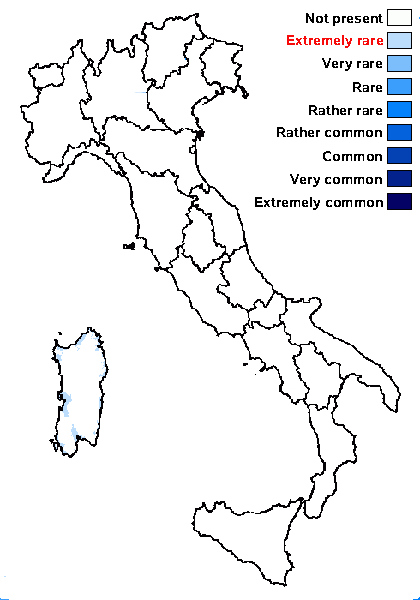
Predictive model
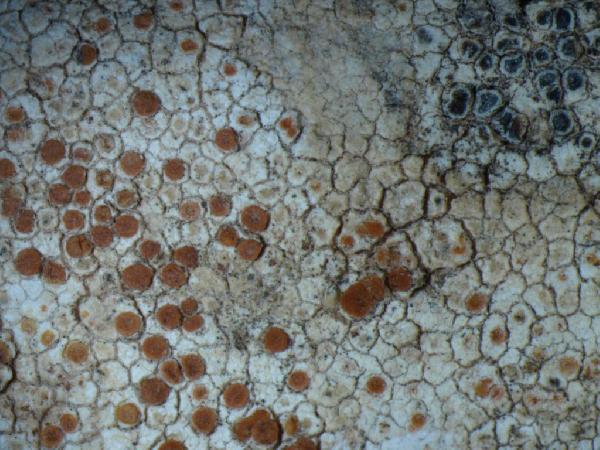
Source: https://botanika.prf.jcu.cz/lichenology/index.php?pg=5&func=cat&idx=32
Portugal 1983 van den Boom 845
Growth form: Crustose
Substrata: rocks
Photobiont: green algae other than Trentepohlia
Reproductive strategy: mainly sexual
Taxon bound to maritime-coastal situations
Commonnes-rarity: (info)
Alpine belt: absent
Subalpine belt: absent
Oromediterranean belt: absent
Montane belt: absent
Submediterranean belt: absent
Padanian area: absent
Humid submediterranean belt: absent
Humid mediterranean belt: extremely rare
Dry mediterranean belt: extremely rare
Predictive model