Variospora latzelii (Servít) S.Y. Kondr.
in Kondratyuk & al., Acta Bot. Hung., 59, 1-2: 123, 2017 . Basionym: Blastenia latzelii Servít - Hedwigia , 74, 2: 151, 1934.
Synonyms:
Distribution:
Description: Thallus crustose, thinly episubstratic or hemiendosubstratic, pale yellow to orange, forming up to 2 cm wide patches. Apothecia zeorine, 0.25-0.4(-0.5) mm across, sessile, with a concave to finally flat, epruinose, orange-red disc and paler proper margin. Proper exciple 40-90 μm wide, prosoplectenchymatous, of radially arranged hyphae, orange in outer part, colourless within; epithecium orange-brown, with granules of anthraquinones reacting K+ purple-red, 10-15 μm high; hymenium colourless 90-100 μm high; paraphyses simple or forked in upper part, 1.5-2 μm thick at mid-level, not moniliform, the apical cells up to 4 μm wide; hypothecium colourless, 70-120 μm high. Asci 8-spored, clavate, functionally unitunicate, apically thickened with a broad internal beak, the inner part of apex and external cap I+ blue, Teloschistes-type. Ascospores 2-celled, polarilocular, hyaline, 12-13(-18) x 7-11 μm, at maturity strongly swollen at septum and thickened at apex, with reduced lumina, recalling the Mischoblastia- type spores of some Rinodina-species. Photobiont chlorococcoid. Spot tests: thallus and apothecia K+ purple-red, C-, KC-, P-. Chemistry: thallus and apothecia with parietin (major), fallacinal, emodin, teloschistin and parietinic acid (minor), corresponding with chemosyndrome A of Søchting (1997).Note: a calcicolous species avoiding direct sunlight, often occurring together with the superficially similar Xanthocarpia ochracea, with an apparently eastern distribution in Europe, known from the Balkan Peninsula (Dalmatia to Greece), and from eastern Asia (Turkey, Russian Caucasus, Israel). The species was synonymised with Variospora dalmatica by Poelt (1969), but that species has quite different ascospores; according to Navarro-Rosinés & Hladun (1992) it could be that material distributed by Massalongo is heterogeneous. To be looked for in southern Italy.
Growth form: Crustose
Substrata: rocks
Photobiont: green algae other than Trentepohlia
Reproductive strategy: mainly sexual
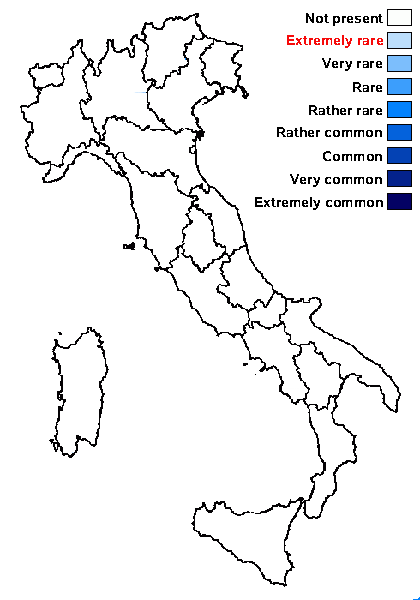
Predictive model
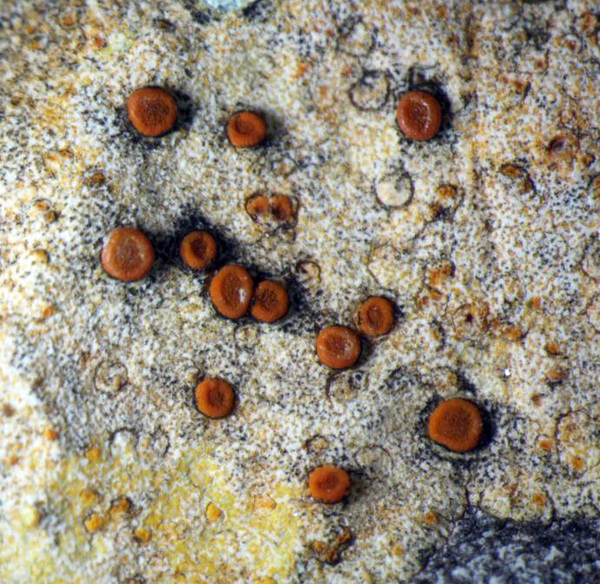
Jan Vondrak; Owner: Source: http://botanika.bf.jcu.cz/lichenology/index.php?pg=8&cat=32&idx=7250 Greece, CBFS JV8598
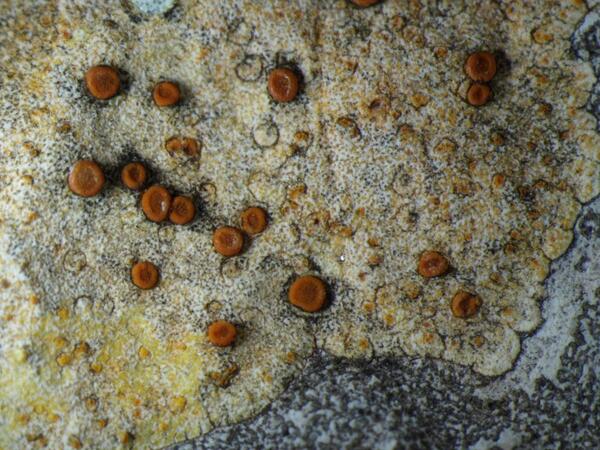
Jan Vondrak; Owner: Source: http://botanika.bf.jcu.cz/lichenology/index.php?pg=8&cat=32&idx=7250
Greece, CBFS JV8598
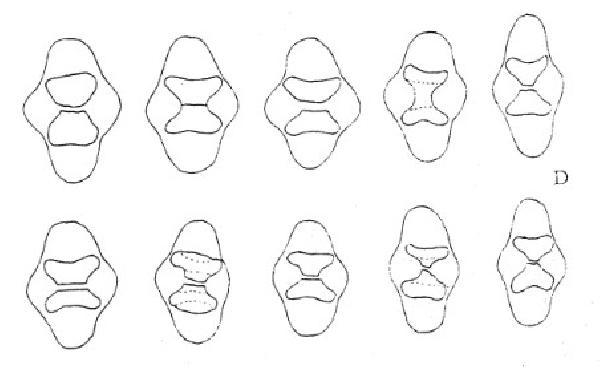
Source: Navarro-Rosinés P., Hladun N,L, 1992, Caloplaca latzelii y C. glomerata (Teloschistaceae, Líquenes), dos especies con esporas atípicas. Cryptogamie, Bryol.-Lichénol. 13, 3: 227-235.
Growth form: Crustose
Substrata: rocks
Photobiont: green algae other than Trentepohlia
Reproductive strategy: mainly sexual
Predictive model

Jan Vondrak; Owner: Source: http://botanika.bf.jcu.cz/lichenology/index.php?pg=8&cat=32&idx=7250 Greece, CBFS JV8598

Jan Vondrak; Owner: Source: http://botanika.bf.jcu.cz/lichenology/index.php?pg=8&cat=32&idx=7250
Greece, CBFS JV8598