Sticta arenosella Di Meglio & Goward
Bryologist, 126, 1: 97, 2023.
Synonyms:
Distribution:
Description: Thallus foliose, heteromerous, dorsiventral, 2.5-5 cm across at maturity, isidiate, with several suborbicular to weakly elongate, 0.5-1 cm wide and to 0.5-1(-1.5) long lobes. Lobes mostly simple, adnate to ascending, imbricate and overlapping, flat to slightly involute, with an entire margin. Upper surface smooth to weakly scrobiculate (especially in old lobes), dark brown or rarely pale grey, dull. Isidia abundant, at first granular, then copiously branched, both laminal and marginal, with cylindrical elongated terminal portions and narrow-stalked basal portions. Lower surface smooth or scrobiculate, pale orange to brownish, darker towards the center in old thalli, sparsely to densely tomentose, with a primary tomentum of erect, sparse, evenly spaced, 135-350 μm long hyphae arranged in fascicles of 10-40, not obscuring the lower surface and a much reduced, compact, arachnoid secondary tomentum of 5-10(-20) μm long, branched, strongly moniliform hyphae with globose cells and free apices. Cyphellae 0.3-0.7(-1.2) mm wide, round or angular, weakly urceolate, white, the membrane made of a layer of rounded cells (5-9 μm in diam.) with outer side (that in contact with the air) covered with minute papillae. Upper cortex paraplectenchymatous, unstratified, of several layers of equally sized cells; medulla white, lax; lower cortex paraplectenchymatous, made of 3-5 rows of isodiametrical cells. Apothecia and pycnidia unknown. Photobiont cyanobacterial ( Nostoc, the cells in compact masses). Spot tests: cortex and medulla K-, C-, KC-, P-, UV-. Chemistry: without lichen substances.Note: a species previously known only from North and South America, and recently found also in a single station in Switzerland (Bernet & al. 2025), growing in humid, old montane forests. To be looked for in Italy.
Growth form: Foliose, broad lobed
Substrata: bark
Photobiont: cyanobacteria, filamentous (e.g. Nostoc, Scytonema)
Reproductive strategy: mainly asexual, by isidia, or isidia-like structures (e.g. schizidia)
Most common in areas with a humid-warm climate (e.g. most of Tyrrenian Italy)
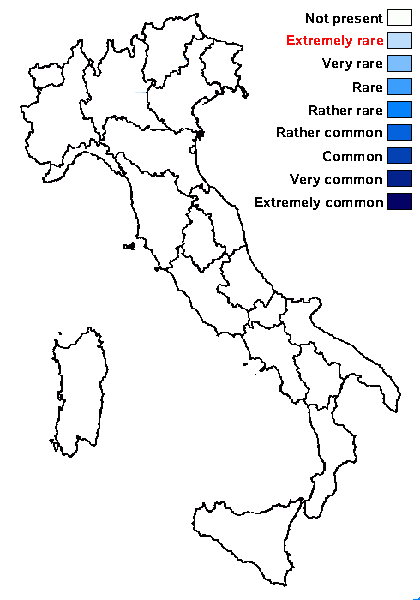
Predictive model
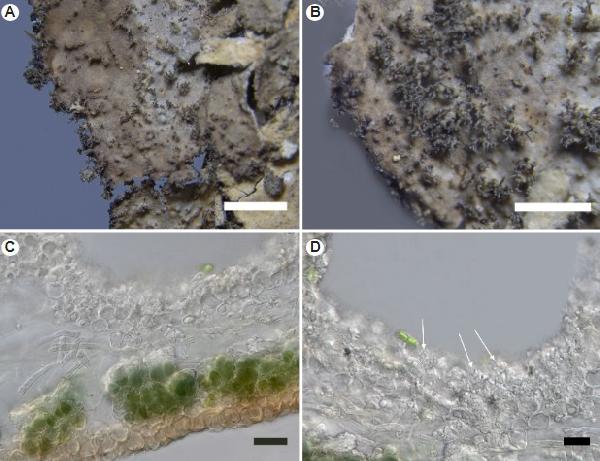
CC BY 4.0 - Source: Bernet J, Vonarburg C, Otálora MA G. First European record of Sticta arenosella and new Central European records of Sticta fuliginoides. Plant and Fungal Systematics. 2025;70(2):75–84. doi:10.35535/pfsyst-2025-0008.
Sticta arenosella (voucher: ChV1285). A, B – marginal, stalked isidia; C – cross-section of the lichen with unstratified cortex; D –
papillate surface cells on the cyphellary membrane. Scales: A, B = 2 mm; C = 20 μm; D = 10 μm
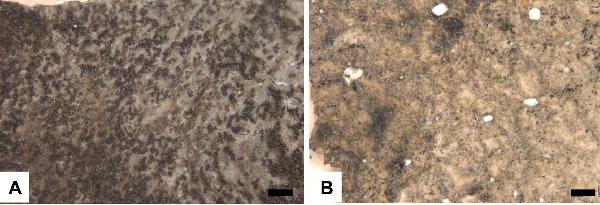
Source: Ossowska EA, Schiefelbein U, Kukwa M. First records of Sticta arenosella and S. cellulosa from South America based on molecular and morphological data. Plant and Fungal Systematics. 2024;69(1):77-84. doi:10.35535/pfsyst-2024-0008. - CC BY 4.0
A – upper surface S. arenosella with laminalisidia; B – ridged lower surface S. arenosella with sparse tomentum Scale = 1 mm
Growth form: Foliose, broad lobed
Substrata: bark
Photobiont: cyanobacteria, filamentous (e.g. Nostoc, Scytonema)
Reproductive strategy: mainly asexual, by isidia, or isidia-like structures (e.g. schizidia)
Most common in areas with a humid-warm climate (e.g. most of Tyrrenian Italy)
Predictive model

CC BY 4.0 - Source: Bernet J, Vonarburg C, Otálora MA G. First European record of Sticta arenosella and new Central European records of Sticta fuliginoides. Plant and Fungal Systematics. 2025;70(2):75–84. doi:10.35535/pfsyst-2025-0008.
Sticta arenosella (voucher: ChV1285). A, B – marginal, stalked isidia; C – cross-section of the lichen with unstratified cortex; D – papillate surface cells on the cyphellary membrane. Scales: A, B = 2 mm; C = 20 μm; D = 10 μm