Verrucaria humida Orange
in Thüs & al.,, Phytotaxa, 197, 3: 178, 2015.
Synonyms:
Distribution:
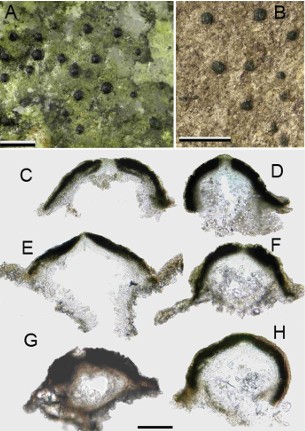
Description: Thallus crustose, very thinly episubstratic, c. 12-25 μm thick, smooth, continuous, grey-green or brown, subgelatinous and often green and translucent when wet, without a distinct prothallus. Upper cortex weakly defined; algal cells not arranged in vertical columns; medulla weakly differentiated, very thin, paraplectenchymatous, without a black basal layer. Perithecia black, forming conical-hemispherical to hemispherical projections 0.2-0.36 μm across, the ostiolar region inconspicuous, or ostiole visible as a pale, c. 40 μm wide dot; thalline layer absent or present only at extreme base. Involucrellum 11-30 μm thick, appressed to exciple in upper part and usually diverging at base, dark brown or dark green; exciple 170-200 μm wide, colourless at sides and base; hamathecium of 17-26 μm long periphysoids, interascal filaments absent; hymenial gel hemiamyloid, I+ red (I+ blue at very low concentrations of I), K/I+ blue. Asci 8-spored, clavate, I-, fissitunicate, the wall thickened above, with an ocular chamber, dehiscent by extrusion of an endotunica to form a delicate rostrum, Verrucaria-type. Ascospores 1-celled, hyaline, oblong-ellipsoid, (20-)22-25(-26) x 10-12(-12.5) μm, in average c. 2.1 times as long as wide, not halonate. Photobiont chlorococcoid. Spot tests: K-, C-, KC-, P-, UV-. Chemistry: without lichen substances.Note: a recently-described freshwater species of base-rich siliceous rocks, so far known from several sites in western and northern Europe. To be looked for in Italy. For further details see Thüs & al. (2015) and Krzewicka (2012, sub V. andesiaca).
Growth form: Crustose
Substrata: rocks
Photobiont: green algae other than Trentepohlia
Reproductive strategy: mainly sexual
Periodically submerged (e.g. in creeks)
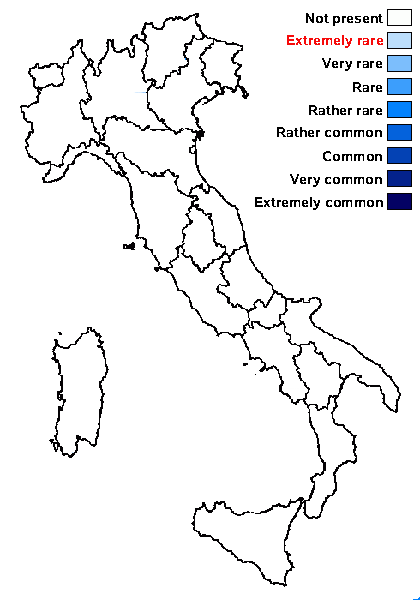
Predictive model

Source: Thüs H., Orange A., Gueidan C., Pykälä J., Ruberti C., Lo Schiavo F. & Nascimbene, J. (2015) Phytotaxa 197(3): 161-185 Revision of the Verrucaria elaeomelaena species complex and morphologically similar freshwater lichens (Verrucariaceae, Ascomycota).
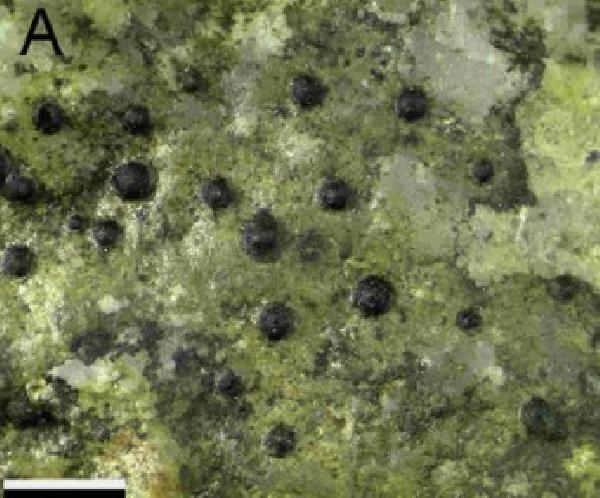
A. Thallus of specimen Orange 19370 (holotype, NMW), Scale bar: 1 mm
Source: Thüs H., Orange A., Gueidan C., Pykälä J., Ruberti C., Lo Schiavo F. & Nascimbene, J. (2015) Phytotaxa 197(3): 161-185 Revision of the Verrucaria elaeomelaena species complex and morphologically similar freshwater lichens (Verrucariaceae, Ascomycota).
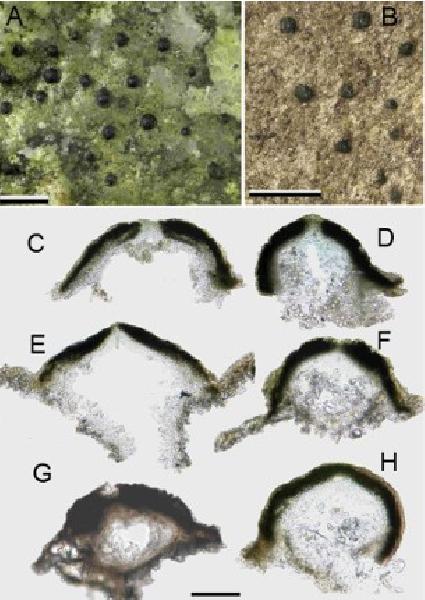
Anatomy and habitus of Verrucaria humida. A. Thallus of specimen Orange 19370 (holotype, NMW), B. Thallus of
specimen Orange 16783 (NMW). C–D. Cross-sections of perithecia of specimen Orange 19370 (holotype, NMW). E–F. Cross-sections
of perithecia of specimen Orange 16785 (NMW). G. Cross-section of a perithecium of specimen Krzewicka 2719a (KRAM). H. Cross
section of a perithecium of specimen Orange 19318 (NMW). Scale bar: A–B = 1 mm; C–H = 100 μm.
Growth form: Crustose
Substrata: rocks
Photobiont: green algae other than Trentepohlia
Reproductive strategy: mainly sexual
Periodically submerged (e.g. in creeks)
Predictive model

Source: Thüs H., Orange A., Gueidan C., Pykälä J., Ruberti C., Lo Schiavo F. & Nascimbene, J. (2015) Phytotaxa 197(3): 161-185 Revision of the Verrucaria elaeomelaena species complex and morphologically similar freshwater lichens (Verrucariaceae, Ascomycota).
A. Thallus of specimen Orange 19370 (holotype, NMW), Scale bar: 1 mm