Verrucaria madida Orange
Lichenologist, 36: 349, 2004.
Synonyms:
Distribution:
Description: Thallus crustose, episubstratic, dark green or dark grey-green, (30-)40-60 µm thick, smooth and continuous, subgelatinous when wet, without a distinct prothallus. Cortex with a dull green or in part brownish pigment; algal cells weakly arranged in columns; medulla very thin or absent, without a black basal layer. Perithecia black, numerous (128-260 per cm2) forming 0.2-0.42 mm wide, low to moderately conical-hemispherical projections, at first covered by a thalline layer, later often partly naked, the apex rounded to slightly flattened. Involucrellum conical or somewhat spreading at the sides and then slightly down-curved, reaching down to the thallus base, with a pale area between involucrellum and lower part of the exciple; exciple 140-290 µm across, colourless or brown in lower part; hamathecium of periphysoids, interascal filaments absent. Asci (3-)4(-5)-spored, clavate, I-, fissitunicate, the wall thickened above, with an ocular chamber, dehiscent by extrusion of an endotunica to form a delicate rostrum, Verrucaria-type, 27-30 x 14-16 μm. Ascospores 1-celled, hyaline, ellipsoid, (9-)10.5-13.5(-15.5) x (5.5-)6-7(-7.5) µm, (1.4-)1.6-2.1(-2.6) times as long as wide, without a perispore. Pycnidia rare, scattered, visible as black, 40-55 μm wide dots. Conidia thread-like, straight
or slightly curved, (6.5-)9.5-12(-15) x c. 0.8 μm. Photobiont chlorococcoid. Spot tests: K-, C-, KC-, P-, UV-. Chemistry: without lichen substances.Note: an amphibious species found in frequently inundated sites on siliceous rocks, known from several localities in northwestern and Central Europe, but perhaps overlooked elsewhere. For further information see Thüs & Schultz (2008), Thüs & Wirth (2009), Krzewicka (2012), Orange & al. (2023) and Yakovchenko & Davydov (2026). To be looked for in Italy.
Growth form: Crustose
Substrata: rocks
Photobiont: green algae other than Trentepohlia
Reproductive strategy: mainly sexual
Most common in areas with a humid-warm climate (e.g. most of Tyrrenian Italy)
Periodically submerged (e.g. in creeks)
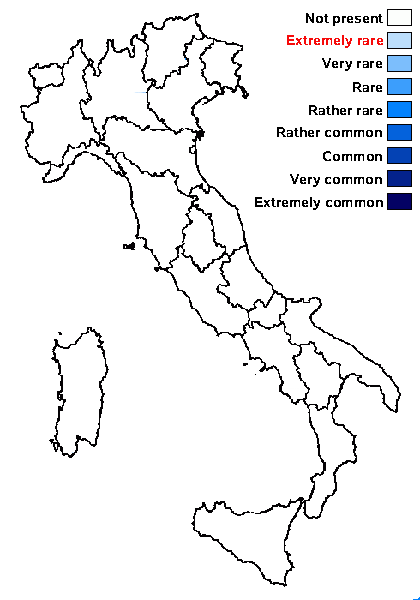
Predictive model
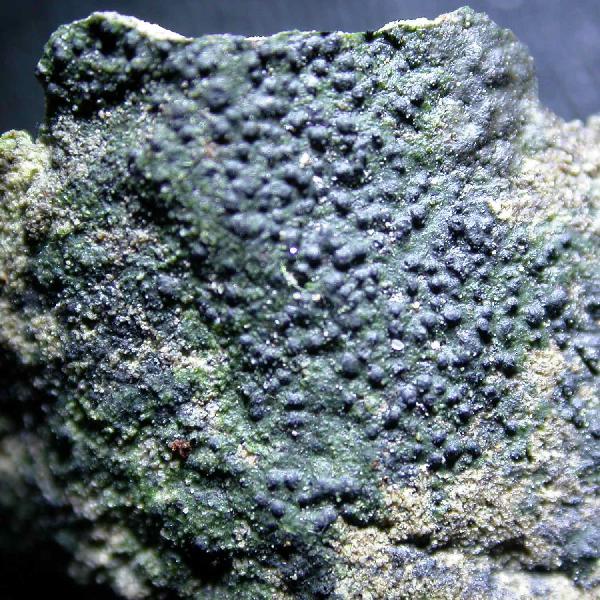
Source: https://fungi.myspecies.info/all-fungi/verrucaria-madida - Photo uploaed by Mark Powell -CC BY NC
Verrucaria madida, specimen on sandstone pebble from stream, VC 62 (NE Yorkshire). The thallus is thin, uncracked and sub-gelatinous. The perithecia form projections typically ca 300 µm diameter in this specimen.
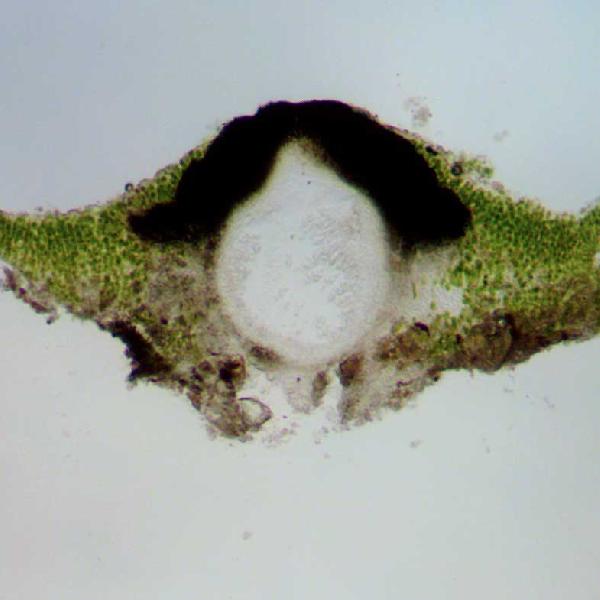
Source: https://fungi.myspecies.info/all-fungi/verrucaria-madida - Photo uploaed by Mark Powell -CC BY NC
Verrucaria madida, section of perithecium and thallus.
Growth form: Crustose
Substrata: rocks
Photobiont: green algae other than Trentepohlia
Reproductive strategy: mainly sexual
Most common in areas with a humid-warm climate (e.g. most of Tyrrenian Italy)
Periodically submerged (e.g. in creeks)
Predictive model
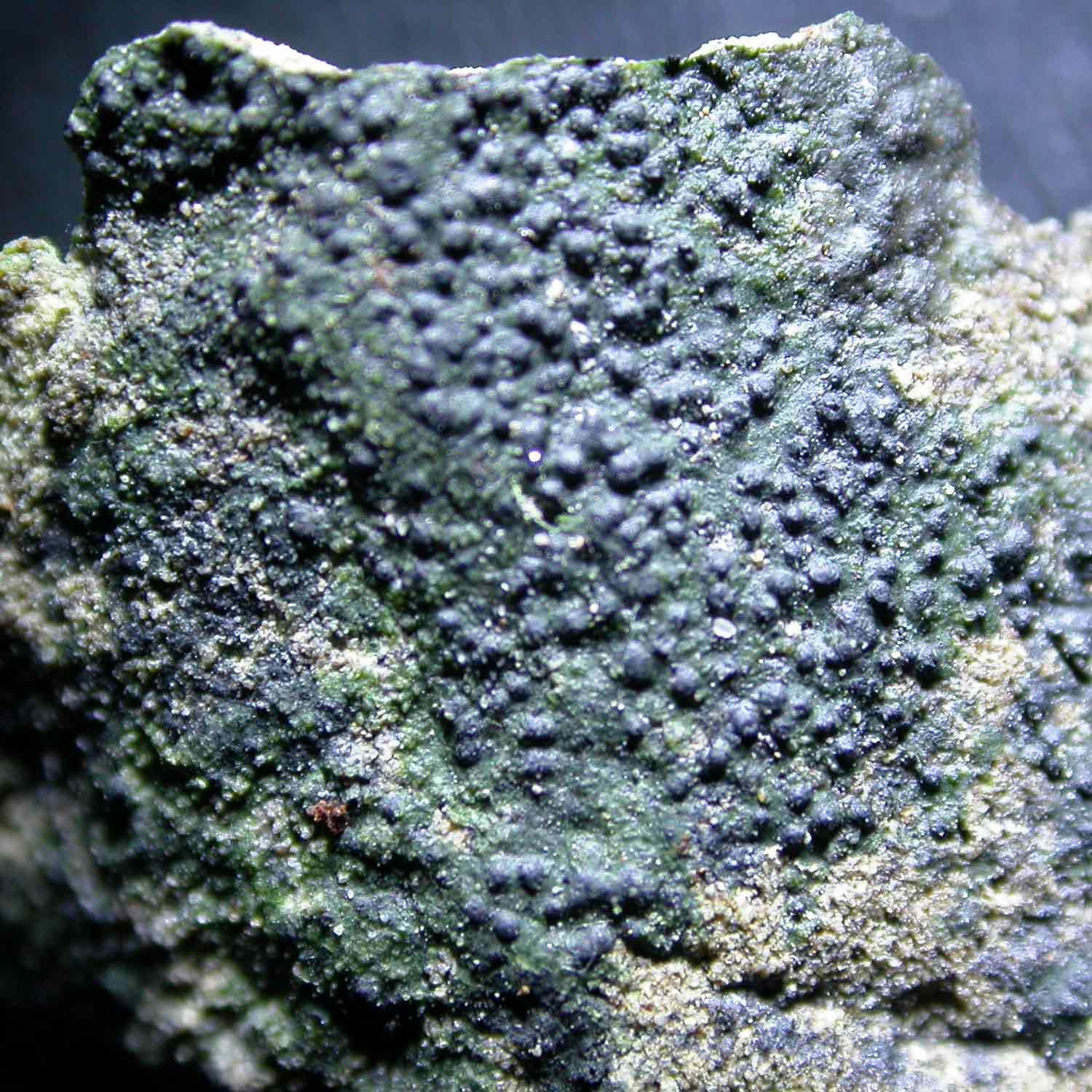
Source: https://fungi.myspecies.info/all-fungi/verrucaria-madida - Photo uploaed by Mark Powell -CC BY NC
Verrucaria madida, specimen on sandstone pebble from stream, VC 62 (NE Yorkshire). The thallus is thin, uncracked and sub-gelatinous. The perithecia form projections typically ca 300 µm diameter in this specimen.