Verrucaria sublobulata Eitner ex Servít
Stud. Bot. Čechoslov. 11, 1: 36, 1950.
Synonyms: Verrucaria sublobulata var. robustior Servít
Distribution:
Description: Thallus crustose, episubstratic, up to 200 µm thick, pale olive, greenish to greenish grey, turning pale brown after long storage in herbarium, uneven, continuous to rimose or subareolate, the margins thinning abruptly, rarely almost lobate, never subgelatinous when wet. Cortex weakly differentiated, colourless; algal layer paraplectenchymatous, the algal cells arranged in scattered groups; medulla proso- to paraplectenchymatous, rarely in part with a brown pigment, without a black basal layer. Perithecia black, very small, 0.08-0.12(-0.15) mm across, immersed to semi-immersed and then forming low projections. Involucrellum thin, either apical and often poorly developed, or reaching down to base-level and slightly spreading laterally, usually fading in lower part; exciple up to 0.15(-0.18) mm across, the wall colourless; hamathecium of up to 10 µm long periphysoids, interascal filaments absent; hymenial gel hemiamyloid, I+ red (I+ blue at very low concentrations of I), K/I+ blue. Asci 8-spored, clavate, I-, fissitunicate, the wall thickened above, with an ocular chamber, dehiscent by extrusion of an endotunica to form a delicate rostrum, Verrucaria-type, 40-60 x 14-20 μm. Ascospores 1-celled, hyaline, ellipsoid, (13.5-)16-18(-21) x (6-)7-9(-10) µm, (1.8-)2-2.4(-2.7) times as long as wide, not halonate. Pycnidia rare. Conidia 4.5-6 x c. 1.2 μm. Photobiont chlorococcoid, the cells not arranged in vertical columns. Spot tests: K-, C-, KC-, P-, UV-. Chemistry: without lichen substances. Note: a much misunderstood, but quite characteristic silicicolous amphibious species, whose European distribution is very poorly known. For further details see Thüs & Schultz (2009), Krzewicka (2012), and Orange & al. (2023). The species has been often synonymised with V. lignicola Zschacke, a name that would have priority, but in the absence of DNA data this synonymisation is not certain (see Roux & Coll. 2025). To be looked for in Italy.
Growth form: Crustose
Substrata: rocks
Photobiont: green algae other than Trentepohlia
Reproductive strategy: mainly sexual
Periodically submerged (e.g. in creeks)
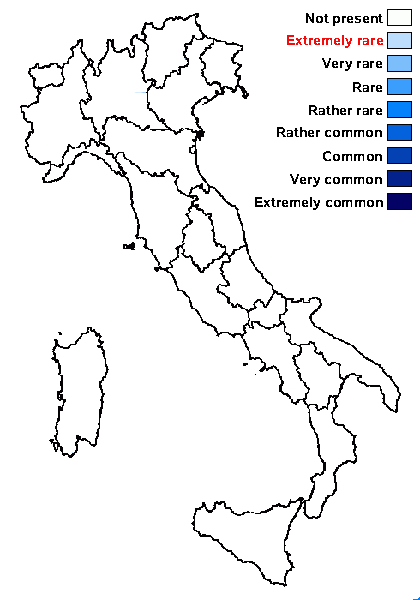
Predictive model
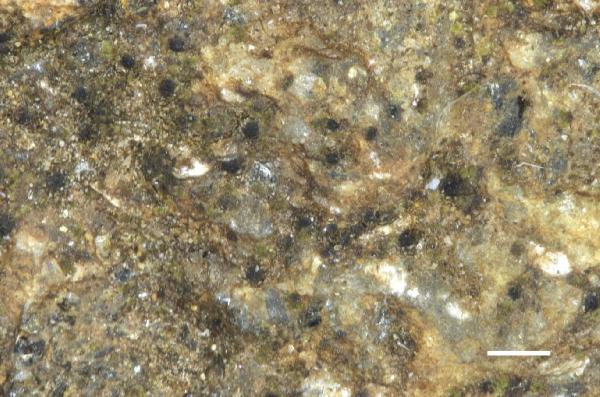
Source: Pykälä, J. 2023. Additions to the lichen flora of Finland. X. Graphis Scripta 35 (3): 14–29. Oslo. ISSN 2002- 4495 - CC BY-4.0
Pykälä 53586 (H). Scale bar = 0.5 mm.
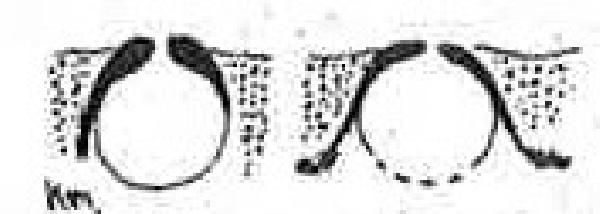
Source: Servít M. 1954a. Lichenes familiae Verrucariacearum. Prag, 249 pp.
Growth form: Crustose
Substrata: rocks
Photobiont: green algae other than Trentepohlia
Reproductive strategy: mainly sexual
Periodically submerged (e.g. in creeks)
Predictive model

Source: Pykälä, J. 2023. Additions to the lichen flora of Finland. X. Graphis Scripta 35 (3): 14–29. Oslo. ISSN 2002- 4495 - CC BY-4.0
Pykälä 53586 (H). Scale bar = 0.5 mm.