Verrucaria viridigrana Breuss
Linzer biol. Beitr., 30, 1: 278, 1998.
Synonyms:
Distribution:
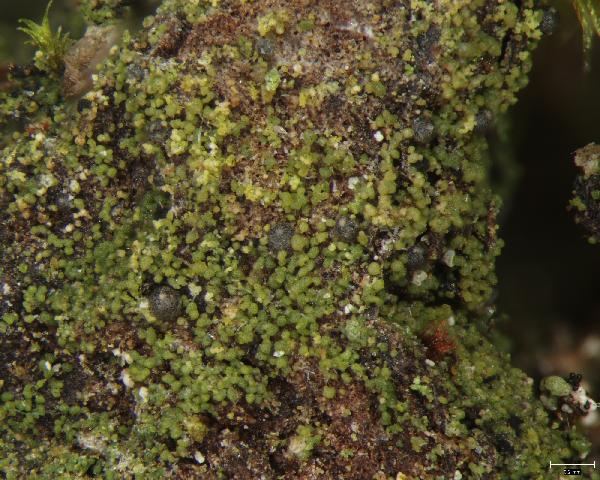
Description: Thallus crustose, episubstratic, bright green, finely granulose, consisting of 20-50 μm wide goniocysts surrounded by a colourless hyphal coat, which are often gathered into larger, coralloid to subsquamulose structures. Perithecia black, more or less pyriform, 0.18-0.3 mm wide, projecting among the granules. Involucrellum absent; exciple 25 μm thick, brown-black, at first pale at base but soon darkening throughout, with a thin colourless layer in outer part, made of 5-7 μm wide cells; hamathecium of forked periphysoids measuring 20-30 x 2.5-3 μm, interascal filaments absent; hymenial gel hemiamyloid. Asci 8-spored, clavate, I-, fissitunicate, the wall thickened above, with an ocular chamber, dehiscent by extrusion of an endotunica to form a delicate rostrum, Verrucaria-type. Ascospores 1-celled, hyaline, narrowly ellipsoid,, 20-25(-27) x 7.5-9 μm, without gelatinous appendages. Photobiont chlorococcoid. Spot tests: K-, C-, KC-, P-, UV-. Chemistry: without lichen substances.Note: a characteristic epiphytic species of shaded-humid situations, known from Austria, Slovakia and the Ukraine. To be looked for in Italy.
Growth form: Crustose
Substrata: bark
Photobiont: green algae other than Trentepohlia
Reproductive strategy: mainly sexual
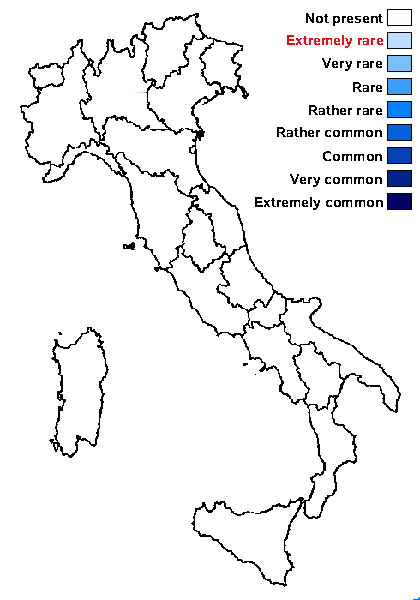
Predictive model
Growth form: Crustose
Substrata: bark
Photobiont: green algae other than Trentepohlia
Reproductive strategy: mainly sexual
Predictive model