Verrucaria epixylon Zschacke
Rabenhorst's Krypt.-Fl., 2nd ed., 9, 1.1: 260, 266, fig. 120, 1933.
Synonyms:
Distribution:
Description: Thallus crustose, episubstratic, grey to brownish, verruculose-areolate, the areoles more or less convex. Perithecia black, up to c. 0.4 mm wide, hemispherically projecting among the areoles. Involucrellum completely fused with exciple and hardly distinguishable from it; exciple globose, the wall pale brown to blackish brown in inner part, merging with the black involucrellum in outer part to form black wall; hamathecium of periphysoids, interascal filaments absent; hymenial gel hemiamyloid, I+ red (I+ blue at very low concentrations of I), K/I+ blue. Asci 8-spored, clavate, I-, fissitunicate, the wall thickened above, with an ocular chamber, dehiscent by extrusion of an endotunica to form a delicate rostrum, Verrucaria-type. Ascospores 1-celled, hyaline, broadly ellipsoid to subglobose, 8-12 x 6-8 μm. Photobiont chlorococcoid. Spot tests: K-, C-, KC-, P-, UV-. Chemistry: without lichen substances.Note: a poorly known species found on wooden fences in rural environments, only reported from the Eastern Alps (Austria), related to V. sphaerospora (Breuss 1998b). To be looked for in Italy.
Growth form: Crustose
Substrata: lignum
Photobiont: green algae other than Trentepohlia
Reproductive strategy: mainly sexual
Poorly known taxon in need of further study
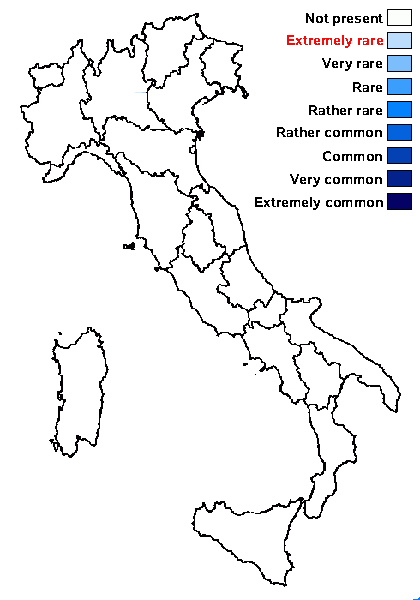
Predictive model
Growth form: Crustose
Substrata: lignum
Photobiont: green algae other than Trentepohlia
Reproductive strategy: mainly sexual
Poorly known taxon in need of further study
Predictive model