Verrucaria hegetschweileri auct. non (Naegeli ex Hepp) Garov.
Synonyms:
Distribution:
Description: Thallus crustose, very thinly episubstratic, grey-green, continuous to weakly rimose. Algal layer c. 70 µm thick. Perithecia black, rather numerous, small, 0.15-0.2 mm across, immersed in the thallus at base, projecting with the upper part. Involucrellum absent; exciple at first pale in lower part, but soon darkening throughout; hamathecium of periphysoids, interascal filaments absent; hymenial gel hemiamyloid, I+ red (I+ blue at very low concentrations of I), K/I+ blue. Asci 8-spored, clavate, I-, fissitunicate, the wall thickened above, with an ocular chamber, dehiscent by extrusion of an endotunica to form a delicate rostrum, Verrucaria-type, c. 70 µm long. Ascospores 1-celled, hyaline, elongate-ellipsoid, 14-19 x 6-8 µm. Photobiont chlorococcoid, the cells 7-10 µm wide. Spot tests: K-, C-, KC-, P-, UV-. Chemistry: without lichen substances.Note: an epiphytic species, so far known from a few localities in the Alps, to be looked for in Italy. The name, attributed to Körb. ex Nyl., is illegitimate as it post-dates V. hegetschweileri (Naegeli ex Hepp) Garov., which is a different lichen; furthermore, according to Pykälä & al. (2024), the Nylanderian material, from Switzerland is characterized by the presence of an involucrellum. This is V. hegetschweileri in the sense of Breuss (1998b).
Growth form: Crustose
Substrata: bark
Photobiont: green algae other than Trentepohlia
Reproductive strategy: mainly sexual
Poorly known taxon in need of further study
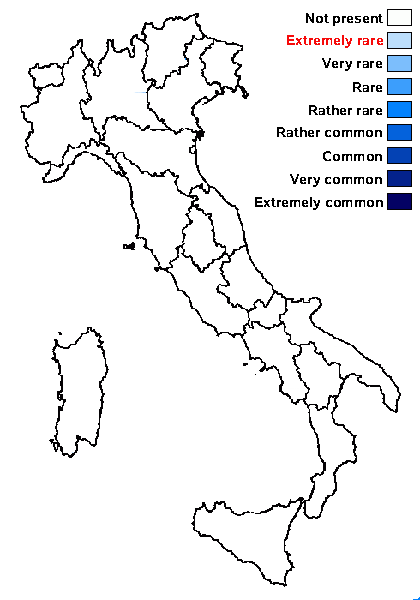
Predictive model
Growth form: Crustose
Substrata: bark
Photobiont: green algae other than Trentepohlia
Reproductive strategy: mainly sexual
Poorly known taxon in need of further study
Predictive model