Verrucaria breussii Diederich & van den Boom
Herzogia, 24, 1: 146, 2011.
Synonyms: Verrucaria sorbinea Breuss
Distribution:
Description: Thallus crustose, thinly episubstratic, uneven, grey to grey-green, continuous or subdivided into small, scattered areoles, without a distinct hypothallus. Perithecia black, broadly pyriform to subglobose, 0.15-0.25 mm across, basally more or less immersed in the bark, projecting with the upper part. Involucrellum absent; exciple 20-25 µm thick laterally, blackish in upper part, colourless to pale brown in lower part; hamathecium of short and dense periphysoids measuring c. 25 x 3-3.5 µm, interascal filaments absent; hymenial gel hemiamyloid, I+ red (I+ blue at very low concentrations of I), K/I+ blue. Asci 8-spored, clavate, I-, fissitunicate, the wall thickened above, with an ocular chamber, dehiscent by extrusion of an endotunica to form a delicate rostrum, Verrucaria-type, 55-75 x 27-35 µm. Ascospores 1-celled, hyaline, ellipsoid, (20-)23-26 x (9-)10-12.5 µm. Photobiont chlorococcoid. Spot tests: K-, C-, KC-, P-, UV-. Chemistry: without lichen substances.Note: a corticolous species known from Luxembourg (on Sorbus) and Spain (Mallorca, on Pinus halepensis and Quercus ilex). To be looked for in Italy. For nomenclatural matters see Diederich & van den Boom (2011).
Growth form: Crustose
Substrata: bark
Photobiont: green algae other than Trentepohlia
Reproductive strategy: mainly sexual
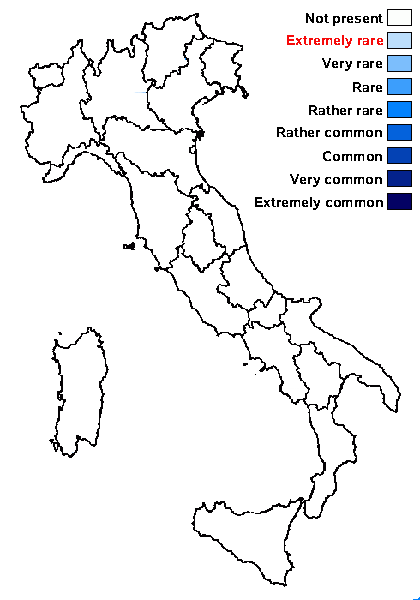
Predictive model
Growth form: Crustose
Substrata: bark
Photobiont: green algae other than Trentepohlia
Reproductive strategy: mainly sexual
Predictive model