Verrucaria phloeophila Breuss
Linzer biol. Beitr., 30, 2: 831, 1998.
Synonyms:
Distribution:
Description: Thallus crustose, thinly episubstratic, greenish brown, subdivided into small, scattered flat to slightly convex areoles, without a distinct hypothallus. Perithecia black, immersed, 0.2-0.3 mm across. Involucrellum absent; exciple 20-30 µm thick laterally, black throughout; hamathecium of periphysoids, interascal filaments absent; hymenial gel hemiamyloid, I+ red (I+ blue at very low concentrations of I), K/I+ blue. Asci 8-spored, clavate, I-, fissitunicate, the wall thickened above, with an ocular chamber, dehiscent by extrusion of an endotunica to form a delicate rostrum, Verrucaria-type, 60-75 x 23-30 µm. Ascospores 1-celled, hyaline, ellipsoid to slightly ovoid, (23-)25-30 x (11-)12-14 µm. Photobiont chlorococcoid. Spot tests: K-, C-, KC-, P-, UV-. Chemistry: without lichen substances.Note: a poorly known species growing on bark and wood, known from Portugal (on Quercus ilex) and the Carpathians (on semi-inundated wood), similar to the terricolous V. geophila but with smaller perithecia and a thinner exciple (Breuss 1998b). To be looked for in Italy.
Growth form: Crustose
Substrata: bark and lignum
Photobiont: green algae other than Trentepohlia
Reproductive strategy: mainly sexual
Poorly known taxon in need of further study
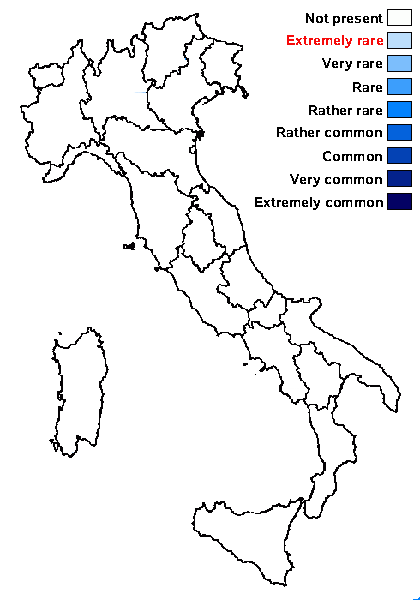
Predictive model
Growth form: Crustose
Substrata: bark and lignum
Photobiont: green algae other than Trentepohlia
Reproductive strategy: mainly sexual
Poorly known taxon in need of further study
Predictive model