Verrucaria corticola (Arnold) Servít
Acta Mus. Nat. Prag., 5B, 9, Bot. 3: 21, 1949. Basionym: Verrucaria papillosa f. corticola Arnold - Verh. Kl.-K. zool.-bot. Ges. Wien, 18: 959, 1868.
Synonyms:
Distribution:
Description: Thallus crustose, thinly episubstratic, brown to olive-brown, greenish and subgelatinous when wet, continuous, rimose or subdivided into 0.1-0.2 mm wide areoles, without a distinct hypothallus. Cortex poorly developed, 8-11 µm thick, colourless to brownish; algal layer 10-25 µm thick; medulla poorly developed, often brown at base. Perithecia black, c. 0.15 mm across, basally more or less immersed in the bark, hemispherically projecting with the upper part. Involucrellum reaching the base of the perithecium but not completely surrounding it; exciple 10-11 µm thick laterally, at first colourless but soon darkening also in lower part; hamathecium of short and dense, c. 15 µm long periphysoids, interascal filaments absent; hymenial gel hemiamyloid, I+ red (I+ blue at very low concentrations of I), K/I+ blue. Asci 8-spored, clavate, I-, fissitunicate, the wall thickened above, with an ocular chamber, dehiscent by extrusion of an endotunica to form a delicate rostrum, Verrucaria-type, 40-55 x up to 15 µm. Ascospores 1-celled, hyaline, oblong-ellipsoid, straight or slightly curved, 14-18 x (5-)6-7(-8) µm. Photobiont chlorococcoid, the cells arranged in globose clusters. Spot tests: K-, C-, KC-, P-, UV-. Chemistry: without lichen substances.Note: a poorly known epiphytic species, collected several times by Arnold in Bavaria, at the base of old trunks of Fagus. For further details see Bresuss (1998b). To be looked for in Italy.
Growth form: Crustose
Substrata: bark
Photobiont: green algae other than Trentepohlia
Reproductive strategy: mainly sexual
Poorly known taxon in need of further study
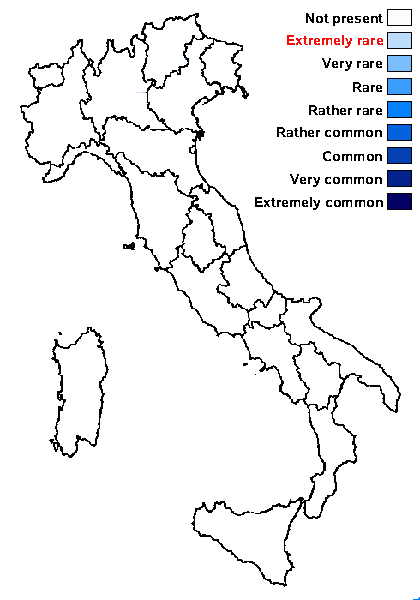
Predictive model
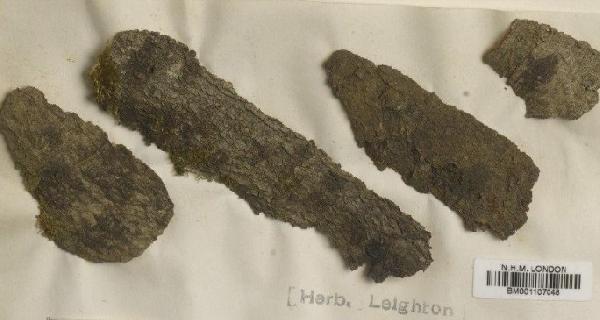
Source:https://www.europeana.eu/en/item/872/NHMUKXBOTXBM001107048
Verrucaria corticola (Arnold) Servít - 1867 - The Trustees of the Natural History Museum, London, United Kingdom - CC BY. Ferdinand Christian Gustav Arnold (collector) (field number: s.n.)
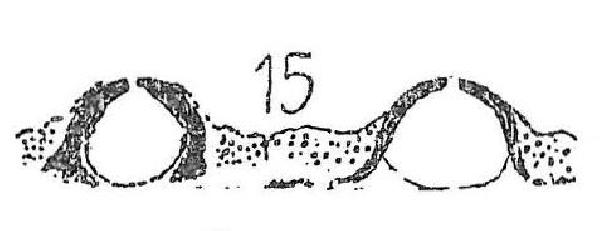
Source: Servit, M 1949: Nove nebo mene zname druhy lisejnikove celedi Verrucariaceae. Species Verrucariacearum (Lichenes) novae vel minus cognitae. - Sbornik Narodniho Musea v Praze 5(9): 1-51. Tab.1 - Public Domain
Growth form: Crustose
Substrata: bark
Photobiont: green algae other than Trentepohlia
Reproductive strategy: mainly sexual
Poorly known taxon in need of further study
Predictive model
 DOLICHENS

Source:https://www.europeana.eu/en/item/872/NHMUKXBOTXBM001107048
Verrucaria corticola (Arnold) Servít - 1867 - The Trustees of the Natural History Museum, London, United Kingdom - CC BY. Ferdinand Christian Gustav Arnold (collector) (field number: s.n.)