Placidiopsis sbarbaronis (Servít) Clauzade & Cl. Roux
Bull. Soc. bot. Centre-Ouest, n.sér., num. spec. 7: 827, 1985. Basionym: Paraplacidiopsis sbarbaronis Servít - Ann. Mus. Civ. Stor. Nat. Genova, 66: 247, 1953.
Synonyms:
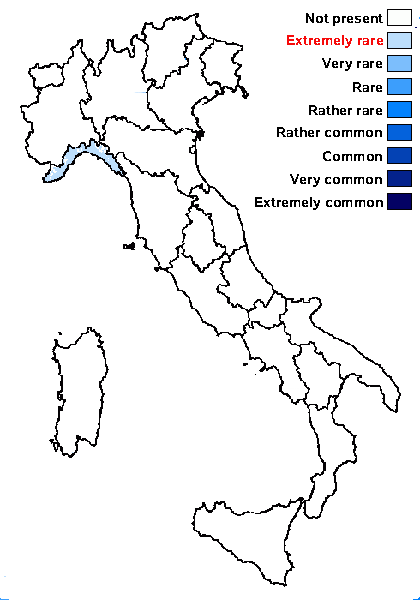
Distribution: N - Lig.
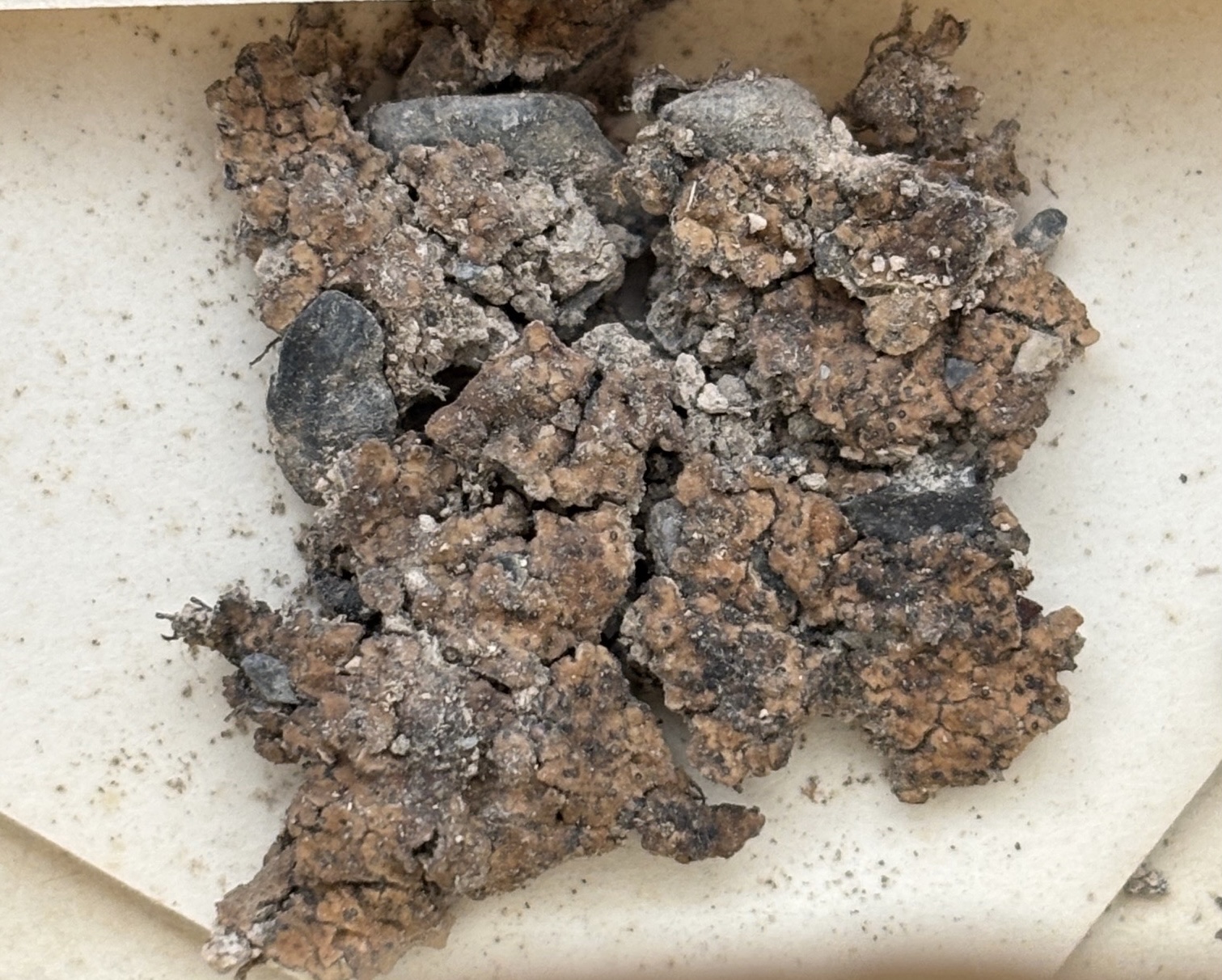
Description: Thallus minutely squamulose, the squamules up to 1.2 mm wide, flat to slightly convex, yellowish brown turning faintly olive when wet, the surface covered in smooth, up to 0.2 mm wide, convex warts, the margins crenulate to sublobulate. Upper cortex up to 15 µm thick, colourless or pale brown, consisting of up to 6 µm wide, thin-walled cells, overlain by a 10-15 µm thick epinecral layer; algal layer 60-100 µm thick, paraplectenchymatous, the algal cells arranged in vertically arranged, up to 20 µm wide glomerules; medulla white, up to 100 µm thick; lower cortex absent or poorly developed. Perithecia 2/3 immersed in the center of the squamules, the projecting part c. 0.15 µm across, convex, brown-black. Involucrellum black, appressed to the upper third of exciple, up to 40 µm thick; exciple globose, to 120 µm across, the wall c. 10 µm thick, brown-black throughout; hamathecium of c. 15 µm long periphyses, interascal filaments absent; hymenial gel hemiamyloid. Asci 8-spored, narrowly clavate, thin-walled, apically slightly thickened, with a small ocular chamber, K/I-, 40-45 x12-15 µm, with 1-2-seriately arranged spores. Ascospores 1-septate, hyaline, ellipsoid, 16-17 x 6-8 µm Photobiont chlorococcoid. Spot tests: cortex and medulla K-, C-, KC-, P-, UV-. Chemistry: without lichen substances.Note: a very poorly known species collected by Sbarbaro near Genova, on a cement wall, and only known from the type locality. Breuss (1996) could not see the type, so that its generic placement is not confirmed.
Growth form: Squamulose
Substrata: rocks
Photobiont: green algae other than Trentepohlia
Reproductive strategy: mainly sexual
Poorly known taxon in need of further study
Commonnes-rarity: (info)
Alpine belt: absent
Subalpine belt: absent
Oromediterranean belt: absent
Montane belt: absent
Submediterranean belt: extremely rare
Padanian area: absent
Humid submediterranean belt: extremely rare
Humid mediterranean belt: extremely rare
Dry mediterranean belt: absent
Predictive model
Growth form: Squamulose
Substrata: rocks
Photobiont: green algae other than Trentepohlia
Reproductive strategy: mainly sexual
Poorly known taxon in need of further study
Commonnes-rarity: (info)
Alpine belt: absent
Subalpine belt: absent
Oromediterranean belt: absent
Montane belt: absent
Submediterranean belt: extremely rare
Padanian area: absent
Humid submediterranean belt: extremely rare
Humid mediterranean belt: extremely rare
Dry mediterranean belt: absent

Predictive model