Polyblastia sbarbaronis Servít
Ann. Mus. Civ. Stor. Nat. Genova, 66: 241, 1953.
Synonyms:
Distribution: C - Tosc.
Description: Thallus crustose, thinly episubstratic, grey-brown, rimose or rimose-areolate near the perithecia, the areoles – when present - up to 0.4 mm wide, smooth, acutely angular, separated by thin fissures. Cortex up to 12 μm thick, brown and paraplectenchymatous in upper part, the cells c. 4 x 2 μm; algal layer c. 50 μm thick, inspersed with rock granules; medulla poorly developed, colourless or patchily brownish in lower part. Perithecia black, 0.3-0.4 mm across, semi immersed in 0.4-0.6 mm wide, convex thalline warts, projecting with the up to 0.2 mm wide, at first concave, then flattened upper part. Involucrellum carbonaceous, up to 60 μm thick, dimidiate, appressed to exciple; exciple up to 0.3 mm across, up to 25 μm thick in lower part, colourless except in the periostiolar area; hamathecium of 25 μm long periphysoids, interascal filaments absent; hymenial gel hemiamyloid, I+ red (I+ blue at very low concentrations of I), K/I+ blue. Asci 8-spored, clavate, K/I–, fissitunicate, the wall thickened above, with an ocular chamber, dehiscent by extrusion of an endotunica to form a delicate rostrum, 90-35 x 27-35 μm. Ascospores 3-7 transversally septate, rarely weakly submuriform with a single longitudinal septum., hyaline, oblong-ellipsoid to oblong-ovoid, 35-50 x 16-20 μm. Photobiont chlorococcoid. Spot tests: K-, C-, KC-, P-, UV-. Chemistry: without lichen substances.Note: a species which deserves further study, known only from the type collection from Saltino near Vallombrosa, at c. 1000 m, on siliceous rocks.
Growth form: Crustose
Substrata: rocks
Photobiont: green algae other than Trentepohlia
Reproductive strategy: mainly sexual
Poorly known taxon in need of further study
Commonnes-rarity: (info)
Alpine belt: absent
Subalpine belt: absent
Oromediterranean belt: absent
Montane belt: extremely rare
Submediterranean belt: absent
Padanian area: absent
Humid submediterranean belt: absent
Humid mediterranean belt: absent
Dry mediterranean belt: absent
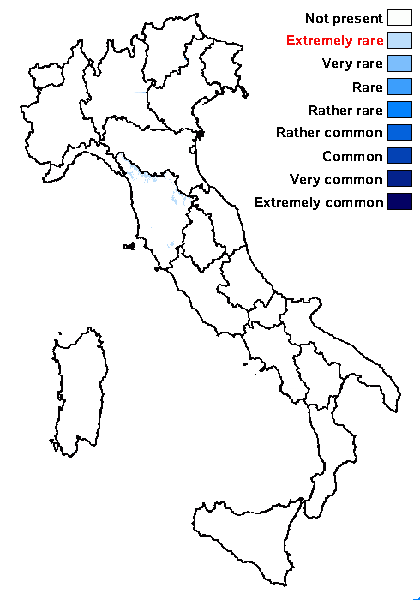
Predictive model
Herbarium samples
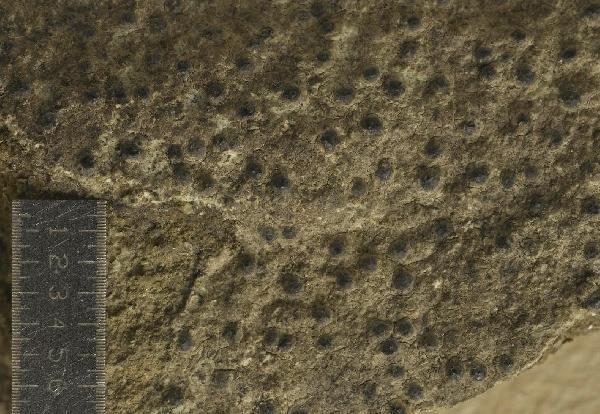
© The Trustees of the Natural History Museum, London – CC BY-SA NC 4.0
detail of BM001106564_a - isotype
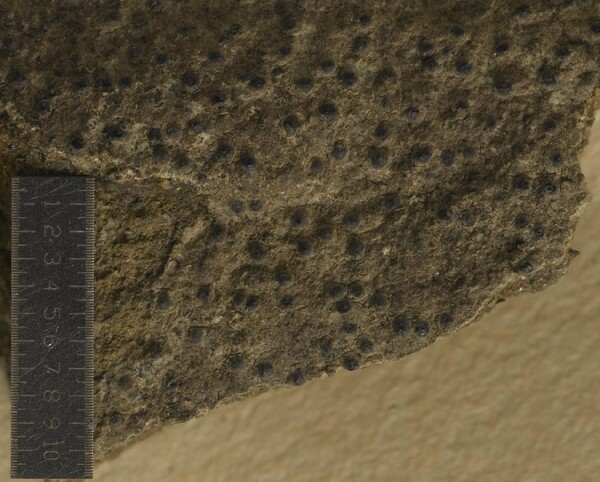
© The Trustees of the Natural History Museum, London – CC BY-SA NC 4.0
BM001106564_a - isotype
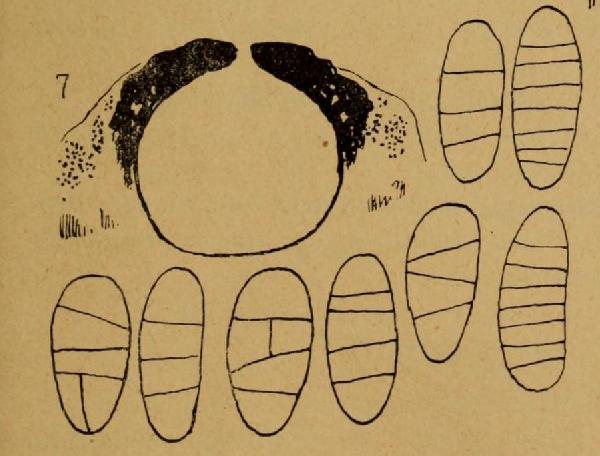
Source: Servít M. 1953. Novae lichenum Pyrenocarporum species in Italia inventae (III). Ann. Mus. Civ. St. Nat. Genova, 66: 236-249. - Public Domain
Growth form: Crustose
Substrata: rocks
Photobiont: green algae other than Trentepohlia
Reproductive strategy: mainly sexual
Poorly known taxon in need of further study
Commonnes-rarity: (info)
Alpine belt: absent
Subalpine belt: absent
Oromediterranean belt: absent
Montane belt: extremely rare
Submediterranean belt: absent
Padanian area: absent
Humid submediterranean belt: absent
Humid mediterranean belt: absent
Dry mediterranean belt: absent
Predictive model
| Herbarium samples |

© The Trustees of the Natural History Museum, London – CC BY-SA NC 4.0
detail of BM001106564_a - isotype

© The Trustees of the Natural History Museum, London – CC BY-SA NC 4.0
BM001106564_a - isotype