Lecanora pseudargentata Lumbsch
J. Hattori bot. Lab., 77: 127, 1994.
Synonyms:
Distribution:
Description: Thallus crustose, thinly episubstratic, continuous to dispersed verruculose, yellowish white to whitish grey, epruinose, without a distinct prothallus. Apothecia lecanorine, sessile to constricted at base, 0.3-1 mm across, with a red-brown, dark brown or orange-brown, not or only slightly pruinose disc and a thin, smooth to verruculose thalline margin. Thalline exciple corticate, the cortex gelatinous, c. 20 μm thick laterally and 20-35 μm basally, with large crystals visible in polarized light, which are insoluble in K (pulicaris-type), proper exciple colourless, with numerous small crystals 10-15 μm thick; epithecium red-brown, c. 10-15 μm high, chlarotera-type, i.e. with often sparse, rather coarse (1-2 μm) crystals visible under polarized light, mainly located on the paraphyses tips and usually slowly soluble in N; hymenium colourless, 75-85 μm high; paraphyses c. 1.5 μm thick, sparingly branched in upper part, with slightly thickened apical cells. hypothecium colourless. Asci 8-spored, clavate, very thin-walled, with a K/I+ blue, tall tholus penetrated by a faintly amyloid apical cushion, the wall K/I-, surrounded by a blue outer layer, Lecanora-type, 55-65 x 10-13 μm. Ascospores 1-celled, hyaline, broadly ellipsoid to ellipsoid, 8.5-12.5 x 5.5-8 μm. Photobiont chlorococcoid. Spot tests: thallus K+ yellow, C-, KC-, P+ pale yellow. Chemistry: atranorin and gangaleoidin (major); chloroatranorin, 4-dechlorogangaleoidin, and norgangaleoidin (minor or traces).Note: an epiphytic species of humid sites, resembling L. argentata, but differing in the presence of epithecial crystals; it was described from Australia but is widespread worldwide, and was recently reported also from Europe (Austria, Russia and Spain). For further details see Lumbsch (1994), LaGreca & Lumbsch (2001) and Arup & al. (2025). To be looked for in Italy.
Growth form: Crustose
Substrata: bark
Photobiont: green algae other than Trentepohlia
Reproductive strategy: mainly sexual
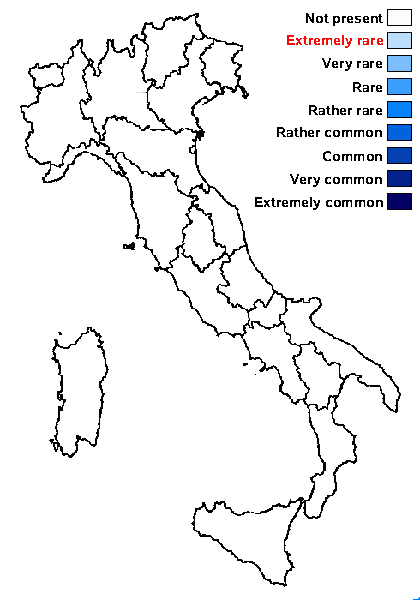
Predictive model
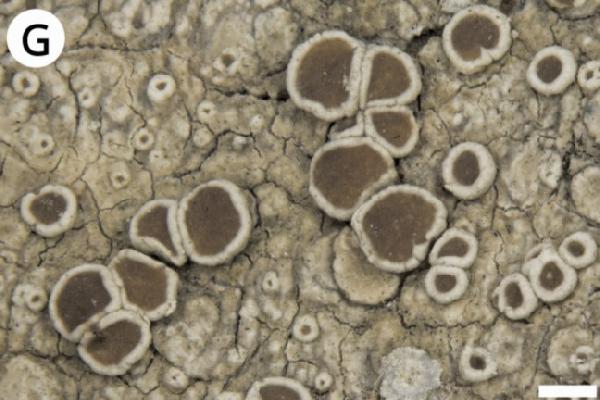
CC BY 4.0 - Source: Arup U, Malíček J, Schiefelbein U, Holien H. Lecanora hybocarpa and similar European species. The Lichenologist. 2025;57(6):239-255. doi:10.1017/S0024282925101291
L. pseudargentata (Vondrák 22871, PRA). - Scale bar: 0.5 mm
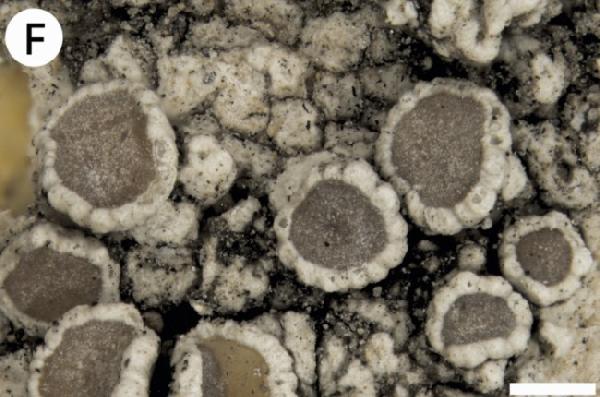
CC BY 4.0 - Source: Arup U, Malíček J, Schiefelbein U, Holien H. Lecanora hybocarpa and similar European species. The Lichenologist. 2025;57(6):239-255. doi:10.1017/S0024282925101291
L. pseudargentata, holotype
(GZU). - Scale bar: 0.5 mm
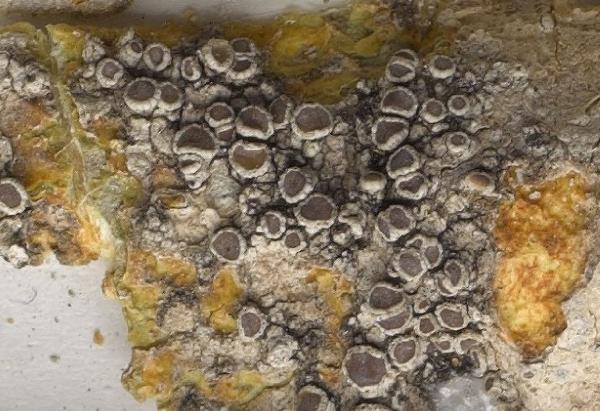
Detail from: https://gzu.jacq.org/GZU000290848
GZU000290848 - Hafellner,J. & Rogers,R.W. 18604a - 1986-08-22 Label Australia, Queensland: NE of Gunalda, about 59 km S of Maryborough, E of Hwy 1 ; Alt. 180 m
Habitat on trees in a grazing ground, Ficus
Growth form: Crustose
Substrata: bark
Photobiont: green algae other than Trentepohlia
Reproductive strategy: mainly sexual
Predictive model

CC BY 4.0 - Source: Arup U, Malíček J, Schiefelbein U, Holien H. Lecanora hybocarpa and similar European species. The Lichenologist. 2025;57(6):239-255. doi:10.1017/S0024282925101291
L. pseudargentata (Vondrák 22871, PRA). - Scale bar: 0.5 mm

CC BY 4.0 - Source: Arup U, Malíček J, Schiefelbein U, Holien H. Lecanora hybocarpa and similar European species. The Lichenologist. 2025;57(6):239-255. doi:10.1017/S0024282925101291
L. pseudargentata, holotype (GZU). - Scale bar: 0.5 mm