Verrucaria austriaca Riedl
Linzer biol. Beitr., 22, 1: 154, 1990.
Synonyms: Verrucaria irrigua Zschacke non Taylor
Distribution:
Description: Thallus crustose, hemiendosubstratic, pale grey, weakly rimose to subareolate. Perithecia black, mostly immersed, 0.2-0.25 mm across. Involucrellum absent; exciple black-brown in upper part, colourless in lower part; hamathecium of periphysoids, interascal filaments absent; hymenial gel hemiamyloid, I+ red (I+ blue at very low concentrations of I), K/I+ blue. Asci 8-spored, subcylindrical to oblong-clavate, I-, fissitunicate, the wall thickened above, 70-75 x 16-18 µm, Verrucaria-type. Ascospores 1-celled, hyaline, ellipsoid, 16-18 x 7.5-8 µm. Photobiont chlorococcoid. Spot tests: K-, C-, KC-, P-, UV-. Chemistry: without lichen substances.Note: a calcicolous freshwater species, only known from the type collection in the Eastern Alps (Austria, Sonntagsberge bei Rosenau). For the main diffrerences with similar species see Thüs & Schultz (2009). To be loooked fron in the Italian Alps.
Growth form: Crustose
Substrata: rocks
Photobiont: green algae other than Trentepohlia
Reproductive strategy: mainly sexual
Periodically submerged (e.g. in creeks)
Poorly known taxon in need of further study
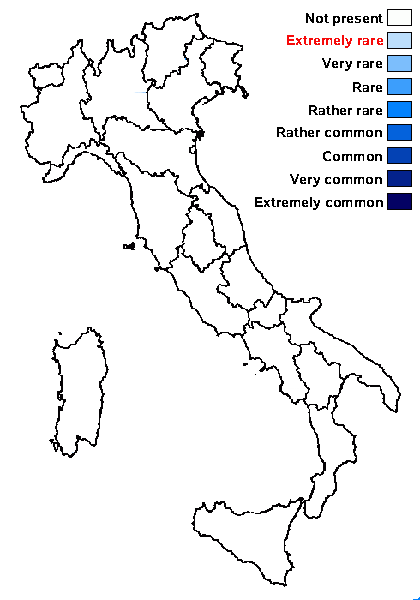
Predictive model

Source: https://www.europeana.eu/en/item/11601/HERBARWXNHMVXAUSTRIAX540119
Verrucaria austriaca Riedl - Natural History Museum, Vienna, Austria - CC BY-SA. Strasser,P. (collector) H. Thüs 2008 (identifier)
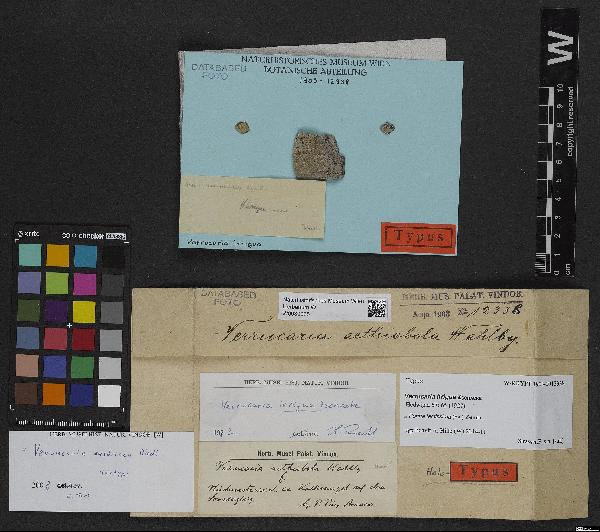
Source: https://www.europeana.eu/en/item/11601/HERBARWXNHMVXAUSTRIAX540119
Verrucaria austriaca Riedl - Natural History Museum, Vienna, Austria - CC BY-SA. Strasser,P. (collector) H. Thüs 2008 (identifier)
Growth form: Crustose
Substrata: rocks
Photobiont: green algae other than Trentepohlia
Reproductive strategy: mainly sexual
Periodically submerged (e.g. in creeks)
Poorly known taxon in need of further study
Predictive model

Source: https://www.europeana.eu/en/item/11601/HERBARWXNHMVXAUSTRIAX540119
Verrucaria austriaca Riedl - Natural History Museum, Vienna, Austria - CC BY-SA. Strasser,P. (collector) H. Thüs 2008 (identifier)