Verrucaria selecta Servít
Stud. Bot. Čechoslov., 11, 3: 124, 1950.
Synonyms:
Distribution:
Description: Thallus crustose, hemiendosubstratic, dull pale beige to brown, sometimes delimited by a dark prothallus, irregularly rimose-areolate, the areoles polygonal, 0.3-0.8 mm wide. Epinecral layer absent or very thin; cortex poorly evident, the 40-50 μm thick algal layer often reaching the surface; medulla poorly developed, not forming a black basal layer, densely inspersed with crystals. Perithecia black, up to 300/cm2, half immersed in the thallus, forming 0.3-0.4 mm wide hemispherical projections. Involucrellum compact, 60-80(-100) µm thick laterally, reaching to base-level and encircling the whole perithecium but thinner, slightly paler and diffuse in lowermost part; exciple 0.2-0.25 mm across, globose, the wall colourless to pale brown, c. 10 μm thick; hamathecium of 20-30 μm long periphysoids, interascal filaments absent; hymenial gel hemiamyloid, I+ red (I+ blue at very low concentrations of I), K/I + blue. Asci 8-spored, pyriform to obovate, I-, fissitunicate, the wall thickened above, with an ocular chamber, dehiscent by extrusion of an endotunica to form a delicate rostrum, Verrucaria-type. Ascospores 1-celled, hyaline, broadly ellipsoid, (13-)14-18(-20) x 8-11 μm. Photobiont chlorococcoid. Spot tests: K-, C-, KC-, P-, UV-. Chemistry: without lichen substances.Note: a calcicolous species of the montane-subalpine belt, only reported from a few scattered localities in the Eastern Alps (Austria). For further details see Breuss & Berger (2010). To be looked for in Italy.
Growth form: Crustose
Substrata: rocks
Photobiont: green algae other than Trentepohlia
Reproductive strategy: mainly sexual
Poorly known taxon in need of further study
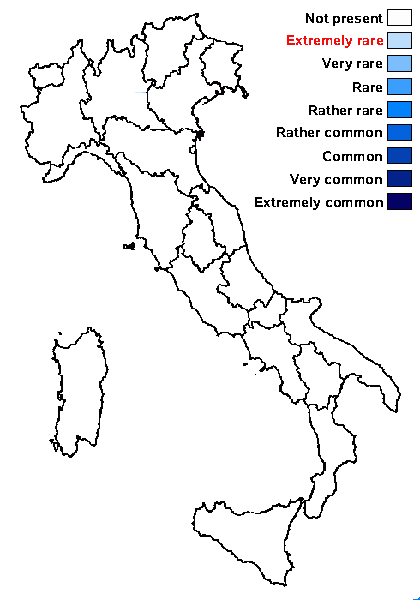
Predictive model
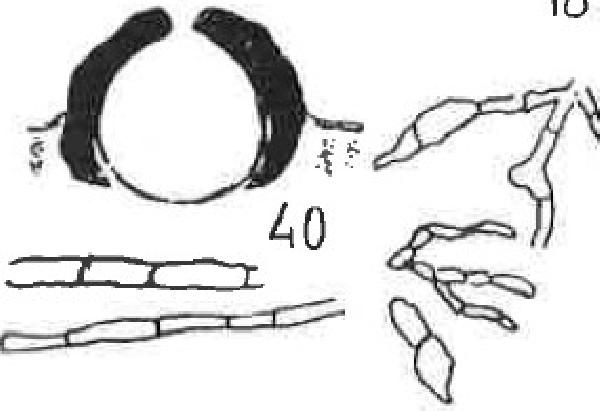
Source: Servít M. 1950b. The new lichens of the Pyrenocarpae-group III. Studia Bot. Cechoslov. 11, (1-2): 7-41.
Growth form: Crustose
Substrata: rocks
Photobiont: green algae other than Trentepohlia
Reproductive strategy: mainly sexual
Poorly known taxon in need of further study
Predictive model