Verrucaria pilosoides Servít
Preslia, 24: 370, 1952.
Synonyms:
Distribution:
Description: Thallus crustose, hemiendosubstratic, the epilithic part very thin (up to 150 μm) continuous, indistinctly rimose or consisting of scattered flecks, whitish, beige or pale brown, at high magnification appearing minutely brown-spotted. Cortex very thin; algal layer 20-30 μm thick; medulla poorly evident, the thallus filled by crystals. Perithecia black, slightly immersed in the rock at base and hemispherically projecting, 0.3-0.4 mm across, with a punctiform ostiole. Involucrellum 30-50 μm thick, sometimes thinner in lower part, dimidiate or often reaching to base-level, strongly diverging from exciple; exciple globose, 0.2-0.25 mm across, colourless to very pale brown; hamathecium of delicate periphysoids measuring 25-30 x c. 1 µm, interascal filaments absent; hymenial gel hemiamyloid, I+ red (I+ blue at very low concentrations of I), K/I + blue. Asci 8-spored, broadly clavate, I-, fissitunicate, the wall thickened above, with an ocular chamber, dehiscent by extrusion of an endotunica to form a delicate rostrum, Verrucaria-type. Ascospores 1-celled, hyaline, ellipsoid to ovoid, 16-21 x 8-11 μm. Photobiont chlorococcoid. Spot tests: K-, C-, KC-, P-, UV-. Chemistry: without lichen substances.Note: a calcicolous species of rather humid sites, known from a few low-elevation sites in the Eastern Alps (Austria, see Breuss & Berger 2010), and from the French Alps (Oïhnéart & al. 2018). To be looked for in Italy.
Growth form: Crustose
Substrata: rocks
Photobiont: green algae other than Trentepohlia
Reproductive strategy: mainly sexual
Poorly known taxon in need of further study
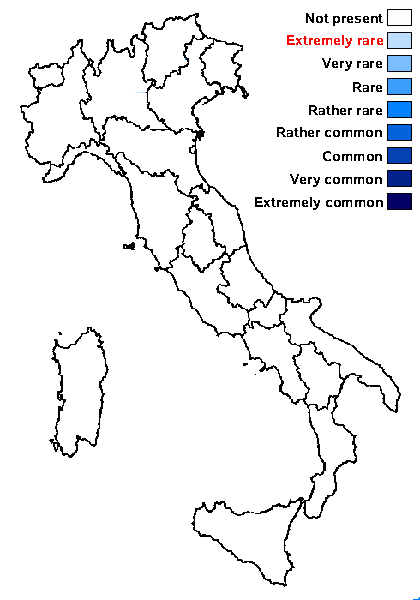
Predictive model
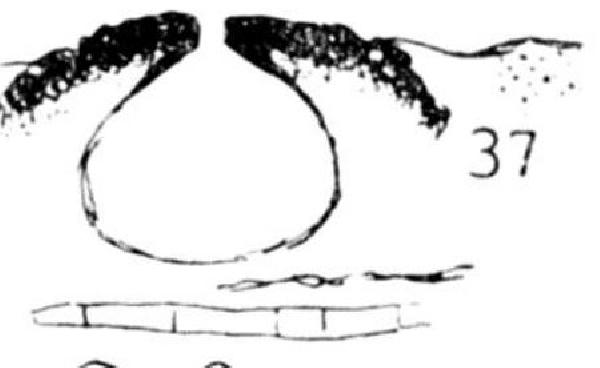
Source: Servít M. Nové a málo známé druhy z čeledí Verrucariaceae a Dermatocarpaceae. Preslia 24: 245-390, 1952, Tab. 2 – Public Domain
Growth form: Crustose
Substrata: rocks
Photobiont: green algae other than Trentepohlia
Reproductive strategy: mainly sexual
Poorly known taxon in need of further study
Predictive model