Verrucaria andesiatica Servít
Stud. Bot. Čechoslov., 11, 1: 14, 1950.
Synonyms:
Distribution:
Description: Thallus crustose, thinly episubstratic, 0.02-0.05 mm thick continuous and smooth to finely rimose around the perithecia, pale to grey-green to pale brown, subgelatinous when wet. Cortex poorly developed; algal cells not arranged in vertical columns; medulla very thin, paraplectenchymatous, not forming a black basal layer. Perithecia almost completely covered with a thin thalline layer, forming (0.3-)0.35-0.5(-0.7) mm wide projections. Involucrellum < 35 μm thick, conical, reaching to base-level and there spreading, the space between its base and the exciple colourless; exciple (0.1-)0.2-0.33 mm across, the wall colourless except at apex; hamathecium of 25-30 μm long periphysoids, interascal filaments absent; hymenial gel hemiamyloid, I+ red (I+ blue at very low concentrations of I), K/I+ blue. Asci 8-spored, pyriform to obovate, I-, fissitunicate, the wall thickened above, with an ocular chamber, dehiscent by extrusion of an endotunica to form a delicate rostrum, Verrucaria-type, 60-80 x 22-28 μm. Ascospores 1-celled, hyaline, ellipsoid, (20-)23-27(-31) x (9.5-)11-13(-15) μm. Photobiont chlorococcoid. Spot tests: K-, C-, KC-, P-, UV-. Chemistry: without lichen substances.Note: a very poorly known and often misundertood silicicolous, amphibious species, with a few records in Central Europe and the Alps of France and Switzerland (records from the British Isles refer to V. elaeomelaena, see Orange & al. 2023). This is at least V. andesiatica in the sense of Thüs & Schultz (2009), and Krzewicka (2012). However, according to Thüs & al. (2015) the type material is in very poor condition, and the name should be best considered as a nomen dubium.
Growth form: Crustose
Substrata: rocks
Photobiont: green algae other than Trentepohlia
Reproductive strategy: mainly sexual
Periodically submerged (e.g. in creeks)
Poorly known taxon in need of further study
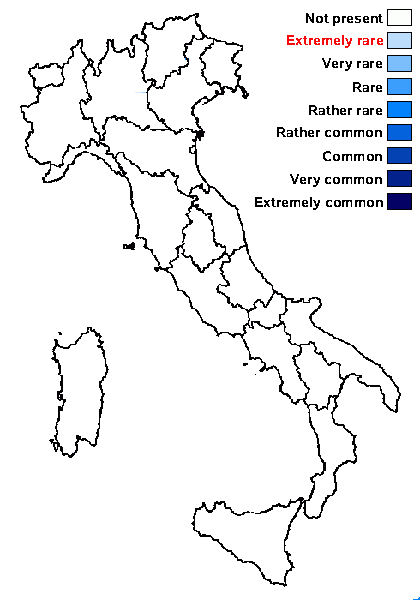
Predictive model
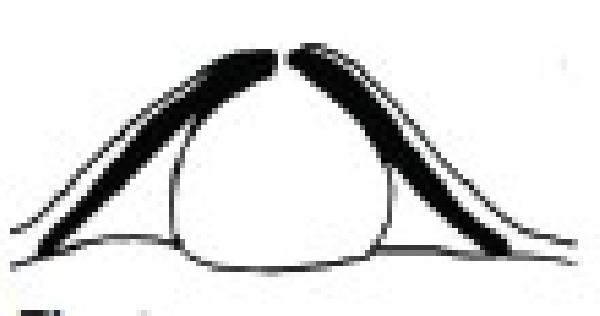
Source: Thüs H., Schultz M. 2009. Fungi: Lichens 1. In: Süßwasserflora Von Mitteleuropa. Spektrum Akademischer Verlag, Heidelberg, Germany. 223 pp.
Drawing from the type
Growth form: Crustose
Substrata: rocks
Photobiont: green algae other than Trentepohlia
Reproductive strategy: mainly sexual
Periodically submerged (e.g. in creeks)
Poorly known taxon in need of further study
Predictive model