Verrucaria bernaicensis Malbr.
Denkschr. kgl. bayer. bot. Ges., 5: 307, 1869.
Synonyms:
Distribution:
Description: Thallus crustose or subsquamulose, areolate, pale grey, epruinose, the areoles minutely wrinkled. flat to slightly convex, when young separated by rather broad fissures, the sterile ones up to 0.2 mm thick, the fertile ones up to 0.4 mm thick, 0.3-0.7 mm wide, but sometimes irregularly divided into smaller units forming a verruculose thallus, slightly constricted and elongated at base into a kind of basal stipe (2-3 times as thick as the rest of the areole) which leaves a cavity when the areole falls off. Cortex indistinct, formed by a single layer of brown, 3-6 µm wide cells, with a 10-60 µm thick, hyaline epinecral layer; algal layer subparaplectenchymatous, filling almost the whole thallus; medulla with tiny substrate particles, the central hyphae hyaline, perpendicular, forming the basal stipe. Perithecia black, largely immersed, projecting only with the uppermost part. Involucrellum absent; exciple 0.2-0.3 mm wide, subglobose, the wall c. 15 µm thick, at first colourless except around the ostiole, later blackening all around; hamathecium of periphysoids measuring 20-25 x 2-2.5 µm; hymenial gel hemiamyloid, I+ red (I+ blue at very low concentrations of I), K/I+ blue. Asci 8-spored, clavate, fissitunicate, the wall not amyloid, not or only slightly thickened above, Verrucaria-type. Ascospores 1-celled, hyaline, broadly ellipsoid to subglobose. 9-12 x 7-9(-10) µm. Pycnidia 50-80 µm across, with an irregularly sunken mouth. Conidia bacilliform, 6-7.5 x c. 1 µm. Photobiont chlorococcoid, the cells 6-12 µm wide. Spot tests: K-, C-, KC-, P-, UV-. Chemistry: without lichen substances.Note: a long-forgotten species growing on soft, weathered, more or less calciferous rocks, sometimes also on thin soil layers, described from France and also known from the Czech Republic, the Ukraine, the Caucasus, and Western North America. The description mainly follows Breuss (2007). To be looked for in Italy.
Growth form: Crustose
Substrata: rocks, soil, terricolous mosses, and plant debris
Photobiont: green algae other than Trentepohlia
Reproductive strategy: mainly sexual
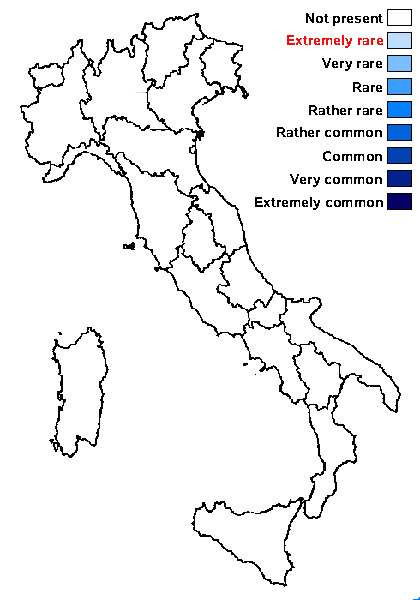
Predictive model
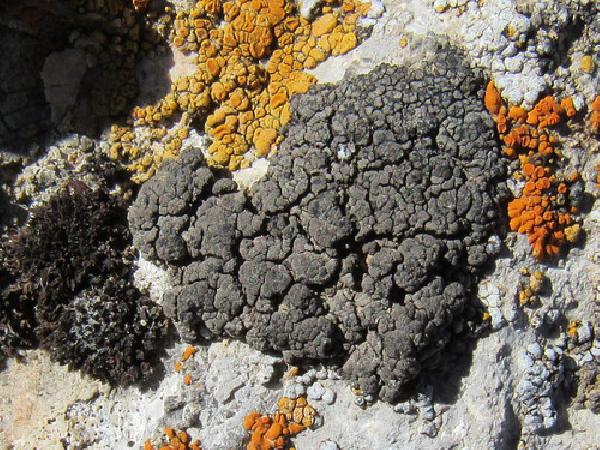
Igor Yevdokimov - CC BY-NC - Source: https://inaturalist.nz/photos/450562047
Kazakhstan , Tulkibas district
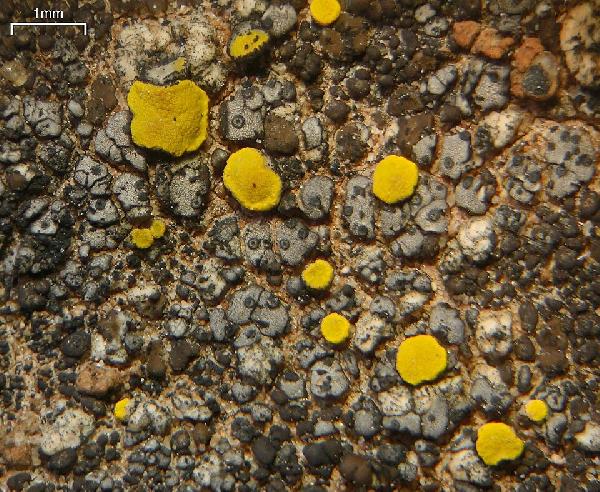
Jason Hollinger CC BY-SA 3.0- https://mushroomobserver.org/image/show_image/603236?obs=234000&q=1nEfo
USA, French Spring Canyon, Wayne Co., Utah, USA. Image is stacked, at 20X magnification.
Growth form: Crustose
Substrata: rocks, soil, terricolous mosses, and plant debris
Photobiont: green algae other than Trentepohlia
Reproductive strategy: mainly sexual
Predictive model

Igor Yevdokimov - CC BY-NC - Source: https://inaturalist.nz/photos/450562047
Kazakhstan , Tulkibas district