Verrucaria invenusta H. Magn.
Ark. Bot., Ser. 2, 2: 50, 1952.
Synonyms:
Distribution:
Description: Thallus crustose, thinly episubstratic, medium brown to ash-grey, soft and gelatinous when wet, patchily discontinuous and fleck-like to almost continuous, uneven, without a distinct prothallus. Perithecia black, slightly to half-immersed and hemispherically projecting, almost completely covered with a thin thalline layer. Involucrellum 40-60 μm thick, covering ½-2/3 of the perithecium, sometimes extending to base-level; exciple colourless to brownish, subglobose, 0.25-0.35 mm across; hamathecium of rather coarse periphysoids measuring (20-)25-30 x c. 2 μm, interascal filaments absent; hymenial gel hemiamyloid, I+ red (I+ blue at very low concentrations of I), K/I+ blue. Asci 8-spored, clavate, I-, fissitunicate, the wall thickened above, with an ocular chamber, dehiscent by extrusion of an endotunica to form a delicate rostrum, Verrucaria-type, 60-70 x 19-25 μm. Ascospores 1-celled, hyaline, ellipsoid, 17-22(-25) x (7-)9-12 μm. Photobiont chlorococcoid. Spot tests: K-, C-, KC-, P-, UV-. Chemistry: without lichen substances. Note: a rarely-collected species, reported from Sweden, Finland and Russia, with a record from Switzerland, closely related to V. ahtii, but mainly silicicolous and without a distinct prothallus. For further details see Pykälä & Breuss (2009), Muchnik & Breuss (2015), and Oïhénart & al. (2018). To be looked for in Italy.
Growth form: Crustose
Substrata: rocks
Photobiont: green algae other than Trentepohlia
Reproductive strategy: mainly sexual
Poorly known taxon in need of further study
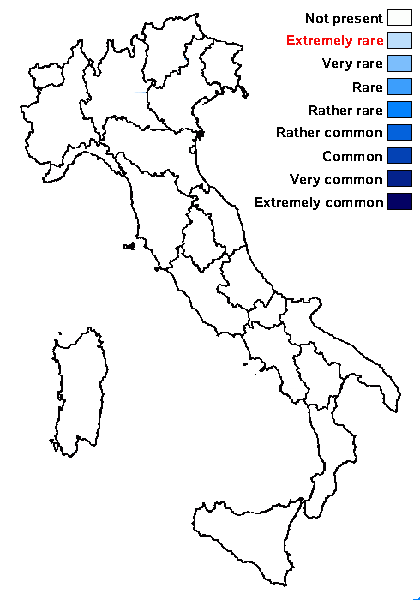
Predictive model
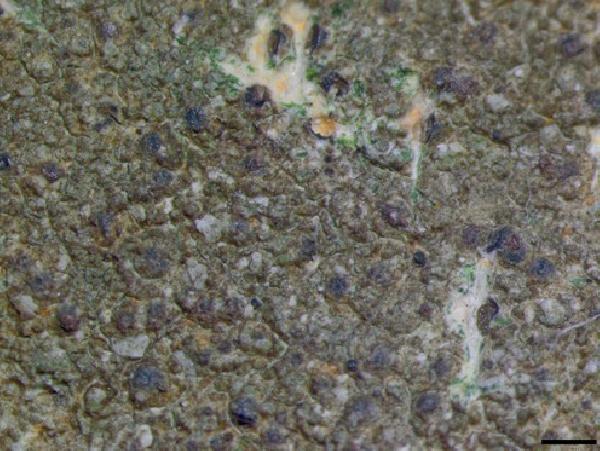
Source: Muchnik E. & Breuss O. (2015) Herzogia 28:746-752 New and noteworthy records of Verrucariaceae (lichenised Ascomycota) from central European Russia.
Verrucaria invenusta. Thallus with perithecia (Muchnik s.n., 02.06.13, LI). Scale bar: 500 µm.
Growth form: Crustose
Substrata: rocks
Photobiont: green algae other than Trentepohlia
Reproductive strategy: mainly sexual
Poorly known taxon in need of further study
Predictive model