Verrucaria praeviridula Nyl.
Flora, 68: 297, 1885.
Synonyms:
Distribution:
Description: Thallus crustose, thinly episubstratic, green, continuous or partially finely rimose, especially near the perithecia. Perithecia black, half-immersed in the thallus, forming 0.15-0.2 mm wide projections, the base not immersed in the rock. Involucrellum thick, limited to upper third of the perithecium, appressed to exciple; exciple colourless; hamathecium of periphysoids, interascal filaments absent; hymenial gel hemiamyloid, I+ red (I+ blue at very low concentrations of I), K/I+ blue. Asci 8-spored, clavate, I-, fissitunicate, the wall thickened above, with an ocular chamber, dehiscent by extrusion of an endotunica to form a delicate rostrum, Verrucaria-type. Ascospores 1-celled, hyaline, ellipsoid, 10-12 x 5-7 μm. Photobiont chlorococcoid. Spot tests: K-, C-, KC-, P-, UV-. Chemistry: without lichen substances.Note: a rarely collected, poorly known species growing on calcareous rocks in shaded-humid situations, related to V. glaucodes, differing mainly in the smaller spores. To be looked for in Italy.
Growth form: Crustose
Substrata: rocks
Photobiont: green algae other than Trentepohlia
Reproductive strategy: mainly sexual
Poorly known taxon in need of further study
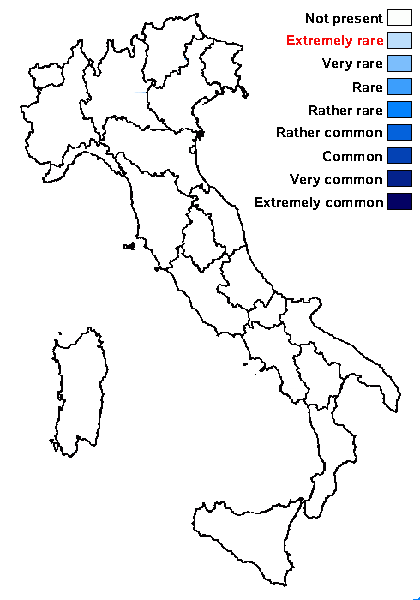
Predictive model
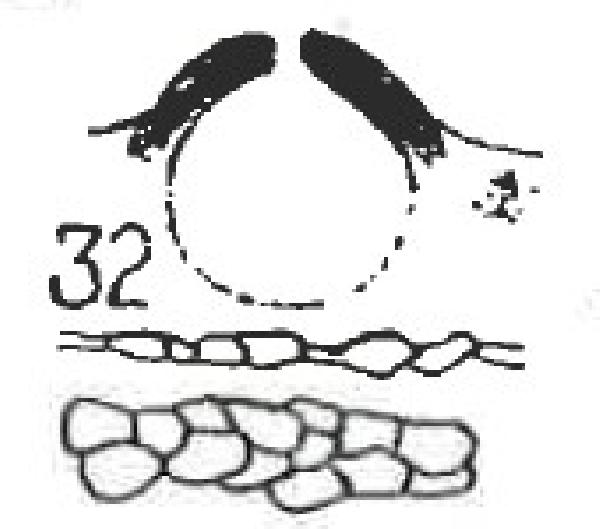
Source: Servít M. 1950b. The new lichens of the Pyrenocarpae-group III. Studia Bot. Cechoslov. 11, (1-2): 7-41.
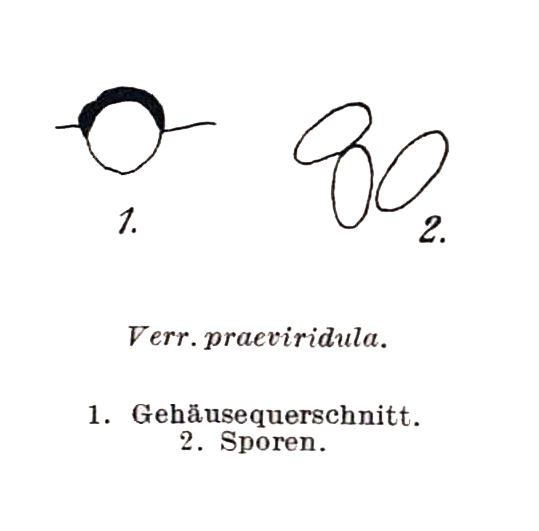
Zschacke, H. (1934) Epigloeaceae, Verrucariaceae und Dermatocarpaceae. In: Dr. L. Rabenhorst‘s Kryptogamen-Flora, Band 9, Abt. 1, Teil 1. Akademische Verlagsgesellschaft, Leipzig, 695 pp. - Public Domain
Growth form: Crustose
Substrata: rocks
Photobiont: green algae other than Trentepohlia
Reproductive strategy: mainly sexual
Poorly known taxon in need of further study
Predictive model
Source: Servít M. 1950b. The new lichens of the Pyrenocarpae-group III. Studia Bot. Cechoslov. 11, (1-2): 7-41.