Verrucaria slovaca Servít
Stud. Bot. Čechoslov., 11, 3: 125, 1950.
Synonyms:
Distribution:
Description: Thallus crustose, fully endosubstratic, of the same colour as the rock. Perithecia black, 0.25-0.35 mm across, 1/3-1/2 hemispherically projecting, rarely fully immersed in the rock, often with a thalline annulus and separated by a cleft from the thallus, the base leaving deep pits in the rock. Involucrellum appressed to exciple or slightly diverging in lower part, reaching to base-level, laterally 70-100 µm thick, not becoming thicker in lower part; exciple subglobose, 0.15-0.25 mm across, the wall colourless to pale brown; hamathecium of periphysoids measuring c. 25 x 2-2.5 µm, interascal filaments absent; hymenial gel hemiamyloid, I+ red (I+ blue at very low concentrations of I), K/I+ blue. Asci 8-spored, clavate, I-, fissitunicate, the wall thickened above, with an ocular chamber, dehiscent by extrusion of an endotunica to form a delicate rostrum, Verrucaria-type. Ascospores 1-celled, hyaline, oblong-ellipsoid, (22-)24-29(-30) x (7.5-)9-11(-12) µm. Photobiont chlorococcoid. Spot tests: K-, C-, KC-, P-, UV-. Chemistry: without lichen substances. Note: a long-neglected, probably more widespread calcicolous species of rather shaded situations, known from a few montane. subalpine localities in Slovakia, Slovenia and France. For further details see Breuss (2016) and Pykälä & al. (2020). To be looked for in Italy.
Growth form: Crustose
Substrata: rocks
Photobiont: green algae other than Trentepohlia
Reproductive strategy: mainly sexual
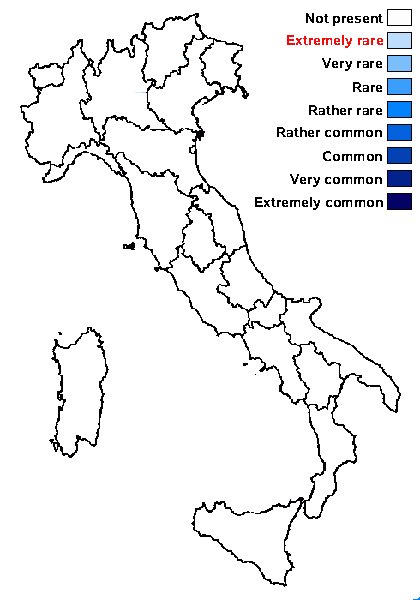
Predictive model
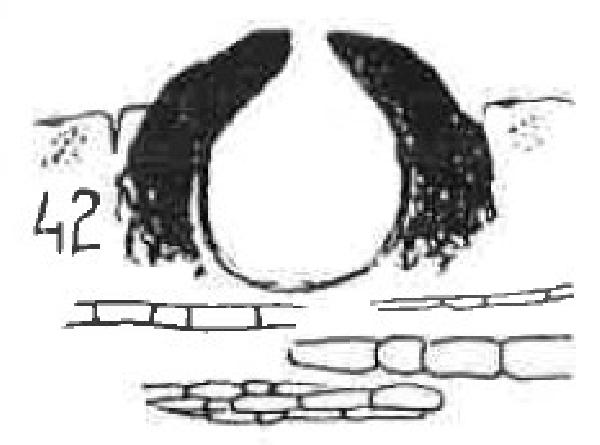
Source: Servít M. 1950b. The new lichens of the Pyrenocarpae-group III. Studia Bot. Cechoslov. 11, (1-2): 7-41.
Growth form: Crustose
Substrata: rocks
Photobiont: green algae other than Trentepohlia
Reproductive strategy: mainly sexual
Predictive model