Verrucaria subtruncatula B. de Lesd.
Recherch. Lich. Dunkerque: 241, 1910.
Synonyms:
Distribution:
Description: Thallus crustose, thinly episubstratic, rimose-areolate, whitish to pale grey. Perithecia black, innate, the apical part visible as flattened, 0.2-0.5 mm wide projection. Involucrellum black, thick, dimidiate, appressed to exciple; exciple globose, the wall dark brown in upper part, pale brown to colourless in lower part; hamathecium of periphysoids, interascal filaments absent; hymenial gel hemiamyloid, I+ red (I+ blue at very low concentrations of I), K/I+ blue. Asci 8-spored, clavate, I-, fissitunicate, the wall thickened above, with an ocular chamber, dehiscent by extrusion of an endotunica to form a delicate rostrum, Verrucaria-type. Ascospores 1-celled, hyaline, oblong-ellipsoid, (23-)25-30(-34) x 10-13 μm. Photobiont chlorococcoid. Spot tests: K-, C-, KC-, P-, UV-. Chemistry: without lichen substances.Note: a poorly known species described from northwestern France and reported from a few localities in Europe, incl. the French Alps (Roux & Coll. 2025); it grows on calcareous pebbles, sometimes also on bricks, at low elevations. To be looked for in Italy.
Growth form: Crustose
Substrata: rocks
Photobiont: green algae other than Trentepohlia
Reproductive strategy: mainly sexual
Poorly known taxon in need of further study
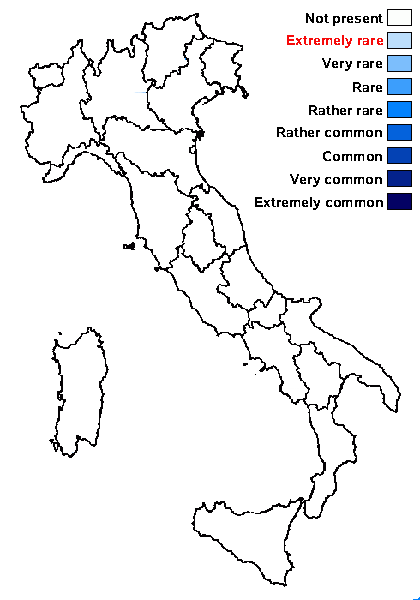
Predictive model
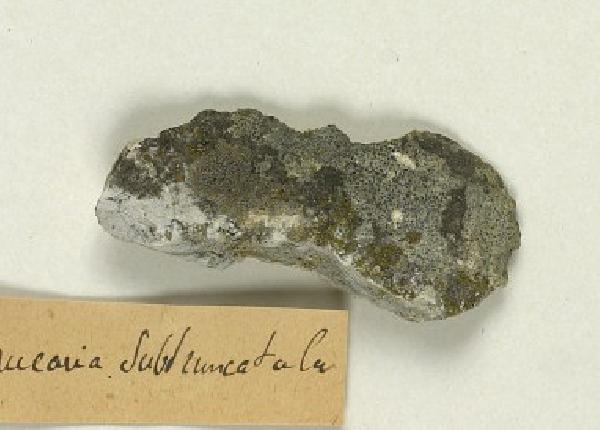
Source: lichenportal.org/portal/collections/individual/index.php?occid=2779273
France
Collector: M. Bouly de Lesdain
Number: s.n.
Date: 1904-04-01
Verbatim Date: 01 Apr 1904
Locality: Hauts-de-France, Nord, Nord berg du canal de East Africatans, Dunkerque. - ISOTYPE
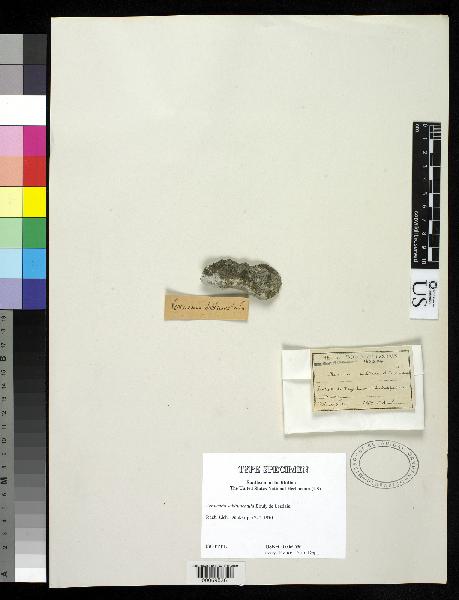
Source: lichenportal.org/portal/collections/individual/index.php?occid=2779273
France
Collector: M. Bouly de Lesdain
Number: s.n.
Date: 1904-04-01
Verbatim Date: 01 Apr 1904
Locality: Hauts-de-France, Nord, Nord berg du canal de East Africatans, Dunkerque. - ISOTYPE
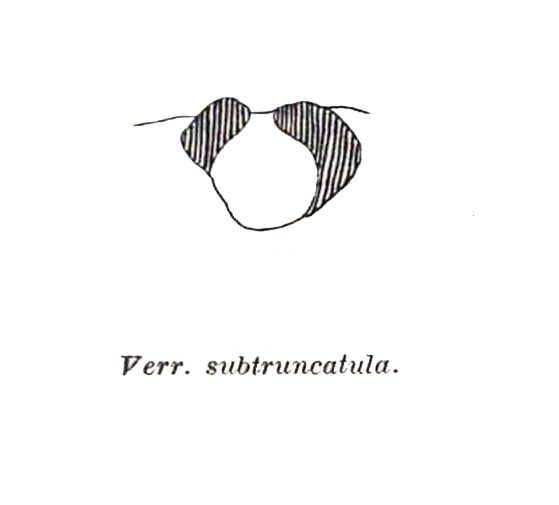
Zschacke, H. (1934) Epigloeaceae, Verrucariaceae und Dermatocarpaceae. In: Dr. L. Rabenhorst‘s Kryptogamen-Flora, Band 9, Abt. 1, Teil 1. Akademische Verlagsgesellschaft, Leipzig, 695 pp. - Public Domain
Growth form: Crustose
Substrata: rocks
Photobiont: green algae other than Trentepohlia
Reproductive strategy: mainly sexual
Poorly known taxon in need of further study
Predictive model

Source: lichenportal.org/portal/collections/individual/index.php?occid=2779273
France
Collector: M. Bouly de Lesdain
Number: s.n.
Date: 1904-04-01
Verbatim Date: 01 Apr 1904
Locality: Hauts-de-France, Nord, Nord berg du canal de East Africatans, Dunkerque. - ISOTYPE

Source: lichenportal.org/portal/collections/individual/index.php?occid=2779273
France
Collector: M. Bouly de Lesdain
Number: s.n.
Date: 1904-04-01
Verbatim Date: 01 Apr 1904
Locality: Hauts-de-France, Nord, Nord berg du canal de East Africatans, Dunkerque. - ISOTYPE