Verrucaria illinoisensis Servít
Bryologist, 53, 2: 160, 1950.
Synonyms:
Distribution:
Description: Thallus crustose, thinly episubstratic, 0.02-0.15(-0.2) mm thick, whitish to pale grey, rimose-areolate, often with minute brownish flecks, sometimes delimited by a dark prothallus. Sterile areoles 0.2-0.35 mm wide, fertile areoles up to 0.5 mm wide. Cortex usually unpigmented, or with a dilute brown pigment; medulla thin, white. Perithecia black, not covered by a thalline layer, 0.2-0.25 mm across, 1/2-3/4 immersed in the thallus, the apical part hemispherically projecting, the apex slightly flattened, sometimes shallowly depressed, the base not in pits. Involucrellum (30-)40-60(-70) μm thick, reaching down c. 1/3-of the perithecium, slightly diverging from exciple in lower part; exciple 0.15-0.25 mm across, the wall colourless to pale brown in apical part; hamathecium of periphysoids measuring 20-25(-30) x 2-3 μm, interascal filaments absent; hymenial gel hemiamyloid, I+ red (I+ blue at very low concentrations of I), K/I+ blue. Asci 8-spored, clavate, I-, fissitunicate, the wall thickened above, with an ocular chamber, dehiscent by extrusion of an endotunica to form a delicate rostrum, Verrucaria-type. Ascospores 1-celled, hyaline, ellipsoid, (18-)20-24(-27) x 8-10(-13) μm. Photobiont chlorococcoid. Spot tests: K-, C-, KC-, P-, UV-. Chemistry: without lichen substances.Note: a long-forgotten calcicolous species of the poorly known V. muralis complex, described from North America and later reported from several European countries, including Austria at low elevations. For further details see Pykälä & al. (2012) and Breuss (2021). To be looked for in Italy.
Growth form: Crustose
Substrata: rocks
Photobiont: green algae other than Trentepohlia
Reproductive strategy: mainly sexual
Poorly known taxon in need of further study
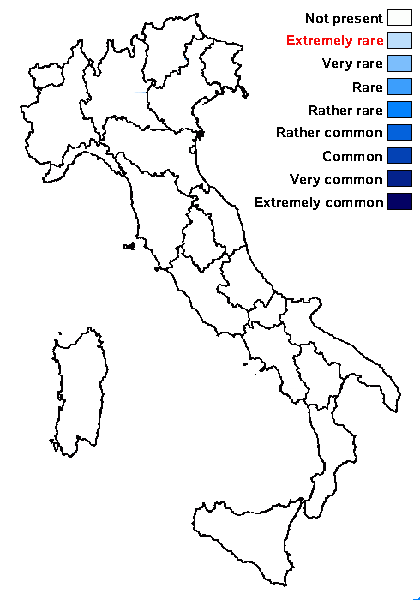
Predictive model
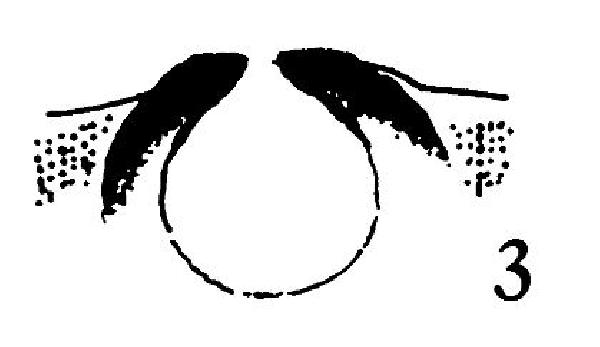
Source: M. Servít, Bryologist 53(2): 160 (1950)
Growth form: Crustose
Substrata: rocks
Photobiont: green algae other than Trentepohlia
Reproductive strategy: mainly sexual
Poorly known taxon in need of further study
Predictive model