Verrucaria simplex P.M. McCarthy
Lichenologist, 20: 245, 1988.
Synonyms:
Distribution:
Description: Thallus crustose, thinly episubstratic, 50-90 µm thick, brown, turning greenish and subgelatinous when wet, continuous to weakly rimose, without a distinct prothallus. Thallus pseudoplectenchymatous throughout, the cells 3-6 µm wide. Perithecia black, small, semi-immersed to superficial, forming 80-130 µm wide hemispherical projections, not covered by a thalline layer. Involucrellum absent; exciple brown to brown black, the wall 12-22 µm thick; hamathecium of periphysoids measuring 14-20 x c. 1 μm, interascal filaments absent; hymenial gel hemiamyloid, I+ red (I+ blue at very low concentrations of I), K/I+ blue. Asci 8-spored, broadly clavate, I-, fissitunicate, the wall thickened above, with an ocular chamber, dehiscent by extrusion of an endotunica to form a delicate rostrum, Verrucaria-type. Ascospores 1-celled, hyaline, ellipsoid (6-)7-9.5(-10.5) x (3.5-)4-5(-5.5) µm, (1.7-)1.8-2(-2.1) times as long as wide, without a distinct perispore. Photobiont chlorococcoid. Spot tests: K-, C-, KC-, P-, UV-. Chemistry: without lichen substances.Note: a probably overlooked species described from the British Isles and later found in the Czech Republic, and Korea, growing on brick and mortar, often in urban wasteland environments. To be looked for in Italy.
Growth form: Crustose
Substrata: rocks
Photobiont: green algae other than Trentepohlia
Reproductive strategy: mainly sexual
Pioneer species
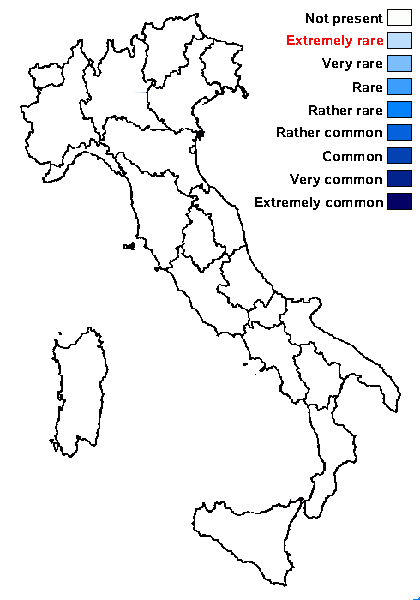
Predictive model
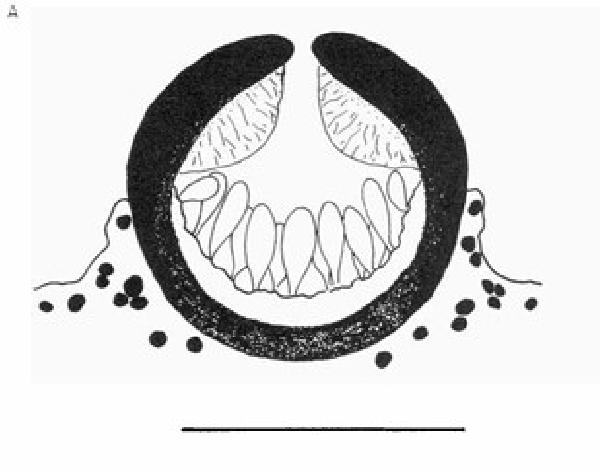
Source: McCarthy P.M. (1988) Lichenologist 20: 245-251 New and interesting species of Verrucaria II.
Scale: 0.1 mm
Growth form: Crustose
Substrata: rocks
Photobiont: green algae other than Trentepohlia
Reproductive strategy: mainly sexual
Pioneer species
Predictive model