Verrucaria ionaspicarpa (J. Nowak) Clauzade & Cl. Roux
Bull. Soc. Bot. Centre-Ouest, N. sér., n. spec. 7: 830, 1985. Basionym: Amphoridium ionaspicarpum J. Nowak - Acta Mycologica, Warszawa 2: 3, 1966.
Synonyms:
Distribution:
Description: Thallus crustose, fully endosubstratic, whitish, continuous, somehow farinose. Upper cortex (lithocortex) (70-100 μm thick, entirely composed of crystals; algal layer continuous, up to 100 μm thick; medulla white, rather lax, without oil cells (macrosphaeroids), with many crystals. Perithecia black, bottle-shaped, 0.3-0.5 mm across, completely immersed in the rock and leaving pits when they fall off, rarely slightly projecting with the periostiolar area. Involucrellum absent; exciple 20-35 μm thick (slightly thicker in uppermost part), colourless at base, purple pink at least in upper part, the pigmented parts K+ dark red turning to dark greenish; hamathecium of branched and anastomosing periphysoids measuring up to 90 x 1-2 μm; hymenial gel hemiamyloid, I+ red (I+ blue at very low concentrations of I), K/I+ blue. Asci 8-spored, clavate, I-, fissitunicate, the wall thickened above, with an ocular chamber, dehiscent by extrusion of an endotunica to form a delicate rostrum, Verrucaria-type, 70-90 x 18-30 μm. Ascospores 1-celled, hyaline, ellipsoid, (22-)24-30(-32) x 10-15 μm, guttulate. Photobiont chlorococcoid. Spot tests: K-, C-, KC-, P-, UV-. Chemistry: without lichen substances.Note: a species described from Poland and later found in many localities in the eastern and northwestern parts of Spain (see Navarro- Rosinés & al. 1994), growing on horizontal, nutrient-enriched surfaces of weathered calcareous rocks at low altitudes. To be looked for in Italy.
Growth form: Crustose
Substrata: rocks
Photobiont: green algae other than Trentepohlia
Reproductive strategy: mainly sexual
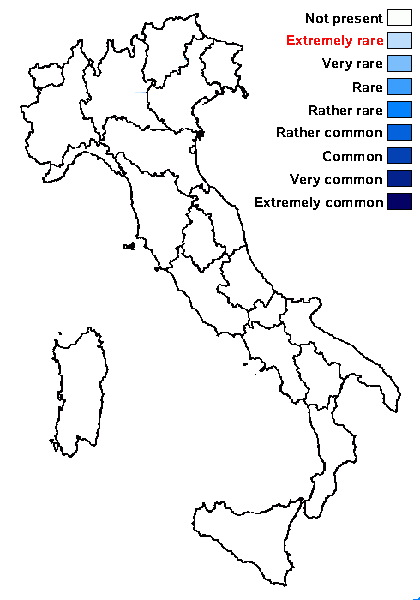
Predictive model
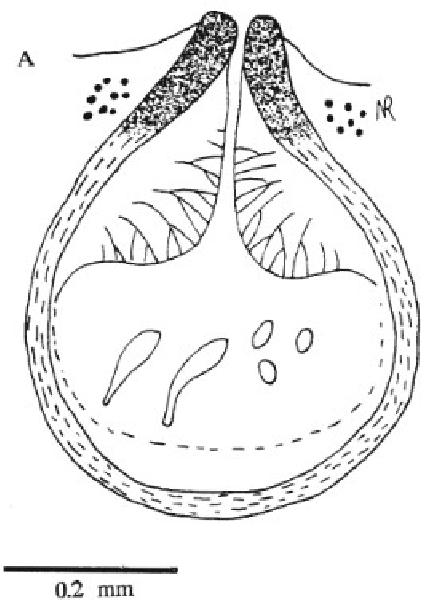
Source: Navarro-Rosinés P., Etayo J., Alonso L. et Egea J.-M., 1994.– Sobre la presencia de Verrucaria ionaspicarpa en la Península Ibérica. Cryptog., Bryol. Lichénol., 15(1) : 67-72.
Growth form: Crustose
Substrata: rocks
Photobiont: green algae other than Trentepohlia
Reproductive strategy: mainly sexual
Predictive model