Verrucaria transfugiens Zschacke
Rabenhorst's. Krypt.-Fl., Ed. 2. 1.1: 56, 85, fig. 33, 1933.
Synonyms:
Distribution:
Description: Thallus crustose, fully endosubstratic, pale grey to grey-white, continuous, often delimited by dark lines from conspecific thalli. Upper cortex poorly differentiated; medulla with a few oil cells (macrosphaeroids). Perithecia black, 0.4-0.5 mm across, immersed and leaving deep pits in the rock. Involucrellum absent; exciple dark brown to brown-black throughout; hamathecium of periphysoids, interascal filaments absent; hymenial gel hemiamyloid, I+ red (I+ blue at very low concentrations of I), K/I+ blue. Asci 8-spored, two-layered, fissitunicate, with a thin tholus reacting I-, Verrucaria-type. Ascospores 1-celled, hyaline, ellipsoid, 18-26 x 9-13 μm. Photobiont chlorococcoid. Spot tests: K-, C-, KC-, P-, UV-. Chemistry: without lichen substances.Note: a poorly known calcicolous species, described from Germany and also known from a few stations in the Eastern Alps (Nimis & al. 2018) and the French Alps (Roux & Coll. 2025), but perhaps not always distinguished. To be looked for in the Italian Alps.
Growth form: Crustose
Substrata: rocks
Photobiont: green algae other than Trentepohlia
Reproductive strategy: mainly sexual
Poorly known taxon in need of further study
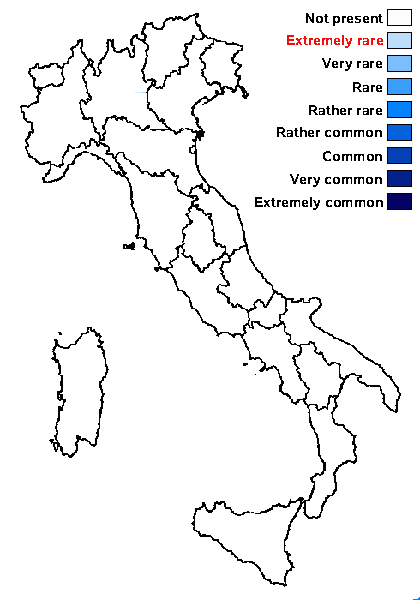
Predictive model
Growth form: Crustose
Substrata: rocks
Photobiont: green algae other than Trentepohlia
Reproductive strategy: mainly sexual
Poorly known taxon in need of further study
Predictive model