Verrucula navasianaria Nav.-Ros. & Cl. Roux
in Navarro-Rosinés & al., Bull. Soc. linn. Provence, 58: 163, 2007 (as V. navasaria).
Synonyms:
Distribution:
Description: Thallus crustose, greyish brown, 0.08-0.13 mm thick, consisting of scattered or contiguous areoles, forming 1-12 mm wide patches on the thalli of Flavoplaca navasiana, the central parts often dying and falling off. Areoles polygonal to rarely rounded, flat to slightly convex, 0.1-0.6(-0.8) mm wide, epruinose or faintly grey-pruinose, the pruina consisting of dead cells. Cortex paraplectenchymatous, 7-15 μm thick, of 2-3 layers of cells with brown pigment, overlain by a thin, continuous epinecral layer; medulla (25-)60-75 µm thick, with abundant crystals in lower part, I-. Perithecia 1-3(-5) per areole, 0.1-0.22 mm across, usually projecting with the upper part. Involucrellum absent; exciple globose, the wall paraplectenchymatous, colourless except around the ostiole. hamathecium of periphyses along the ostiolar channel and periphysoids in upper part of the perithecium, the paraphyses disappearing early. Asci 8-spored, clavate, bitunicate, with a thin tholus reacting I-, Verrucaria-type. Ascospores 1-celled, hyaline, ellipsoid, (11-)12-15.5(-18) x (5-)5.5-8.5(-9.5) µm, (1.5-)1.7–2.4(-2.7) times as long as wide. Photobiont chlorococcoid. Spot tests: K-, C-, KC-, P-, UV-. Chemistry: without lichen substances.Note: a very rare species, hitherto known only from France, parasitic on the thalli of Flavoplaca navasiana in coastal-maritime situations. For further details see Navarro-Rosinés & al. (2007). To be looked for in Italy.
Growth form: Crustose
Substrata: rocks
Photobiont: green algae other than Trentepohlia
Reproductive strategy: mainly sexual
paras Flavoplaca navasiana
Taxon bound to maritime-coastal situations
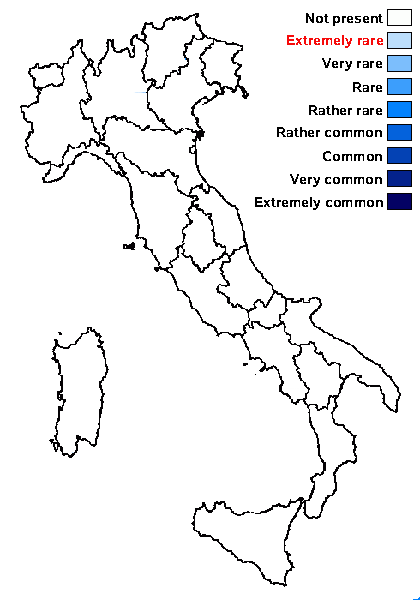
Predictive model
Growth form: Crustose
Substrata: rocks
Photobiont: green algae other than Trentepohlia
Reproductive strategy: mainly sexual
paras Flavoplaca navasiana
Taxon bound to maritime-coastal situations
Predictive model