Verruculopsis irrubescentis (Ménard & Cl. Roux) Gueidan, Nav.-Ros. & Cl. Roux
in Navarro-Rosinés & al., Bull. Soc. linn. Provence, 58: 168, 2007 . Basionym: Verrucaria irrubescentis Ménard & Cl. Roux - Biocosme Mésogéen, 8, 1: 1, 1991.
Synonyms:
Distribution:
Description: Thallus crustose, areolate or squamulose-areolate, 3-6 mm wide, starting the life-cycle on the thalli of Squamulea subsoluta, the old thalli often finally appearing autonomous. Areoles scattered or forming small clusters, 0.3-1.2 mm wide, 0.2-0.4 mm thick, concave to flat, often with raised margins, dirty grey to grey-brown, epruinose or faintly grey-pruinose (the pruina consisting of dead cells), without black margins, more or less constricted at base and sometimes almost umbilicate, the lower surface whitish to brown. Cortex 10-15 μm thick, of 1-2 layers of brown cells, sometimes with a thin epinecral layer; medulla rather lax, 30-100 µm thick, I-. Perithecia black, (1-)2-4(-6) per areole, 0.1-0.15 mm across, globose, at first immersed in the thallus, later sometimes conically projecting. Involucrellum absent; exciple 0.15-0.24 mm across, the wall paraplectenchymatous, 15-20 μm thick, brown-black around the ostiole, becoming progressively paler and finally colourless downwards; hymenial gel I+ reddish; hamathecium of periphyses along the ostiolar channel and periphysoids in upper part of the perithecium, the paraphyses disappearing early. Asci 8-spored, clavate, bitunicate, with a thin tholus reacting I-, Verrucaria-type. Ascospores 1-celled to rarely 1-septate, hyaline, long-ellipsoid to subcylindrical, (10.5-)12-17(-18) x (4-)4,5-6(-8) µm, (2.1-)2.4-3.2(-3.5) times as long as wide. Pycnidia numerous, globose, black, immersed in the thallus, Dermatocarpon-type, up to 0.1 mm across, the wall colourless except at the brown apex. Conidia simple, bacilliform, slightly curved, (3-)5-6(-8) x 1-1.5(-2) µm. Photobiont chlorococcoid. Spot tests: K-, C-, KC-, P-, UV-. Chemistry: without lichen substances.Note: a very rare, Mediterranean species, known only from the type collection in southern France, starting the life-cycle on the thalli of Squamulea subsoluta. For further details see Navarro-Rosinés & al. (2007). To be looked for in Italy.
Growth form: Crustose
Substrata: rocks
Photobiont: green algae other than Trentepohlia
Reproductive strategy: mainly sexual
paras Squamulea subsoluta
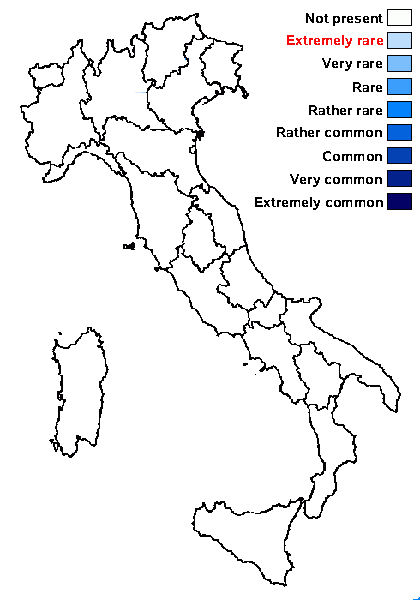
Predictive model
Growth form: Crustose
Substrata: rocks
Photobiont: green algae other than Trentepohlia
Reproductive strategy: mainly sexual
paras Squamulea subsoluta
Predictive model