Placynthium nigrum f. crustaceum Hepp ex Walt. Watson
Lich. Somerset: 18, 1905.
Synonyms:
Distribution: N - Ven (Pistocchi & al. 2026), TAA (Pistocchi & al. 2026).
Description: Thallus crustose, episubstratic, dark olive to dark greyish-brown, dull, 0.1-0.2 mm thick in peripheral parts, 0.6 (1) mm thick in central parts, continuous to rimose-areolate, the areoles irregularly shaped, 0.8-1.6 mm wide, with a smooth to somewhat uneven surface, composed of very densely aggregated, erect papillae or minute lobules, forming up to 5 cm wide patches, without a distinct prothallus. Upper cortex indistinct, the thallus paraplectenchymatous or densely reticulate with hyphae more or les arranged in vertical rows, the cells ± isodiametrical or somewhat elongated, especially in the upper photobiont layer; medulla lacking or very thin; lower cortex of 1-2(-3) rows of small, roundish to slightly angular cells. Apothecia biatorine, immersed to semi-sessile, 0.32-0.75(-1) mm across, black, with a slightly concave to weakly convex disc and an initially slightly prominent, eventually somewhat receding proper margin. Proper exciple dark bluish green, epithecium dark bluish green; hymenium colourless, 50-65(-75) µm high; paraphyses distinctly septate, bifurcate in upper part, the apical cell slightly swollen; subhymenium brownish. Asci 8-spored, apically thickened, with a distinct amyloid tube structure in the apex. Ascospores (0-)1-septate, hyaline, ellipsoid, (12-)15-19(-21) x 5-7(-8) µm, sometimes with unequal cells. Photobiont cyanobacterial, Scytonema-like. Spot tests: all negative. Chemistry: without lichen substances. Note: this taxon, which is worthy of further study, has been recognized as different from the main form (Czeika & Czeika 2007), from which it also differs in ecology, being associated with long-submerged siliceous rocks at high elevations. For further details see also Thüs & Schultz (2009).
Growth form: Crustose
Substrata: rocks
Photobiont: cyanobacteria, filamentous (e.g. Nostoc, Scytonema)
Reproductive strategy: mainly sexual
Periodically submerged (e.g. in creeks)
Poorly known taxon in need of further study
Commonnes-rarity: (info)
Alpine belt: very rare
Subalpine belt: extremely rare
Oromediterranean belt: absent
Montane belt: absent
Submediterranean belt: absent
Padanian area: absent
Humid submediterranean belt: absent
Humid mediterranean belt: absent
Dry mediterranean belt: absent
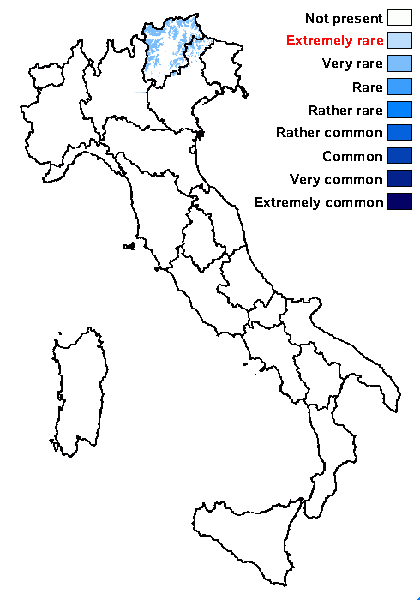
Predictive model
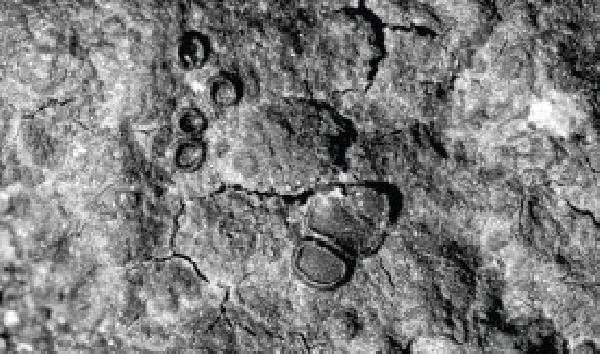
Source: Thüs H. & Schultz M. (2009) Freshwater flora of central Europe. Vol. 21(1): 1-223 Fungi Part I: Lichens.
Growth form: Crustose
Substrata: rocks
Photobiont: cyanobacteria, filamentous (e.g. Nostoc, Scytonema)
Reproductive strategy: mainly sexual
Periodically submerged (e.g. in creeks)
Poorly known taxon in need of further study
Commonnes-rarity: (info)
Alpine belt: very rare
Subalpine belt: extremely rare
Oromediterranean belt: absent
Montane belt: absent
Submediterranean belt: absent
Padanian area: absent
Humid submediterranean belt: absent
Humid mediterranean belt: absent
Dry mediterranean belt: absent
Predictive model
 DOLICHENS