Xanthocarpia epigaea (Søchting, Huneck & Etayo) Frödén, Arup & Søchting
in Arup & al., Nordic J. Bot., 31, 1: 57, 2013. Basionym: Caloplaca epigaea Søchting, Huneck & Etayo - Bibl. Lichenol., 96: 282, 2007.
Synonyms:
Distribution:
Description: Thallus crustose, orange to yellow-orange, areolate, the areoles irregular, strongly convex to almost bullate, crowded, up to 0.4 mm wide, the margin sometimes indistinctly effigurate. Apothecia lecanorine to zeorine, numerous, sessile, gradually covering most of the thallus, up to 0.5-1 (-1.3) mm across, with a flat, orange-pruinose disc and a paler, prominent, persistent, c.150 µm thick margin. Thalline exciple corticate, the cortex of perpendicularly arranged hyphae terminating in 9-11 µm long and 5-6 µm thick cells; proper exciple of fan-shaped, narrow, up to 5 µm long hyphae; epithecium orange, with an orange epipsamma reacting K+ purple-red; hymenium colourless, 80-100 µm high; paraphyses c. 1.5 µm thick, apically sometimes branched, with swollen, up to 5 µm wide apical cells; hypothecium colourless, inspersed with oil droplets. Asci (6-)8-spored, clavate, functionally unitunicate, apically thickened with a broad internal beak, the inner part of apex and external cap I+ blue, Teloschistes-type. Ascospores 2-celled, polarilocular, hyaline, ellipsoid, 16.5-20 x 6.5-9 µm, the septum 1-1.5 µm. Photobiont chlorococcoid. Spot-tests: thallus and apothecia K+ purple-red, C-, KC-, P-. Chemistry: parietin (major), with a smaller proportion of emodin, teloschistin, fallacinal and parietinic acid (chemosyndrome A of Søchting 1997). Note: a species of alkaline soils and more or less soil-impregnated detritus in arid, summer-warm sites, known from Spain (on gypsum soils) and Central Germany (on plant remains over limestone). According to Vondrák & al. (2011), the species could belong to X. borysthenica or X. crenulatella s. lat. To be looked for in Italy, especially in gypsum areas.
Growth form: Crustose
Substrata: soil, terricolous mosses, and plant debris
Photobiont: green algae other than Trentepohlia
Reproductive strategy: mainly sexual
Subcontinental: restricted to areas with a dry-subcontinental climate (e.g. dry Alpine valleys, parts of Mediterranean Italy)
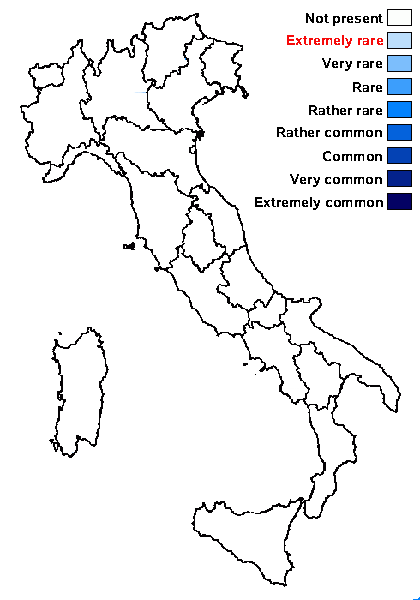
Predictive model
Growth form: Crustose
Substrata: soil, terricolous mosses, and plant debris
Photobiont: green algae other than Trentepohlia
Reproductive strategy: mainly sexual
Subcontinental: restricted to areas with a dry-subcontinental climate (e.g. dry Alpine valleys, parts of Mediterranean Italy)
Predictive model