Xylopsora diffissa Vondrák, Šoun, S. Svoboda, Malíček, Palice & Timdal
in Vondrák & al., Preslia, 96: 393, 2024.
Synonyms:
Distribution:
Description: Thallus at first consisting of pale brown to pale grey, adnate to erect, up to 0.6 mm wide and up to 200 μm thick squamules. Alveolate cortex (sensu Vondrák & al. 2009) up to 40 μm thick, with an up to 20 μm thick epinecral layer; algal layer thick; medulla present in places, thin, of a loose prosoplectenchymatous tissue; lower cortex absent. Each squamule soon fully dissolves into a pale-grey to brown, up to 0.3 mm high pile of 20-30 μm wide soredia and up to 100 μm wide consoredia, the cell structure in soredia being obscured by high concentrations of friesiic acid (dissolving in K), the exposed soredia with an orange-red pigment. Apothecia and pycnidia not known. Photobiont chlorococcoid, the mature cells up to 13 μm wide, dividing into several, 4-6 μm wide daughter cells. Spot tests: K-, C+ fleeting pink, KC+ fleeting pink, P-, UV+ white, but shaded by the orange-red pigment, which reacts K+ brown, N+ brown-red. Chemistry: friiesic acid, plus an unknown pigment.Note: a recently-described, sterile and easily overlooked species, hitherto known from the Czech Republic and Austria, but probably more widespread. It grows in old-growth and old managed, mainly pine-dominated forests and in fir-beech forests, on hard, slowly decaying wood in microhabitats sheltered from rain. For further details see Vondrák & al. (2024). To be looked for in the Italian Alps.
Growth form: Crustose
Substrata: lignum
Photobiont: green algae other than Trentepohlia
Reproductive strategy: mainly asexual, by soredia, or soredia-like structures (e.g. blastidia)
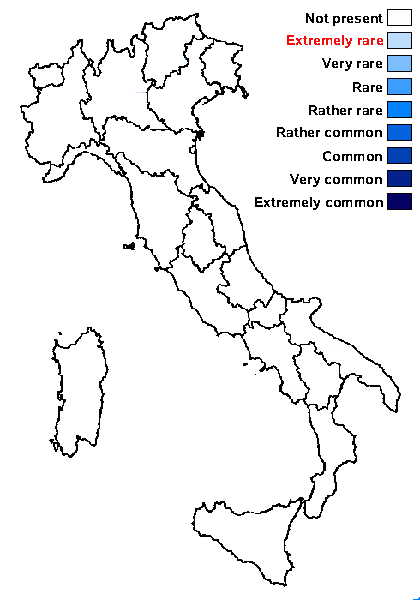
Predictive model
Source: Vondrák J., Svoboda S., Malíček J., Šoun J., Košnar J., Svensson M., Timdal E., Machač J. & Palice Z. (2024) Combining environmental DNA data and taxonomic surveys provides an unprecedented understanding of lichen diversity and accelerates the discovery of new species. – Preslia 96: 351–417, https://doi.org/10.23855/preslia.2024.351 – CC BY 4.0
Czech Republic
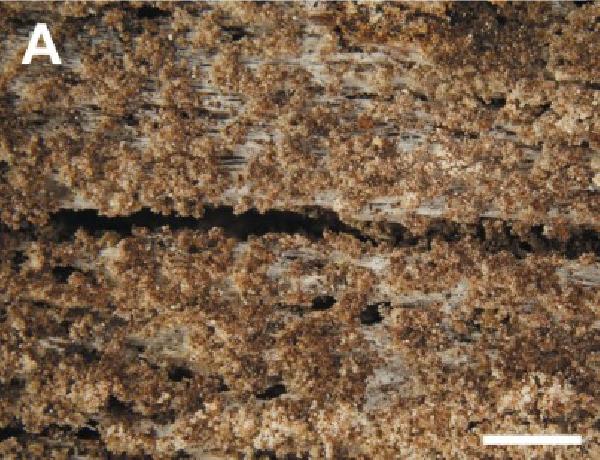
Xylopsora diffissa ( holotype). A, sorediate thallus Bar: 1 mm
Source: Vondrák J., Svoboda S., Malíček J., Šoun J., Košnar J., Svensson M., Timdal E., Machač J. & Palice Z. (2024) Combining environmental DNA data and taxonomic surveys provides an unprecedented understanding of lichen diversity and accelerates the discovery of new species. – Preslia 96: 351–417, https://doi.org/10.23855/preslia.2024.351 – CC BY 4.0
Czech Republic
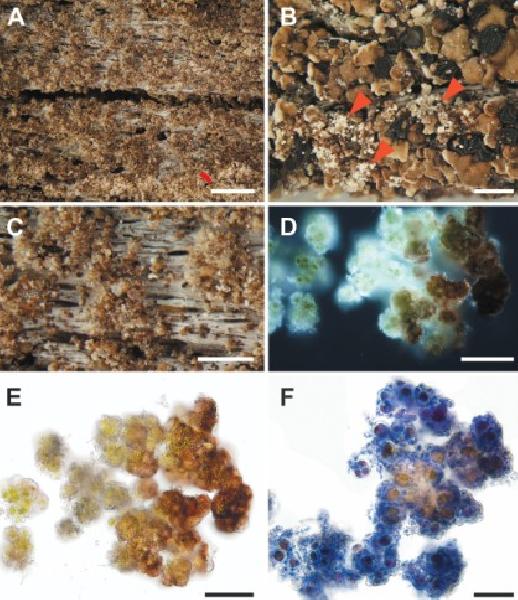
Xylopsora diffissa (A, C, holotype; B, Šoun 732; D-F, Šoun 1717). A, sorediate thallus; B, mechanicalhybrid of X. diffissa (arrowheads) with predominant X. friesii s. lat.; C, detail of diffused soralia; D,soredia/consoredia in polarized light; E, orange-brown pigment in exposed soredia, inner soredia unpigmented;F, structure of soredia; D, E, observed in water; F, stained by cotton blue. Bars: A, 1 mm; B, C, 0.5 mm; D, E,50 μm; F, 20 μm.
Growth form: Crustose
Substrata: lignum
Photobiont: green algae other than Trentepohlia
Reproductive strategy: mainly asexual, by soredia, or soredia-like structures (e.g. blastidia)
Predictive model
Source: Vondrák J., Svoboda S., Malíček J., Šoun J., Košnar J., Svensson M., Timdal E., Machač J. & Palice Z. (2024) Combining environmental DNA data and taxonomic surveys provides an unprecedented understanding of lichen diversity and accelerates the discovery of new species. – Preslia 96: 351–417, https://doi.org/10.23855/preslia.2024.351 – CC BY 4.0
Czech Republic
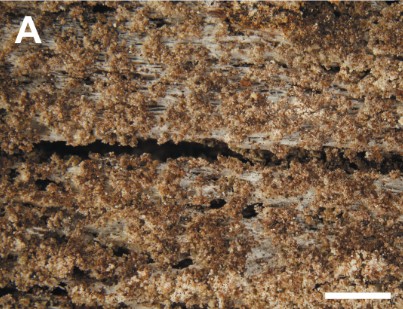
Xylopsora diffissa ( holotype). A, sorediate thallus Bar: 1 mm