Acarospora poumaratii Cl. Roux
Bull. Soc. Linn. Provence, 72: 32, 2021.
Synonyms:
Distribution:
Description: Thallus crustose to subsquamulose, areolate, pale brown, glossy, poorly delimited, forming up to 2 cm wide patches, the areoles 0.15-1.7 x 0.2-1.7 mm, up to 0.3 mm thick, smooth, flat or usually slightly convex, the free part of the lower surface brown to black. Epicortex 3-6 µm thick; upper cortex 35-55 µm thick, paraplectenchymatous, brown in upper part, colourless and filled with crystals soluble in K and insoluble in N in lower part; algal layer 55-80 µm thick, the upper part irregularly toothed, but not interrupted by hyphal strands; medulla white, 110-160 µm thick, rich in crystals; lower cortex 10-25 µm thick, limited to the marginal, darkened parts. Apothecia 0.15-0.6 mm across, aspicilioid, 1-3(-7) per areole, round to angular, dark brown (much darker than thallus), with a concave, rugose but not umbonate disc and a very thin, often soon excluded margin.
Proper exciple continuous with the hypothecium, colourless except in uppermost part, 20-40 µm thick, rich in colourless crystals; epithecium brown, 7-15 µm high; hymenium colourless 40-60 µm high (incl. the epithecium), euamyloid, I+ persistently dark blue; paraphyses mostly simple 1.5-2 µm thick at base, the apical cells up to 3(-4) µm wide; subhymenium colourless, 10-15 µm high, subparaplectenchymatous, I+ blue; hypothecium colourless, 7-12 µm high, I– or I+ faintly blue, prosoplectenchymatous, of periclinally arranged hyphae. Asci c. 150-spored, clavate, 36-55 x 17- 21 µm. Ascospores 1-celled, hyaline, oblong-ellipsoid, (3.5-)4-6(-7.5) x 1.5-2.5 µm. Photobiont chlorococcoid. Spot tests: cortex K-, C+ faintly pink, KC+ faintly pink, P-. Chemistry: gyrophoric acid.
Note: a recently-described species hitherto known only from southern France, growing on basalt in sunny and dry situations. For an extended description see Roux (2021). To be looked for in Mediterranean Italy.
Growth form: Crustose
Substrata: rocks
Photobiont: green algae other than Trentepohlia
Reproductive strategy: mainly sexual
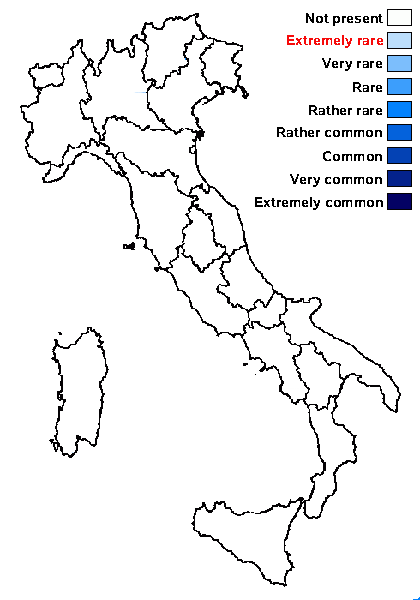
Predictive model
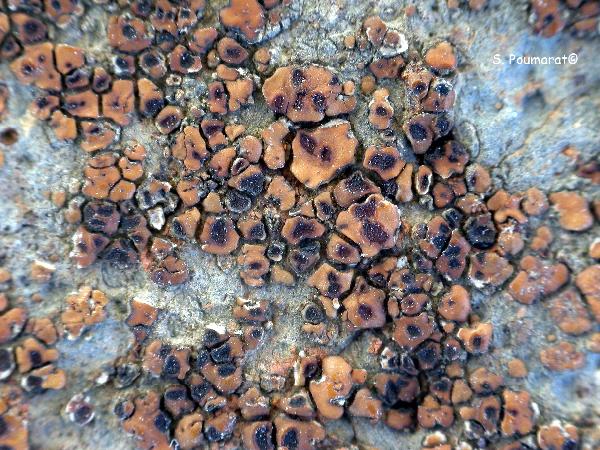
Courtesy S. Poumarat - http://mycologie.catalogne.free.fr/lichenPhoto2021/Acarospora_poumaratii_3.jpg
Hérault, holotype
Growth form: Crustose
Substrata: rocks
Photobiont: green algae other than Trentepohlia
Reproductive strategy: mainly sexual
Predictive model