Acarospora picea H. Magn.
Göteborgs Kungl. Vetensk. Samh. Handl., Ser. B, Math. Naturvet. Skr. 6, 17: 24, 1956.
Synonyms:
Distribution:
Description: Thallus crustose-placodioid, episubstratic, chestnut brown, epruinose, glossy, smooth or rugose, areolate in central parts, the marginal lobes convex, radiating, up to 2 mm long, 0.4-1.5 mm wide. Cortex dark brown in upper part, colourless in lower part; algal layer more or less continuous; medulla white. Apothecia lecanorine, angular, immersed, with a sulcate, brown-black disc and a thin thalline margin. Proper exciple indistinct or very thin; epithecium brown; hymenium colourless, 90-150 µm high; paraphyses stout, 2-3 µm thick base; hypothecium colourless. Asci 100-200-spored, clavate, the apical dome K/I-. Ascospores 1-celled, hyaline, broadly ellipsoid to subglobose, 3-4.5(-5.5) x 2-3.5 µm. Photobiont chlorococcoid. Spot tests: cortex and medulla K-, C-, KC-, P-, UV-. Chemistry: without lichen substances.Note: among the species with a brown effigurate thallus, this is the only one with subglobose ascospores; described from high altitudes in the Sierra Nevada (Spain), with a few records from the Western Alps (France) and from the mountains of Morocco, growing on non- or slightly calciferous siliceous rocks in dry, sunny, moderately eutrophicated situations. To be looked for in Italy.
Growth form: Crustose placodiomorph
Substrata: rocks
Photobiont: green algae other than Trentepohlia
Reproductive strategy: mainly sexual
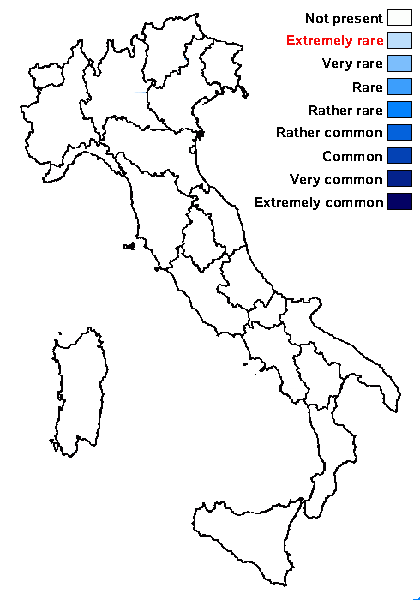
Predictive model
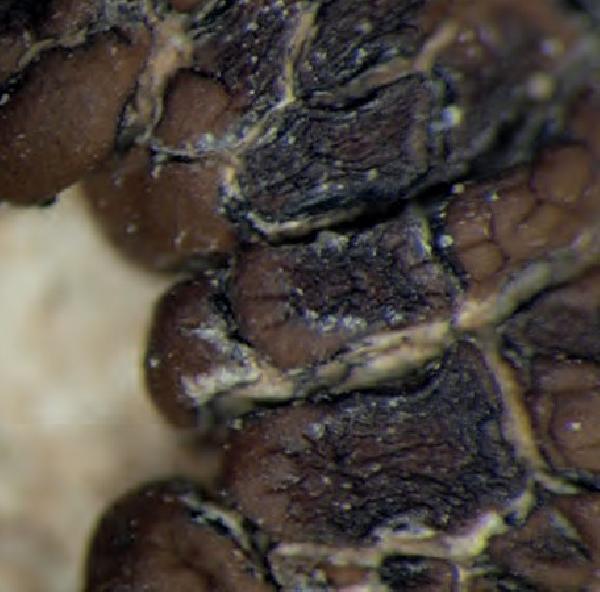
Courtesy Michel Bertrand
France
Growth form: Crustose placodiomorph
Substrata: rocks
Photobiont: green algae other than Trentepohlia
Reproductive strategy: mainly sexual
Predictive model